


1 Timoteo
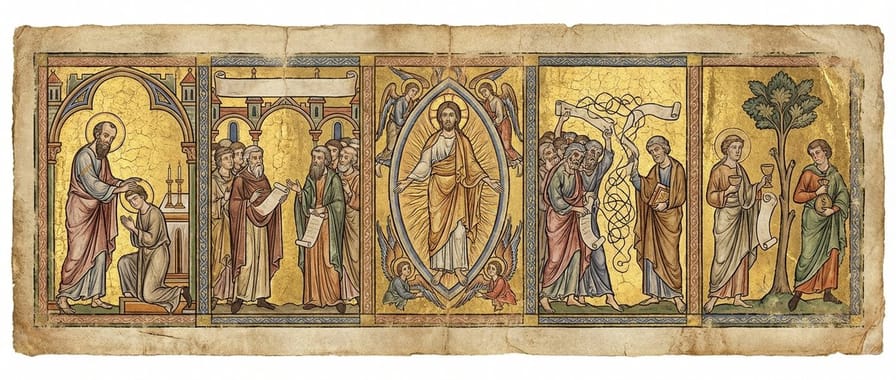
Illustration of the Book of 1 Timothy, one of the 27 books of the New Testament (Nano Banana Pro).
This introduction aims to unveil the theological and practical riches contained in Paul’s First Epistle to Timothy, one of the most crucial documents for ecclesiology and Christian piety. As part of the Pastoral Epistles, 1 Timothy offers an invaluable window into the challenges and directives of the apostolic church, providing timeless principles for faith and practice. The perspective adopted will be that of the conservative evangelical Protestant tradition, which upholds the inerrancy and the authority of Scripture, traditional Pauline authorship, and a Christocentric reading of the canon.
This analysis will not be content with a mere superficial exposition but will seek to delve into the historical, literary, and theological nuances of the text. We will defend traditional positions against the assaults of modern criticism, which frequently questions the authenticity and relevance of such writings. At the same time, we will seek to extract the divine wisdom from 1 Timothy in a way that is accessible and edifying for the contemporary church, demonstrating its perennial application in an ever-changing world.
The structure of this introduction has been conceived as a comprehensive model, applicable to the analysis of any biblical book, covering essential aspects for a robust and contextualized understanding. From the historical setting and the question of authorship to the hermeneutical challenges and canonical relevance, each section has been designed to provide a solid foundation for the in-depth study of 1 Timothy and, by extension, of all of God's Word. The beauty and depth of divine revelation, as expressed in this epistle, will be the central focus of our exploration.
1. Historical Context, Dating, and Authorship
1.1. Traditional Pauline Authorship and the Challenge of Higher Criticism
The First Epistle to Timothy, along with 2 Timothy and Titus, is traditionally attributed to the apostle Paul. This attribution is not merely a conjecture but is rooted in a strong foundation of internal and external evidence dating back to the early centuries of the church. The text itself begins with the unequivocal declaration: "Paul, an apostle of Christ Jesus by the command of God our Savior and of Christ Jesus our hope" (1 Timothy 1:1). Such self-identification is consistent with the Pauline pattern observed in his other epistles, establishing a strong prima facie argument for his authorship.
However, starting in the 19th century, modern higher criticism began to raise serious objections to the Pauline authorship of the Pastoral Epistles. The main criticisms focus on three areas: vocabulary and style, theology, and historical setting. It is argued that the vocabulary of the Pastorals contains a significant number of hapax legomena (words that appear only once) and non-Pauline words, in addition to a less rhetorical and more didactic style than the undisputedly Pauline epistles. In theological terms, some critics point to a more developed ecclesiology and a soteriology that, according to them, differs from that found in Romans or Galatians.
Additionally, the historical setting of the Pastorals does not seem to fit perfectly into the chronology of Paul's life as narrated in the Acts of the Apostles. The apostle appears to be free from prison and traveling, which does not align with the end of Acts. These objections, though significant for critical scholarship, are often based on methodological presuppositions that tend to underestimate Paul's authorial flexibility and the complexity of the theological and ecclesiastical development of the early church.
1.2. Internal and External Evidence for Pauline Authorship
Despite the criticisms, the defense of traditional Pauline authorship is robust. Internally, the epistle breathes the Pauline spirit. The concern for sound doctrine, the emphasis on God's grace (1 Timothy 1:14-16), the centrality of Christ as mediator (1 Timothy 2:5), and the passion for the order and purity of the church are indelible marks of Paul's ministry. The deeply personal nature of the letter, with references to Timothy as his "true child in the faith" (1 Timothy 1:2), and the mention of specific individuals such as Hymenaeus and Alexander (1 Timothy 1:20), lend an authentic tone that would be difficult to forge.
The external evidence is equally convincing. The early Church Fathers, who were much closer to the apostolic era, unanimously accepted the Pauline authorship of the Pastorals. Polycarp of Smyrna (c. 69-155 A.D.), a disciple of the apostle John, makes clear allusions to 1 Timothy in his Epistle to the Philippians. Ignatius of Antioch (c. 35-107 A.D.), another apostolic contemporary, also demonstrates familiarity with the teachings of the Pastorals. Irenaeus of Lyons (c. 130-202 A.D.) and Tertullian (c. 155-240 A.D.) cite the epistles as Pauline without hesitation. The Muratorian Canon (c. 170 A.D.), one of the oldest catalogs of New Testament books, includes the Pastorals under Paul's name.
The consistency of these ancient witnesses, both in the East and in the West, is a powerful testimony to the universal acceptance of Pauline authorship. The early church, which possessed rigorous criteria for canonicity and apostolicity, had no doubts about the provenance of these letters. The persistence of this tradition, despite later academic objections, is a crucial factor for the conservative evangelical perspective.
1.3. Dating and the Historical-Geographical Context
The dating of 1 Timothy is intrinsically linked to the question of Pauline authorship. If Paul is the author, the letter must be situated in a period subsequent to the final account in Acts (c. 62 A.D.), which leaves him under house arrest in Rome. The narrative of Acts does not allow for a subsequent journey of Paul to Macedonia (1 Timothy 1:3) and a stay in Ephesus at the time Timothy was left there to oversee the church, before his final imprisonment and martyrdom.
The most plausible explanation, accepted by many evangelical scholars, is that Paul was released from his first Roman imprisonment (mentioned in Acts 28), undertook a "fourth missionary journey," during which he visited Crete (cf. Titus), Ephesus (leaving Timothy there), and Macedonia. He would have written 1 Timothy from Macedonia, around 64-67 A.D., before being imprisoned again and martyred under Nero. This historical reconstruction, although not explicitly detailed in Acts, is inferred from the Pastorals themselves and from early Christian tradition.
The geographical context of 1 Timothy is Ephesus, one of the largest and most influential cities of the Greco-Roman world. Ephesus was a vibrant commercial and cultural center, known for its temple dedicated to Artemis (Diana), one of the Seven Wonders of the Ancient World. The city was a melting pot of different philosophies, cults, and religious practices, which made Timothy's task as church leader particularly challenging. The church in Ephesus had been established by Paul and was a strategic point for the propagation of the gospel in Asia Minor.
In this complex environment, the church faced both external pressures from pagan culture and internal pressures from false teachers who were distorting Christian doctrine. Paul writes to Timothy to equip him with the necessary guidelines to combat these heresies, establish godly leadership, and promote order and piety in the body of Christ. Knowledge of this background is essential to appreciate the urgency and relevance of Paul's instructions.
1.4. Evangelical Response to Modern Criticisms
The evangelical perspective, firmly anchored in biblical inerrancy, offers consistent answers to the criticisms raised against Pauline authorship. Regarding vocabulary and style, it is reasonable to assume that Paul, throughout his ministry, would adapt his language and approach to different audiences and purposes. The Pastorals are personal letters to co-workers, dealing with specific ecclesiastical issues, which would naturally lead to a distinct vocabulary and style from more doctrinal letters like Romans or Galatians.
Furthermore, the use of an amanuensis (secretary) was common in antiquity, and Paul may have employed different scribes, each with their own style and vocabulary, under apostolic supervision. Moreover, Paul himself may have evolved in his vocabulary and theological emphases as his life and ministry progressed, without this implying doctrinal contradiction. The theology of the Pastorals, far from being anomalous, represents a natural development of Pauline concerns, focusing on the practical application of the doctrine of salvation in the life of the church.
Questions about the more developed ecclesiology and soteriology are best understood as a continuation and application of earlier Pauline teachings, adapted to the specific needs of an already established church facing organizational challenges and false teachings. The historicity of the "fourth missionary journey" is a legitimate inference from the epistles themselves, complementing (and not contradicting) the account in Acts, which is not intended to be an exhaustive biography of Paul. Evangelical faith maintains that modern criticism often proceeds from naturalistic presuppositions that are intrinsically skeptical of divine intervention and the authenticity of sacred texts, and therefore, its conclusions should be approached with discernment.
2. Structure, Division, and Main Content
2.1. The Epistolary Genre and Pastoral Nature
1 Timothy is, in essence, an epistle, a letter written by one individual to another, or to a group. However, it is distinguished by its intrinsically "pastoral" nature. It is not a comprehensive doctrinal letter like Romans, nor a rebuke to a problematic church like Corinthians or Galatians. Instead, it is a direct communication from an experienced apostolic mentor, Paul, to his young and perhaps hesitant disciple and co-worker, Timothy, who was entrusted with a challenging task in the church of Ephesus.
The pastoral nature of the epistle is evident in its tone of encouragement, exhortation, and practical instruction. Paul is not merely transmitting information; he is equipping Timothy to lead, shepherd, and protect the flock. The letter addresses matters of ecclesiastical order, correct doctrine, leadership qualities, and appropriate behavior for church members. It is a practical manual for life and ministry in a Christian community, reflecting Paul's concern for the spiritual and organizational health of the churches he had planted and nurtured.
2.2. Thematic Divisions and Argumentative Flow
The Epistle of 1 Timothy follows a logical and argumentative flow, albeit with some abrupt transitions characteristic of Paul's epistolary style. The book can be divided into distinct thematic sections, each addressing a crucial aspect of church life and Timothy's ministry.
After the initial greeting (1:1-2), Paul immediately confronts the pressing issue of false teachers in Ephesus, exhorting Timothy to firmly oppose them and to promote sound doctrine (1:3-20). This is a recurring theme in the letter, underlining the importance of theological purity. Next, Paul proceeds to give instructions on public conduct in the church, specifically regarding prayer and the role of men and women in worship (2:1-15). This section is of particular importance and generates much hermeneutical debate.
Chapter 3 is dedicated to the qualifications of church leaders – bishops (or elders/overseers) and deacons – emphasizing the importance of godly character and fitness for service (3:1-13). Paul then states the purpose of his instructions: so that Timothy may know how to conduct himself in "the household of God," which is the church of the living God (3:14-16). Chapter 4 returns to the threat of false teachers, warning of future apostasy and exhorting Timothy to be an example of piety (4:1-16).
Chapters 5 and 6 contain various instructions on how Timothy is to interact with different groups in the church: widows, elders, slaves, and the rich (5:1-6:19). These guidelines demonstrate Paul's concern for social justice, pastoral care, and Christian ethics in all spheres of life. The epistle concludes with a final exhortation to Timothy to guard the deposit of faith and avoid useless debates, culminating in a doxology and a blessing (6:20-21).
2.3. A Synthetic Outline of the Book
- I. Greeting and Initial Exhortation (1:1-20)
- Apostolic Greeting (1:1-2)
- Warning against False Teachers in Ephesus (1:3-11)
- Paul's Personal Testimony and God's Grace (1:12-17)
- Timothy's Task: Fighting the Good Fight (1:18-20)
- II. Instructions on Worship and Order in the Church (2:1-3:16)
- Exhortation to Prayer for Rulers and All People (2:1-7)
- The Role of Men and Women in Worship (2:8-15)
- Qualifications for Bishops/Elders (3:1-7)
- Qualifications for Deacons and Deaconesses (3:8-13)
- The Purpose of the Instructions: The Household of God (3:14-16)
- III. Exhortations against Apostasy and for Personal Piety (4:1-16)
- Warning about Future Apostasy and False Teachings (4:1-5)
- Instructions for Timothy as a Good Minister of Christ (4:6-10)
- Timothy's Example in Word and Life (4:11-16)
- IV. Guidelines for Pastoral Care and Relationships in the Church (5:1-6:19)
- Treatment of Different Groups of People (5:1-2)
- Care for Widows (5:3-16)
- Honor for Elders (5:17-25)
- Duties of Slaves (6:1-2a)
- Warnings against False Teachers and Greed (6:2b-10)
- Exhortation to Piety and the Good Fight of Faith (6:11-16)
- Instructions to the Rich (6:17-19)
- V. Final Exhortation and Doxology (6:20-21)
- Guard the Deposit of Faith (6:20)
- Final Blessing (6:21)
3. Central Theological Themes and Purpose
3.1. Sound Doctrine and the Refutation of Heresy
One of the most prominent themes in 1 Timothy is the defense of sound doctrine and the vigorous refutation of heresy. Paul exhorts Timothy to "command certain people not to teach false doctrines any longer or to devote themselves to myths and endless genealogies" (1 Timothy 1:3-4). Paul's concern is not merely academic; he sees correct doctrine as essential for godly living and for the health of the church. Heresy is portrayed as a poison that corrupts faith and leads people away from the truth.
The false teachers in Ephesus seemed to promote a mixture of Jewish legalism and incipient Gnostic speculations, with prohibitions on marriage and certain foods (1 Timothy 4:3), and an emphasis on "falsely called knowledge" (1 Timothy 6:20). Paul contrasts this "doctrine of demons" (1 Timothy 4:1) with sound doctrine, which is "according to the gospel of the glory of the blessed God" (1 Timothy 1:10-11). Sound doctrine is not merely a set of intellectual propositions, but has a direct impact on ethics and practical life, producing "love that comes from a pure heart, a good conscience, and a sincere faith" (1 Timothy 1:5).
3.2. Order and Piety in the Local Church
Another central theme is the importance of order and piety in the local church. Paul provides detailed instructions on how the church should conduct itself in public worship, in the selection of its leaders, and in the treatment of its members. The church is described as "the household of God, which is the church of the living God, a pillar and buttress of the truth" (1 Timothy 3:15). This metaphor underscores the church's responsibility to uphold and proclaim God's truth in a fallen world.
Ecclesiastical order is not an end in itself, but a means to promote piety and the effectiveness of the church's witness. The qualifications for bishops and deacons (chapter 3) emphasize moral character, spiritual maturity, and the ability to manage one's own household before leading the household of God. Piety, which is "profitable for everything, since it holds promise for the present life and also for the life to come" (1 Timothy 4:8), is the ultimate goal of all instruction. It encompasses personal conduct, spiritual discipline, and dedication to God's service.
3.3. The Gospel of God's Grace and the Sufficiency of Christ
Although 1 Timothy is often seen as a practical and ecclesiastical epistle, the gospel of God's grace and the sufficiency of Christ are the underlying theological foundations for all instructions. Paul recalls his own conversion as a testimony to God's "overflowing grace" (1 Timothy 1:14), declaring himself the "foremost of sinners" (1 Timothy 1:15) who received mercy so that Christ Jesus might display his perfect patience. This is the essence of the gospel that sustains the hope of every believer.
Christ is the center of the message. He is "God our Savior and Christ Jesus our hope" (1 Timothy 1:1). He is the "one mediator between God and mankind" (1 Timothy 2:5), who "gave himself as a ransom for all people" (1 Timothy 2:6). The "mystery of godliness" (1 Timothy 3:16) is the incarnation, life, death, resurrection, and ascension of Christ, who was "manifested in the flesh, vindicated by the Spirit, seen by angels, proclaimed among the nations, believed on in the world, taken up in glory". This Christ-centrism ensures that all guidelines for the church and godly living are rooted in the redemptive work of Jesus.
3.4. The Primary Purpose of the Epistle
The primary purpose of 1 Timothy is explicitly stated by Paul: "I am writing these things to you, hoping to come to you soon; but if I am delayed, you will know how people ought to conduct themselves in God’s household, which is the church of the living God, the pillar and foundation of the truth" (1 Timothy 3:14-15). Paul is providing Timothy with a comprehensive guide for the administration and care of the church in Ephesus.
This guide had three main objectives: first, to equip Timothy to combat and refute the false teachers who were threatening the doctrinal integrity of the church. Second, to establish and maintain appropriate order and structure in the Christian community, from public worship to the selection of leaders. Third, to promote piety and ethical conduct among all members, so that the church could be an effective witness to the gospel in the world. In summary, 1 Timothy is an apostolic manual for the health and vitality of the local church, rooted in sound doctrine and the transforming power of the gospel.
4. Relevance and Canonical Connections
4.1. The Place of 1 Timothy in the New Testament Canon
The First Epistle to Timothy holds a prominent place in the New Testament canon, especially within the body of Pauline epistles. Together with 2 Timothy and Titus, it forms a trio of "Pastoral Epistles" that serve as a vital bridge between the apostolic era and the post-apostolic church period. While other Pauline letters establish the doctrinal foundations of Christianity (Romans, Galatians) or address general ethical and ecclesiastical issues (Corinthians), the Pastorals provide a glimpse into the practical application of these principles in the organization and daily functioning of local churches.
This book is indispensable for ecclesiology, offering the first detailed instructions on church leadership structure, qualifications for the offices of bishop/elder and deacon, and appropriate conduct in worship. Without 1 Timothy, our understanding of the transition from an incipient church, directly led by the apostles, to an organized church with established local leadership would be significantly impoverished. It is a key document for understanding how Paul's apostolic vision was institutionalized and perpetuated in subsequent generations.
4.2. The Christocentric Reading and Typology in 1 Timothy
Although 1 Timothy focuses on practical church matters, a Christocentric reading reveals that Christ is the foundation and driving force of all instructions. The life and work of Jesus inform and empower the piety and order that Paul seeks to establish. The gospel of Christ is the "sound doctrine" that must be defended against heresy. The grace of Christ is the source of salvation and empowerment for service, as Paul testifies in his own life (1 Timothy 1:12-16).
Christ is presented as the "one mediator between God and mankind" (1 Timothy 2:5), who "gave himself as a ransom for all people" (1 Timothy 2:6). He is the supreme model of leadership and service, whose humility and sacrifice should inspire all who hold positions of authority in the church. The "mystery of godliness" (1 Timothy 3:16) is, in its essence, the revelation of God in Christ, the fundamental truth upon which the church stands as "a pillar and buttress of the truth". Thus, every exhortation to piety, order, and the defense of doctrine flows from the person and work of Christ Jesus.
4.3. Connections with Other Pauline Epistles and the Old Testament
1 Timothy dialogues extensively with other Pauline epistles. The concern with false teachers echoes the warnings in Galatians and Colossians, although the specific heresies may have evolved. The emphasis on church order and leadership qualifications complements the teachings in 1 Corinthians 12-14 on spiritual gifts and orderly worship. The doctrine of grace and justification by faith, though not the primary focus here, is the implicit basis for godly living and service, connecting directly with Romans and Galatians.
The Old Testament also serves as a backdrop for various instructions. Paul's reference to the Law (1 Timothy 1:8-10) is to demonstrate its original purpose of exposing sin, and not as a means of salvation or justification. The discussion about the role of women in chapter 2 makes direct allusion to the order of creation in Genesis (1 Timothy 2:13-14), using the primacy of Adam and the sequence of the Fall as a basis for ecclesiastical directives. This demonstrates the continuity of divine revelation and the importance of canonical hermeneutics for understanding 1 Timothy.
4.4. Perennial Relevance for the Contemporary Church
Despite being written almost two millennia ago for a specific church in Ephesus, 1 Timothy maintains a perennial relevance for the contemporary church. The issues Paul addresses – how to deal with false teachings, the importance of sound doctrine, qualifications for leadership, conduct in worship, pastoral care for different groups, and the ethics of money – are as pertinent today as they were then.
In a postmodern world, where truth is often relativized and doctrine is seen as divisive, Paul's exhortation to defend the truth and adhere to sound doctrine is an urgent call for the church. The guidelines for leadership continue to be the standard for the selection of pastors and deacons, ensuring that those who serve are examples of character and piety. The discussion about the role of men and women in the church, though challenging, forces the church to confront the Scriptures instead of yielding to cultural pressures. The epistle, therefore, is an indispensable guide for the vitality, purity, and mission of the church in all ages.
5. Hermeneutical Challenges and Critical Issues
5.1. The Issue of Women in Ministry and Teaching (1 Timothy 2:9-15)
One of the most challenging and debated passages in 1 Timothy, and indeed in the entire New Testament, is Paul's instruction on the role of women in chapter 2. Specifically, 1 Timothy 2:11-14 states: "A woman should learn in quietness and full submission. I do not permit a woman to teach or to assume authority over a man; she must be quiet. For Adam was formed first, then Eve. And Adam was not the one deceived; it was the woman who was deceived and became a sinner."
The conservative evangelical perspective, known as complementarianism, interprets this passage as a normative and transcultural directive for the church. It is argued that the prohibition for a woman to "teach" or "assume authority over a man" in the church context is founded not on ephemeral cultural issues, but on the order of creation (Adam was formed first) and the nature of the Fall (Eve was deceived). This interpretation distinguishes between value and function, affirming the ontological equality of men and women in Christ, but recognizing distinct roles in leadership and teaching in the church.
Criticisms of this view often argue that Paul's instructions were culturally conditioned by first-century Greco-Roman society, or that they referred to women teaching false doctrines. However, Paul's theological basis for his exhortation, which refers back to creation and the Fall, suggests a universal foundation. The evangelical response emphasizes the importance of allowing Scripture to interpret Scripture, avoiding reinterpretations that unduly conform to modern cultural sensibilities, while maintaining biblical authority.
5.2. Qualifications for Elders and Deacons (1 Timothy 3:1-13)
The lists of qualifications for bishops/elders and deacons in 1 Timothy 3 represent another hermeneutical challenge, though less controversial. The main issue is the application of these qualities in the contemporary context. For example, the requirement that the bishop be "the husband of one wife" (1 Timothy 3:2) is interpreted by some as a prohibition against divorced and remarried men serving as elders, while others understand it as a prohibition of polygamy or promiscuity, emphasizing marital fidelity.
Conservative evangelical interpretation generally views "husband of one wife" as a requirement for monogamy and sexual fidelity, reflecting an irreproachable character in married life. For many, this implies that a man who has divorced and remarried, unless the divorce was for biblical reasons (such as infidelity or desertion by an unbeliever), would not be fit for the office. The main focus, however, should be on exemplary character and spiritual maturity, which are the predominant qualities throughout the list. The qualifications are not merely skills, but expressions of a life shaped by Christian piety.
5.3. The Interpretation of "She will be saved through childbearing" (1 Timothy 2:15)
The enigmatic phrase "she will be saved through childbearing—if they continue in faith, love, and holiness with propriety" (1 Timothy 2:15) has generated various interpretations. At first glance, it might seem to suggest salvation through motherhood, which would contradict the central doctrine of salvation by grace through faith in Christ (cf. Ephesians 2:8-9). However, such an interpretation is rejected by evangelical theology.
The most widely accepted interpretations within the evangelical tradition include: (a) "saved" in the sense of preservation or protection during childbirth, a real danger in antiquity, contextualizing the verse with Eve's punishment in Genesis 3; (b) "saved" in the sense of being preserved from deception and transgression, by fulfilling the role designated by God in motherhood and domestic life, in contrast to Eve's transgression; (c) a reference to salvation through "the Child" (Jesus Christ), meaning that woman finds her salvation through the coming of the Messiah, who was born of a woman. The most common interpretation today is that it refers to the woman's preservation in her sphere of activity, fulfilling God's design, in contrast to Eve's deception. The immediate context of 1 Timothy 2:9-14, which speaks of the order of creation, favors an understanding that links women to their divinely ordained vocation, where they find "salvation" in the sense of well-being and fulfillment of purpose, provided they remain in faith.
5.4. Textual Criticism and the Integrity of the Text
Despite discussions about authorship and interpretation, the textual integrity of 1 Timothy is widely accepted. There are some textual variants, such as in 1 Timothy 3:16, where some manuscripts read "God was manifested in the flesh" (θεὸς ἐφανερώθη) and others read "He who was manifested in the flesh" (ὃς ἐφανερώθη). Most evangelical scholars consider the variant "He who" (ὃς) to have greater textual support. However, even with this variant, the doctrine of Christ's divinity and his incarnation is abundantly clear in other New Testament passages and is not compromised.
The evangelical perspective upholds the inerrancy of the original text (autographs) and the faithfulness of existing copies, which are remarkably consistent. Textual variants are minor and do not affect central doctrines of the Christian faith. Modern textual scholarship, with its vast collection of manuscripts, allows for a reconstruction of the original text with an extremely high degree of certainty, reaffirming the reliability of God's Word.
5.5. Hermeneutical Principles for a Faithful Reading
For a faithful interpretation of 1 Timothy, the evangelical perspective adheres to sound hermeneutical principles. The grammatical-historical method is fundamental, seeking to understand the original meaning of the text for the author and for the original readers, considering grammar, vocabulary, and historical and cultural context. This avoids anachronisms and subjective readings.
Furthermore, canonical hermeneutics is crucial, interpreting 1 Timothy in light of the entire biblical canon. Passages should be understood in harmony with the totality of divine revelation, especially with the central truths of the gospel and Pauline theology in general. Paul's authorial intentionality is sought, recognizing that the Holy Spirit inspired the apostle's words to communicate divine truths. Finally, interpretation should be guided by theological coherence, ensuring that conclusions are in consonance with the fundamental doctrines of the Christian faith, such as the sovereignty of God, human depravity, and salvation by grace, always with the illumination of the Holy Spirit, who guides us into all truth.