


Silas
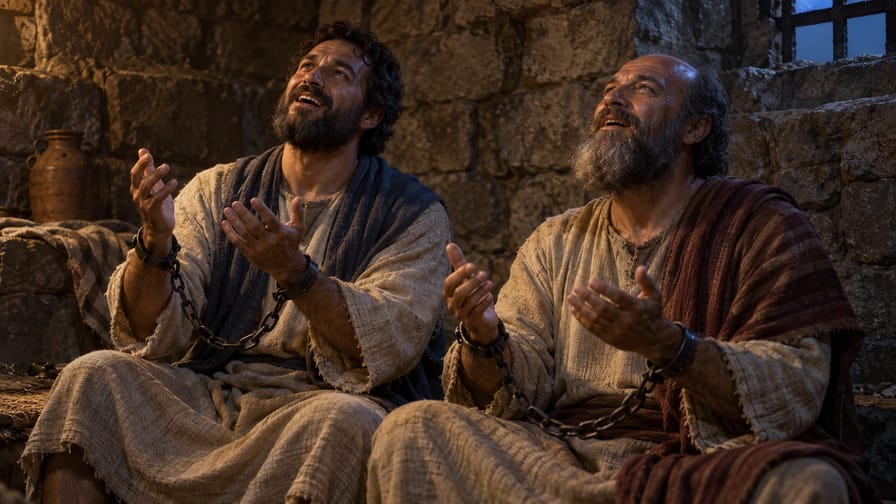
The figure of Silas, also known as Silvanus, emerges in the pages of the New Testament as a prominent leader of the early church and a faithful companion of the Apostle Paul on his missionary journeys. His history and ministry offer valuable insights into the expansion of Christianity in the first century, the dynamic of the apostolic mission, and the resilience of faith amidst persecution.
As one of the "leading men among the brothers" in the church of Jerusalem and, subsequently, a dedicated evangelist, Silas exemplifies dedication to the service of Christ and the importance of cooperation in the advancement of the Gospel. His participation in crucial moments of early church history underlines his theological relevance and his lasting legacy for evangelical Protestant faith.
This analysis will seek to explore the depth of his character, the significance of his name, and the impact of his ministry, as revealed in the Scriptures, from a perspective that values biblical authority and exegetical precision.
As we examine the life and work of Silas, we will be guided by the narratives of the book of Acts and by the Pauline and Petrine epistles, which paint a picture of a committed, courageous, and spiritually gifted servant of God, whose contribution was indispensable for the establishment and strengthening of the first Christian communities.
1. Etymology and meaning of the name
The name Silas (in Greek, Σίλας, Silas) is an abbreviated and Hellenized form of Silvanus (in Greek, Σιλουανός, Silouanós). Both forms are used in the New Testament to refer to the same individual. The form Silas is predominant in the book of Acts, while Silvanus appears in the Pauline epistles (1 Thessalonians 1:1 2 Thessalonians 1:1) and in the First Epistle of Peter (1 Peter 5:12).
The etymology of the name Silvanus, which is the complete form, is Latin. It derives from silva, meaning "forest" or "wood." Thus, the name can be interpreted as "from the forest" or "forest dweller." In Roman mythology, Silvanus was the god of woods and fields, associated with the protection of forests and wildlife.
The association with "forest" or "wood" can carry a symbolism of strength, solidity, or rootedness, characteristics that, indeed, are reflected in Silas's character. His constancy and resilience in the face of adversity, as demonstrated in his imprisonment in Philippi, can be metaphorically linked to the robustness of a tree or a grove.
There are no other prominent biblical characters with the name Silas or Silvanus. This confers a uniqueness to the individual in question, highlighting his specific identity in the New Testament narrative. The variation between the abbreviated and complete forms was common in antiquity, indicating familiarity and acceptance in different contexts.
The theological significance of the name, although not explicitly elaborated in the Scriptures, can be inferred. The Latin name Silvanus suggests that Silas could have been a Roman citizen or, at the very least, someone with a strong connection to Roman culture. This probable Roman citizenship would have been a crucial factor in events such as his imprisonment in Philippi (Acts 16:37-38), where citizen status conferred certain rights and protections.
The duality of his name (Greek/Latin) can also symbolize his bridge between different cultures and peoples, an essential characteristic for a first-century missionary. He was a link between the Jewish church of Jerusalem and the new Gentile communities, fulfilling a vital role in disseminating the Gospel among diverse ethnicities.
2. Historical context and biblical narrative
The life and ministry of Silas unfold in the heart of the 1st century A.D., specifically between the years 49 and 58 A.D., a period of intense missionary expansion for the early Christian church. This was a time of great religious effervescence, with Judaism still exerting strong influence and the Roman Empire providing an infrastructure that, paradoxically, facilitated both persecution and the propagation of the Gospel.
The political context was that of the Roman Empire at its zenith, with a relative peace (Pax Romana) that allowed the movement of people and ideas. Socially, there was a complex mixture of Jewish, Greek, and Roman cultures. Religiously, Jewish monotheism and Greco-Roman polytheism confronted each other, and Christianity emerged as a new monotheistic faith, often misunderstood and suspected.
The Scriptures do not provide details about Silas's genealogy or family origin, but he is introduced in the book of Acts as a "leading man among the brothers" (Acts 15:22) in the church of Jerusalem. This suggests that he was a figure of respect and authority, a leader recognized by the apostolic community. He is also identified as a prophet (Acts 15:32), endowed with the charisma of speaking on behalf of God for edification and exhortation.
2.1. Key events in life and ministry
The first mention of Silas occurs after the Council of Jerusalem (c. 49 A.D.), a crucial event to determine the relationship between Gentile Christians and the Mosaic Law. He was chosen, along with Judas Barsabbas, to accompany Paul and Barnabas to Antioch, carrying the official letter from the Council that confirmed the freedom of Gentile converts from most of the Law's requirements (Acts 15:22-35).
In Antioch, Silas and Judas "encouraged and strengthened the brothers with many words" (Acts 15:32), exercising their prophetic gift. After the dispute between Paul and Barnabas concerning Mark, Silas was chosen by Paul to be his new companion on the second missionary journey (c. 50-52 A.D.). This decision marked the beginning of a ministerial partnership of great impact (Acts 15:36-40).
The journey took them through Derbe and Lystra, where Timothy joined them (Acts 16:1-3). Accompanied by Timothy, Silas and Paul traveled through Phrygia and Galatia, being guided by the Holy Spirit to Macedonia, marking the entry of the Gospel into Europe. In Philippi, they faced severe persecution, being flogged and imprisoned after delivering a young woman from demonic possession (Acts 16:19-24).
In prison in Philippi, Silas and Paul demonstrated remarkable faith and joy, singing hymns and praying to God, which resulted in an earthquake, the opening of the prison doors, and the conversion of the jailer and his family (Acts 16:25-34). The next day, the Roman authorities, upon discovering that they had illegally flogged and imprisoned Roman citizens, implored them to leave (Acts 16:35-40).
Continuing, Silas and Paul ministered in Thessalonica, where they preached in the synagogue for three Sabbaths, converting many Jews and a large number of Greeks and prominent women. However, they were again confronted by a hostile crowd and had to depart secretly (Acts 17:1-10).
In Berea, the reception was more favorable, with the Jews examining the Scriptures daily to verify the preaching of Paul and Silas, resulting in many conversions. However, the hostility of the Jews from Thessalonica followed them, forcing Paul to depart, while Silas and Timothy remained for a time (Acts 17:10-15).
Subsequently, Silas and Timothy rejoined Paul in Corinth, where "Paul devoted himself entirely to the word, testifying to the Jews that Jesus was the Christ" (Acts 18:5). During this period in Corinth, Silas (mentioned as Silvanus) and Timothy are co-authors of the epistles of 1 and 2 Thessalonians (1 Thessalonians 1:1 2 Thessalonians 1:1), which are the earliest Pauline epistles written.
The last mention of Silas (as Silvanus) in the biblical canon is in 1 Peter 5:12, where Peter describes him as a "faithful brother" and uses him to write and deliver his epistle. This suggests that Silas continued his ministry after Paul, possibly serving with Peter, and was a reliable and respected scribe. This association with two of the greatest apostles of early Christianity underscores his importance.
2.2. Geography and relationships
The geography of Silas's ministry encompassed regions crucial for the expansion of Christianity. Starting in Jerusalem and Antioch, he traveled through various cities in Asia Minor (Derbe, Lystra) and, notably, brought the Gospel to Europe, with stops in Philippi, Thessalonica, and Berea, in Macedonia, and then in Corinth, in Achaia.
His most significant relationships were with the Apostle Paul, of whom he became an indispensable partner, and with Timothy, who joined them in Lystra. He also associated with Barnabas and Judas Barsabbas at the beginning of his ministry, and later with the Apostle Peter, demonstrating his ability to collaborate with different apostolic leaders and his acceptance by various factions of the church.
3. Character and role in the biblical narrative
The character of Silas, as revealed in the Scriptures, is that of a man of deep faith, remarkable resilience, and tireless dedication to the service of God. He is presented as a spiritual leader with qualities that made him an ideal partner for Paul's apostolic ministry and an example for believers of the early church.
One of his most evident qualities is his courage and steadfastness in the face of adversity. In Philippi, after being flogged and thrown into prison, he not only endures the suffering but, together with Paul, demonstrates a supernatural joy, singing hymns and praying. This attitude of praise amidst tribulation is a powerful testimony to the strength of the Holy Spirit in his life (Acts 16:25).
His loyalty and reliability are also striking characteristics. He remains by Paul's side through persecutions and difficulties in various cities, never wavering in his commitment to the mission. This loyalty is crucial for the continuity of missionary work and for the formation of effective ministerial teams.
Silas is explicitly identified as a "prophet" (Acts 15:32), which indicates that he possessed the spiritual gift of speaking under divine inspiration to edify, exhort, and console the church. This gift was exercised in Antioch, where he and Judas Barsabbas strengthened the brothers with their words. This demonstrates keen spiritual sensitivity and discernment.
Silas's role in the biblical narrative is multifaceted. Initially, he serves as an apostolic delegate from the church of Jerusalem, tasked with communicating the decisions of the Council of Jerusalem to the Gentile churches, ensuring doctrinal and practical unity. This function required wisdom, tact, and authority.
Subsequently, he becomes a missionary companion of Paul, taking on the role of co-laborer in preaching the Gospel and establishing new churches. His participation in Paul's second missionary journey was essential, serving as a preacher, teacher, and sufferer alongside the apostle. His presence was a moral and spiritual support for Paul.
He also served as a co-author of epistles, specifically 1 and 2 Thessalonians, and as an amanuensis (scribe) in the writing of 1 Peter. This role as scribe and co-author underscores not only his literacy and communication skills but also his deep theological understanding and his agreement with the content of the apostolic messages. He was not a mere copyist but an intellectual and spiritual partner.
There is no record of documented sins, weaknesses, or moral failures for Silas in the Scriptures, which is a testament to his upright character and his dedication to the Lord. His life is presented as a model of faithful service and Christian perseverance. He represents the approved workman who has no need to be ashamed (2 Timothy 2:15).
The development of Silas's character throughout the narrative shows him transitioning from a respected leader in the mother church of Jerusalem to an experienced missionary and an apostolic confidant. His willingness to submit to the leadership of Paul and, subsequently, of Peter, demonstrates humility and a commitment to the greater mission of the Gospel, above any personal pretension.
4. Theological significance and typology
The theological significance of Silas lies in various aspects of his ministry and character, which resonate with central themes of evangelical Protestant faith. His life and service contribute to the understanding of redemptive history and the progressive revelation of God's plan for humanity.
Silas plays a crucial role in the history of the inclusion of Gentiles into the community of faith. As the bearer of the letter from the Council of Jerusalem, he was a divine instrument to communicate the freedom from the yoke of the Mosaic Law for Gentile converts, solidifying the doctrine of salvation by grace through faith in Christ (Acts 15:28-29 Ephesians 2:8-9).
While not a direct typological figure of Christ in the sense of foreshadowing specific aspects of His life or sacrificial work, Silas embodies qualities and experiences that reflect the life of Christ and the Christian calling. His willingness to suffer persecution for the sake of the Gospel, his joy in the midst of pain, and his unwavering faithfulness echo Christ's path and the example He left for His followers (Philippians 3:10 1 Peter 2:21).
His participation in the founding of Gentile churches underlines the universality of the Gospel and the breaking down of ethnic and cultural barriers in Christ. He is a living testimony that salvation is for "everyone who believes, first for the Jew and also for the Greek" (Romans 1:16), a pillar of Pauline and evangelical theology.
The epistles of 1 and 2 Thessalonians, in which Silas is a co-author, are fundamental for the doctrine of eschatology and for the understanding of the second coming of Christ, the resurrection of the dead, and the rapture of the Church. His collaboration in the writing of these letters confers authority and credibility to the teachings on these crucial themes (1 Thessalonians 4:13-18 2 Thessalonians 2:1-12).
Silas's association with Peter in the writing of 1 Peter is also theologically significant. This epistle emphasizes the living hope of believers, holiness, perseverance in suffering, and submission to God, central themes for Christian life. Silas's presence as a "faithful brother" and scribe suggests his affinity with these teachings and his ability to transmit them with precision (1 Peter 1:3-9 1 Peter 5:12).
Silas's ministry exemplifies the doctrine of grace, for he was an instrument of God's grace to bring the message of salvation to many. His obedience to the missionary call and his perseverance in the face of opposition demonstrate the importance of active faith and trust in divine providence, which are pillars of evangelical theology.
He also illustrates the importance of ministerial cooperation. The partnership between Paul, Silas, and Timothy is a model of how different gifts and personalities can unite for the advancement of the Kingdom of God. This reinforces the doctrine of the body of Christ, where each member has a vital function (Romans 12:4-5 1 Corinthians 12:12-27).
5. Biblical-theological legacy and canonical references
The legacy of Silas for biblical theology and Christian tradition is substantial, although he often remains in the shadow of more prominent figures such as Paul and Peter. His contributions are evident in the mentions in various New Testament books and in his influence on the formation of the doctrine and practice of the early church.
He is explicitly mentioned in the book of Acts of the Apostles (Acts 15:22-40 16:19-40 17:1-15 18:5), in Paul's epistles to the Thessalonians (1 Thessalonians 1:1 2 Thessalonians 1:1), and in the First Epistle of Peter (1 Peter 5:12). These canonical references attest to his presence and importance in crucial moments of the history of the apostolic church.
His literary contribution is significant as co-author of 1 and 2 Thessalonians. These epistles are the earliest of Paul's and offer a valuable glimpse into early Pauline theology, addressing themes such as sanctification, Christian ethics, perseverance amidst tribulation, and, notably, Christian eschatology, including the second coming of Christ and the resurrection (1 Thessalonians 4:3-7 5:1-11).
The mention of Silas as the bearer or amanuensis of the First Epistle of Peter (1 Peter 5:12) is equally important. This suggests his connection with the Petrine tradition and his reliability as a messenger of apostolic teachings. Peter's epistle is a bulwark of the theology of suffering, hope, and Christian identity as a "royal priesthood" (1 Peter 2:9).
In Jewish interpretive tradition, Silas has no direct role, as he is a New Testament figure and his activity is intrinsically linked to the formation of the Christian church. However, his Jewish origin, as suggested by his position in the church of Jerusalem, indirectly connects him to the Jewish heritage that served as the cradle for Christianity.
In Christian tradition, Silas is venerated as a saint and one of the seventy disciples, although this latter tradition has no explicit biblical basis. He is remembered for his loyalty, courage, and his fundamental role in the dissemination of the Gospel. His figure inspires perseverance and joy in service, even in the face of persecution.
Reformed and evangelical theology treats Silas as a model of a faithful worker and an example of the sufficiency of the Holy Spirit to empower believers for ministry. His life demonstrates the validity of apostolic authority and the importance of ministerial partners who share the same vision and commitment to biblical truth.
The relevance of Silas for understanding the canon lies in the authenticity that his presence confers on the epistles of Thessalonians and Peter. His association with two such prominent apostles validates the content of these letters as inspired and authoritative, fundamental for Christian doctrine and church practice.
In summary, Silas is a testimony to the universality of the Gospel, the importance of ministerial cooperation, and the resilience of faith in the face of adversity. His life and ministry continue to be a source of inspiration and teaching for the contemporary church, reinforcing the values of faithfulness, courage, and selfless service to Christ.