


Joanna
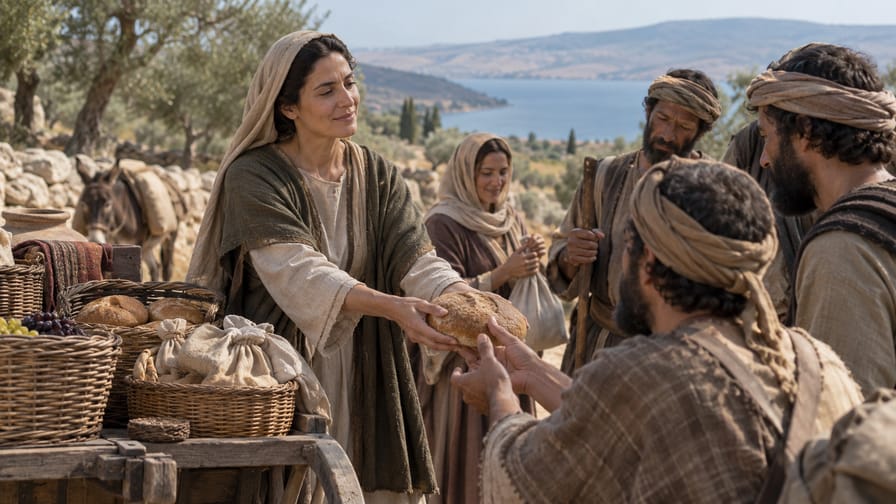
The figure of Joanna, though briefly mentioned in the gospels, emerges as a character of remarkable importance in the discipleship circle of Jesus Christ. Her story, recounted primarily by Luke, offers valuable insights into the inclusive nature of Jesus' ministry and the fundamental role of women in the propagation of the early Christian faith. This biblical-theological analysis explores the etymology of her name, her historical context, her character and role in the sacred narrative, her theological significance, and her lasting legacy, all from a Protestant evangelical perspective.
1. Etymology and Meaning of the Name
The name Joanna is of Greek origin, Iōanna (Ἰωάννα), being the feminine form of the name Iōannēs (Ἰωάννης). This, in turn, is the Greek transliteration of the Hebrew name Yochanan (יוֹחָנָן), which means "Yahweh is gracious" or "The Lord has been gracious." The Hebrew root chanan (חָנַן) denotes grace, favor, and mercy, and the addition of the divine prefix Yo (an abbreviation of Yahweh) emphasizes that this grace comes directly from God.
The meaning of Joanna's name resonates deeply with her personal experience and her role in the biblical narrative. For many evangelical theologians, the name "Yahweh is gracious" is not merely a designation but a theological declaration that reflects divine intervention in her life. It is probable that Joanna experienced God's grace through healing or deliverance by Jesus, as suggested in Luke 8:2, which propelled her into discipleship.
Although the name Yochanan is common in the Old Testament and during intertestamental periods, the feminine form Joanna is distinctive. The most prominent bearers of the masculine name Iōannēs in the New Testament are John the Baptist and John, the apostle. The uniqueness of Joanna's name among the women who followed Jesus highlights her individuality and the specificity of her calling.
The theological significance of the name, "Yahweh is gracious," underscores a central theme of the evangelical message: salvation by grace through faith. Joanna's life, marked by gratitude and service after receiving divine grace, becomes a living testimony to this principle. Her response to God's favor manifests the dynamic of faith working through love, a fundamental concept in Pauline theology (cf. Galatians 5:6).
2. Historical Context and Biblical Narrative
Joanna's life unfolds in the vibrant and complex setting of 1st century AD Galilee and Judea, during the public ministry of Jesus Christ (approximately 27-33 AD). This era was characterized by Roman occupation, political tensions, and an intense messianic expectation among the Jews. Jesus' ministry emerged in this context, challenging the religious and social structures of the time.
Joanna is presented in Luke 8:1-3 as one of the women who accompanied Jesus and the twelve apostles, providing for them out of their own means. Her social position is noteworthy: she was the wife of Chuza, the steward (epitropos, in Greek) of Herod Antipas, the tetrarch of Galilee and Perea. This office held great responsibility and prestige, implying that Chuza managed Herod's finances and properties, affording Joanna a position of significant influence and resources.
Joanna's association with the Herodian court is intriguing. Herod Antipas was the ruler who had John the Baptist imprisoned and beheaded (Mark 6:14-29) and who later mocked Jesus before His crucifixion (Luke 23:6-12). The fact that the wife of one of his closest officials was a dedicated follower of Jesus demonstrates the penetration of the gospel into all spheres of society, even the most unlikely.
The key biblical passages that mention Joanna are:
- Luke 8:1-3: Introduces Joanna as one of the women who had been healed by Jesus and who served him with their possessions, accompanying him on his journeys. She is explicitly named, along with Mary Magdalene and Susanna.
- Luke 24:1-10: Describes Joanna as one of the women who went to Jesus' tomb on Easter Sunday, found the stone removed and the tomb empty, and received the message from the angels about the resurrection. She, Mary Magdalene, and Mary, the mother of James, are the ones who report these events to the apostles.
The geography of her life would have been linked to Galilee, possibly to Herod's capital, Tiberias, or other important cities in the region. Her presence in Jerusalem during the Passover indicates her devotion and active participation in the final events of Jesus' ministry. Her relationships include, besides Jesus and the twelve, other women disciples such as Mary Magdalene and Susanna, forming a community of support and service.
3. Character and Role in the Biblical Narrative
Although the Scriptures offer few biographical details about Joanna, the mentions of her reveal a character of deep faith, devotion, and service. An analysis of her actions and associations allows us to infer her spiritual qualities and her indispensable role in Jesus' ministry.
3.1. Faith and Gratitude
Joanna's primary motivation for following Jesus is explicitly linked to her healing experience: she was one of the women "who had been cured of evil spirits and illnesses" (Luke 8:2). This divine deliverance and healing ignited in her an unwavering faith and profound gratitude, leading her to dedicate her life and resources to the service of her Savior. Her response is a testimony to the transformation that the grace of Christ brings about.
3.2. Service and Generosity
Joanna's most prominent role is that of a provider and supporter of the itinerant ministry of Jesus and his disciples. She, along with other women, "provided for them out of their own means" (Luke 8:3). This implied a significant financial and practical commitment, possibly utilizing her influence and resources derived from her husband's position. Her generosity was crucial for the sustenance of the group, allowing Jesus and the apostles to focus on preaching and teaching, free from logistical and financial concerns.
Joanna's attitude contrasts with the mindset of the time, where women of her social standing were not expected to actively engage in itinerant religious movements or provide for men who were not their family members. Her dedication demonstrates a detachment from social conventions and a prioritization of the Kingdom of God above all else, a powerful example of radical discipleship.
3.3. Courage and Loyalty
Joanna's loyalty to Jesus is evidenced by her continuous presence, even in the darkest moments. Although Luke 23:49 mentions only "all his acquaintances and the women who had followed him from Galilee" at the time of the crucifixion, it is reasonable to assume that Joanna was among them, given her prior commitment (cf. Matthew 27:55-56, Mark 15:40-41). Her presence at the empty tomb on the morning of the resurrection (Luke 24:1-10) is irrefutable proof of her perseverance and courage, defying danger and pain to honor her Lord.
3.4. Witness of the Resurrection
Joanna's most theologically significant role is that of being one of the first witnesses to Jesus' resurrection. She and the other women were the first to discover the empty tomb and to hear the angelic message about the resurrection. They were the first to proclaim this revolutionary news to the apostles, although their message was initially met with disbelief (Luke 24:10-11). This moment underscores the importance of women as messengers of the gospel, even in a culture that devalued female testimony.
4. Theological Significance and Typology
The figure of Joanna, although not the subject of direct prophecies or typologies in the Old Testament sense, holds profound theological significance that resonates with the Protestant evangelical perspective, especially concerning inclusion, discipleship, and the nature of the church.
4.1. Inclusion and Transforming Grace
Joanna's story is a vivid testimony to the inclusive nature of Jesus' ministry. He not only called men of humble origins but also women from different social strata, including one from Herod's court. Her healing and subsequent discipleship demonstrate the transforming power of God's grace, which transcends social, gender, and political barriers. God's grace reaches all who believe, regardless of their position or past.
Her life illustrates the truth that salvation is by grace (Ephesians 2:8-9) and that the response to that grace is faith manifested in service and obedience. As her name indicates, "Yahweh is gracious," and Joanna lived in response to this grace, dedicating her resources and her life to the Lord who delivered and healed her (Luke 8:2).
4.2. Practical Discipleship and the Role of Women
Joanna is a model of practical and sacrificial discipleship. Her willingness to use her possessions to sustain the ministry of Jesus and the apostles (Luke 8:3) is an example of faithful stewardship and selfless service. She represents the importance of material and logistical support for the expansion of the Kingdom of God, a principle that remains relevant for the church today.
Her role also highlights the fundamental contribution of women in Jesus' ministry and the early church. Luke, in particular, is notable for emphasizing the role of women (e.g., Mary, Elizabeth, Anna, Martha and Mary, the women at the tomb). Joanna, alongside others, challenges the idea that female discipleship was marginal, showing that women were active, essential, and recognized by Jesus as full members of his inner circle of followers.
4.3. Witnesses of the Resurrection and the Authority of Female Testimony
Joanna's role as one of the first witnesses to the resurrection is theologically crucial. In a society where female testimony was often legally devalued, Jesus chose women to be the first bearers of the most important news in salvation history (Luke 24:1-10). This subverts cultural norms and elevates the dignity and spiritual authority of women within the context of the gospel.
The apostles' initial disbelief (Luke 24:11) does not diminish the veracity of the testimony of Joanna and the other women, but highlights human resistance to divine truth and God's sovereignty in using whom He chooses. For evangelical theology, this event is an affirmation of spiritual equality in Christ (Galatians 3:28) and the capacity of all people, regardless of gender, to be messengers of the gospel truth.
4.4. The Church as Body and the Diversity of Gifts
Joanna's presence in the group of disciples illustrates the diversity of gifts and services within the body of Christ. While the apostles were called to preach and teach, women like Joanna were called to practical service and support, demonstrating that all functions are vital for the effective functioning of ministry. Her life is a reminder that faithful service in any capacity is valuable in God's eyes and contributes to the advancement of His Kingdom.
5. Biblical-Theological Legacy and Canonical References
The mention of Joanna, though limited to a few passages in the Gospel of Luke, establishes a significant biblical-theological legacy that resonates through church history and continues to inform contemporary evangelical theology. Her presence in the biblical canon ensures that her contribution is not forgotten.
5.1. Exclusive Presence in Luke
Joanna is mentioned explicitly only in the Gospel of Luke (Luke 8:2-3 and Luke 24:10). This exclusivity is noteworthy and aligns with Luke's style of highlighting the role of women, the marginalized, and Gentiles. Luke, as a historian and theologian, seems to have a particular interest in showing the breadth and inclusivity of Jesus' ministry. His inclusion of Joanna enriches the evangelical narrative, providing a more complete perspective on the group of Jesus' followers.
Although Matthew and Mark mention "many women" who served Jesus and were present at the crucifixion and the tomb (Matthew 27:55-56 Mark 15:40-41 Mark 16:1), only Luke chooses to name Joanna. This editorial choice by Luke is a testament to the importance he attributed to her person and her ministry of support.
5.2. Influence on Biblical and Reformed Theology
Joanna's story has often been cited in Reformed and evangelical theology to underscore the importance of female discipleship and Christian stewardship. She serves as an example of how faith translates into concrete actions of service and support for ministry. Evangelical commentators frequently point to Joanna as a model of generosity and dedication, challenging believers to use their resources for the advancement of the gospel.
Furthermore, Joanna's role as a witness to the resurrection reinforces the doctrine of Christ's resurrection as a historical event and fundamental to the Christian faith. The credibility of the women's testimony, though initially questioned, is ultimately validated by subsequent events and by Jesus' own appearance. This contributes to Christian apologetics, demonstrating the soundness of the historical foundations of the faith.
5.3. Contemporary Relevance
For the contemporary church, Joanna's life offers several lessons. She inspires selfless service and generosity, reminding us that the church is sustained not only by visible leaders but also by those who faithfully serve behind the scenes. Her story challenges faith communities to recognize and value the diverse forms of ministry and the gifts of all members, including women, in accordance with biblical principles.
Joanna's life is also a powerful reminder that God's grace shows no partiality. It encourages believers to live lives of gratitude and devotion, responding to Christ's healing and deliverance with a total commitment to His Kingdom. Her faith and courage, especially in remaining faithful in times of danger and sorrow, serve as a model for Christian perseverance in all ages.
In summary, Joanna, the wife of Herod's steward, whose name means "Yahweh is gracious," is a biblical figure of profound relevance. Her story, though concise, is a testament to Christ's transforming grace, active discipleship, and the importance of women's service in the building up of the Kingdom of God. She remains an enduring example of faith, generosity, and loyalty in the sacred canon.