


Baruch
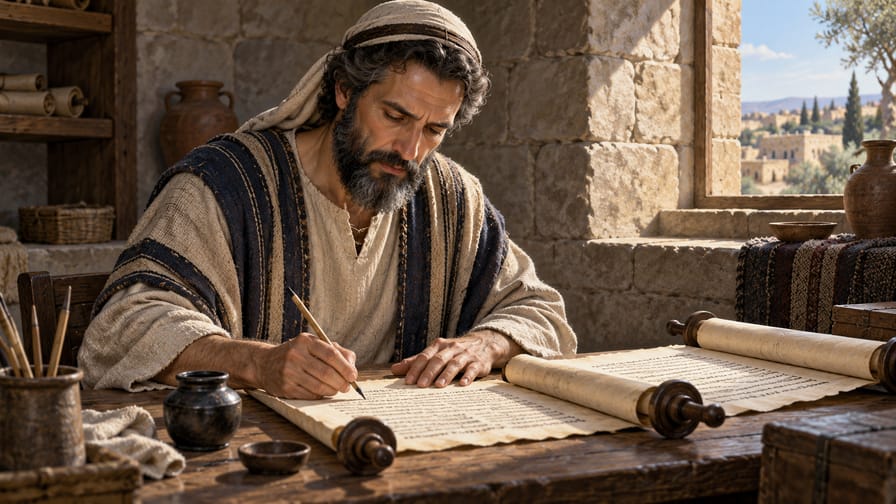
The figure of Baruch, son of Neriah, emerges in the Scriptures as a secondary character, but of paramount importance for the preservation and transmission of divine prophecy. He is recognized primarily as the scribe and confidant of the prophet Jeremiah during one of the most tumultuous periods in Judah's history.
His life and ministry are intrinsically linked to the last days of the Kingdom of Judah, the fall of Jerusalem, and the subsequent Babylonian exile. An analysis of Baruch reveals a man of faith, loyalty, and perseverance, whose story underscores God's providence in safeguarding His Word amidst apostasy and despair.
This study will delve into the etymology of his name, explore his historical context and biblical narrative, analyze his character and role, discuss his theological and typological significance, and consider his biblical-theological legacy from an evangelical Protestant perspective, providing a comprehensive view of his relevance in the Holy Scriptures.
1. Etymology and meaning of the name
The name Baruch derives from the Hebrew Baruk (בָּרוּךְ), which literally means "blessed" or "one who is blessed." The etymological root is b-r-k (ב-ר-ך), which is associated with blessing, kneeling, and praising.
This root is fundamental in biblical theology, appearing in various contexts of divine and human blessing, such as in Genesis 12:2, where God promises to bless Abram, and in Psalm 103:1, where the psalmist blesses the Lord.
The meaning of the name Baruch carries a deep theological resonance. To be "blessed" by God implies not only material prosperity, but a relationship of divine favor and empowerment for service, even amidst adversity.
In the Old Testament context, God's blessing was often linked to obedience to His covenant, as outlined in Deuteronomy 28:1-14. Thus, Baruch's name can be seen as a declaration of his status before God or a foreshadowing of his function.
There is no evidence of other prominent biblical characters with the same name in the Hebrew canon. The uniqueness of the name for this scribe of Jeremiah highlights his specific identity and role in salvation history.
The theological significance of the name lies in the idea that, even in a period of judgment and curse upon Judah, God still raised up individuals who were "blessed" and set apart for His purposes, such as the preservation of His Word.
2. Historical context and biblical narrative
2.1. Historical period and context
Baruch lived and served during one of the most critical and turbulent periods in Israel's history, specifically in the last years of the Kingdom of Judah, from the reign of Jehoiakim until the fall of Jerusalem and the subsequent Babylonian exile, approximately between 609 B.C. and 586 B.C.
This was a time of great political instability, with Judah squeezed between the rising powers of Babylon and the decline of Egypt and Assyria. The alliance with Egypt, advocated by many leaders of Judah, was seen by Jeremiah as a betrayal of the covenant with God, as per Jeremiah 2:18.
The social and religious context was one of deep apostasy and decay. Idolatry was widespread, social justice was neglected, and false prophecy proliferated, leading the people into a false sense of security, as denounced in Jeremiah 7:4.
In this scenario, the prophet Jeremiah was a solitary and unpopular voice, proclaiming imminent destruction and exile as divine judgment. Baruch became his faithful companion and scribe, playing a crucial role in documenting Jeremiah's prophecies.
2.2. Family origin and genealogy
The Scriptures inform us that Baruch was the son of Neriah and brother of Seraiah. In Jeremiah 32:12 and Jeremiah 43:3, he is identified as Baruch, son of Neriah, and in Jeremiah 51:59, Seraiah, Baruch's brother, is mentioned as an official who accompanied King Zedekiah to Babylon.
The mention of Seraiah indicates that Baruch's family had some prominence or access to the royal court. This may have facilitated his role as a scribe and his ability to interact with officials and leaders in Jerusalem.
2.3. Main events and biblical passages
Baruch's life is intimately intertwined with Jeremiah's and is documented primarily in the Book of Jeremiah. He first appears in Jeremiah 32:12-16, where he serves as a witness and guardian of Jeremiah's purchase contract for a field.
His most significant role, however, is revealed in Jeremiah 36. God instructs Jeremiah to write all the words that had been spoken to him, and Jeremiah, being unable to go to the temple, dictates the prophecies to Baruch, who writes them on a scroll, as per Jeremiah 36:4.
Baruch then publicly reads the scroll in the temple during a day of fasting, and subsequently before the princes of Judah, as per Jeremiah 36:10-15. When the scroll is read before King Jehoiakim, he burns it in defiance, in Jeremiah 36:23.
In response, Jeremiah dictates to Baruch a second scroll with the same prophecies and many others, emphasizing the ineffectiveness of human rebellion against the Word of God, as in Jeremiah 36:32.
After the fall of Jerusalem, Baruch accompanies Jeremiah and the remnant of Judah who escaped to Egypt, against the express will of the Lord, as per Jeremiah 43:6-7. He is falsely accused of instigating Jeremiah to advise the people to stay in Judah, in Jeremiah 43:3.
The geography of his activity is concentrated in Jerusalem, the political and religious center of Judah, and later extends to Egypt, where he was taken. His relationship with Jeremiah is one of deep loyalty and service, while his interaction with the leaders of Judah reveals his courage and opposition to apostasy.
3. Character and role in the biblical narrative
3.1. Analysis of character and virtues
Baruch's character is revealed through his actions and his interaction with Jeremiah and other characters. He demonstrates remarkable loyalty and devotion to his master, the prophet Jeremiah, even when Jeremiah was unpopular and persecuted.
His obedience to the Word of God, transmitted by Jeremiah, is one of his most prominent virtues. He faithfully transcribes the divine prophecies, even those that announced severe judgment upon his own people, as we see in Jeremiah 36:4.
Baruch also displays courage by publicly reading Jeremiah's words in the temple and in the royal court, in a hostile environment where the message was clearly unpopular and dangerous, as per Jeremiah 36:10-15.
His diligence as a scribe is evident in his ability to record and reproduce Jeremiah's extensive oracles, ensuring the preservation of God's Word for future generations. He was a man of letters and a dedicated servant.
3.2. Weaknesses and character development
The biblical narrative does not present Baruch as a flawless character. In Jeremiah 45:3, he expresses discouragement and anguish, lamenting his fate: "Woe is me! For the Lord has added sorrow to my pain I am weary with my groaning and find no rest."
This moment of human weakness, of exhaustion and despair in the face of the magnitude of problems and persecution, humanizes Baruch. He is not an automaton, but a man who feels the weight of the situation and the imminent danger.
God, through Jeremiah, responds to Baruch with a personal prophecy in Jeremiah 45:5, warning him not to seek great things for himself and promising him that his life would be preserved wherever he went. This prophecy serves as a comfort and a reminder of divine sovereignty.
Baruch's development is that of a faithful scribe who matures through suffering and trial. He learns to trust in God's protection even amidst destruction and exile, and to prioritize God's Word above his own comforts and ambitions.
3.3. Vocation and specific role
Baruch's primary vocation was that of a scribe (sopher, סוֹפֵר) and personal assistant to Jeremiah. In this role, he not only transcribed prophecies but also acted as a messenger, a confidant, and an executor of the prophet's instructions.
He played a crucial role in the preservation of the Word of God, ensuring that Jeremiah's prophecies were not lost, even when the king burned them, as in Jeremiah 36:23. The reconstruction of the scroll demonstrates his dedication to the divine mission.
His function extended beyond mere writing he was an active participant in the prophetic mission, reading God's words to the people and the court, and even being targeted by false accusations for his association with Jeremiah, as in Jeremiah 43:3.
Baruch is an example of faithful and selfless service in ministry, showing that one does not have to be the primary prophet to have a vital role in God's work. His life is a testament to the importance of collaborators and helpers in the Kingdom.
4. Theological significance and typology
4.1. Role in redemptive history and progressive revelation
Baruch plays a significant role in redemptive history by being the instrument chosen by God to preserve and transmit Jeremiah's prophecies, which were crucial for understanding divine judgment and Israel's future hope.
Through his writing, the Word of God survived royal opposition and physical destruction, ensuring that God's progressive revelation to His people remained intact. He is a guardian of revealed truth in a time of spiritual darkness.
His life illustrates God's sovereignty in using ordinary individuals to fulfill His extraordinary purposes, ensuring that His message of warning and comfort reached future generations, as in Jeremiah 36:32.
Baruch's faithfulness in recording the prophecies contributes to the Old Testament canon, making him a vital link in the chain of inspiration and preservation of the Scriptures.
4.2. Connection to central theological themes
Baruch's story resonates with several central theological themes from an evangelical Protestant perspective. Firstly, the authority and inerrancy of the Word of God are underlined by his dedication to writing and rewriting it, even when the king tried to destroy it (Jeremiah 36:23-24).
His life also exemplifies obedience and faith amidst adversity. Despite the danger and unpopularity, he obeyed Jeremiah's instruction to read the scroll, demonstrating a practical faith in the message he was conveying.
The personal prophecy to Baruch in Jeremiah 45 highlights divine grace and providence. God not only rebukes him for his self-pity but also offers him a promise of protection, showing God's care for His faithful servants, even in times of judgment.
Although Baruch is not a direct typological figure of Christ in the classical sense, his role in preserving the Word of God can be seen as an echo of the importance of the incarnate Word, Jesus Christ, who is the ultimate revelation of God (John 1:1, 14).
Just as Baruch was fundamental for the transmission of the prophetic word, Christ is the very Word who fully reveals God and His will to us. Baruch's perseverance in truth points to the constancy of Christ's truth.
His experience also illustrates the theme of vicarious suffering in ministry, as he shares in Jeremiah's afflictions and persecutions because of the Word of God, reminding believers that faithfulness to Christ often involves suffering (2 Timothy 3:12).
5. Biblical-theological legacy and canonical references
5.1. Mentions in other books and literary contributions
In the evangelical Protestant canon, Baruch is mentioned exclusively in the Book of Jeremiah, where his life and ministry are detailed. He is not referenced in other Old or New Testament books, indicating that his primary role is concentrated in the era of Jeremiah.
His literary contribution within the canon is indirect but fundamental: he was the scribe who recorded and, in one instance, rewrote the prophetic book of Jeremiah. Without Baruch, much of Jeremiah's prophecies could have been lost.
It is important to note that there is an apocryphal book known as the Book of Baruch, which was supposedly written by him. This book, along with other texts such as the Odes of Baruch, the Apocalypse of Baruch (2 Baruch), and 3 Baruch, is not part of the Hebrew canon nor the evangelical Protestant canon.
Despite not being canonical, these intertestamental texts reflect the high esteem and legend that developed around Baruch in early Jewish and Christian tradition, recognizing his importance as a guardian of wisdom and prophecy.
5.2. Influence on biblical theology and tradition
The figure of Baruch, though not a prophet or a king, exerts significant influence on biblical theology by demonstrating the importance of the preservation of the Word of God. He is a model of how God uses faithful servants to protect and transmit His revelation through generations.
His story reinforces the doctrine of verbal and plenary inspiration of the Scriptures. Baruch's obedience in recording the words dictated by Jeremiah, which were the words of God, underscores the belief that the Bible is, in its entirety, the Word of God (2 Timothy 3:16).
In Reformed and evangelical theology, Baruch is often cited as an example of faithfulness and selfless service in ministry. He serves as an inspiration for all those who, in supporting roles, contribute to the dissemination of divine truth.
Jewish and Christian interpretive tradition, even in its non-canonical texts, recognized Baruch as a figure of wisdom and piety. He is seen as a link between the prophet and the people, and a pillar in the continuity of divine revelation.
His importance for understanding the canon lies in his fundamental role in the compilation and preservation of one of the greatest prophetic books of the Old Testament. His dedication ensured that the voice of Jeremiah, and thus the voice of God, would not be silenced by human opposition.
In summary, Baruch is more than a mere scribe he is a testament to divine providence in the preservation of His Word, an example of loyalty and faith, and a figure whose legacy resonates with the importance of Scripture in the life of God's people.