


Abihail
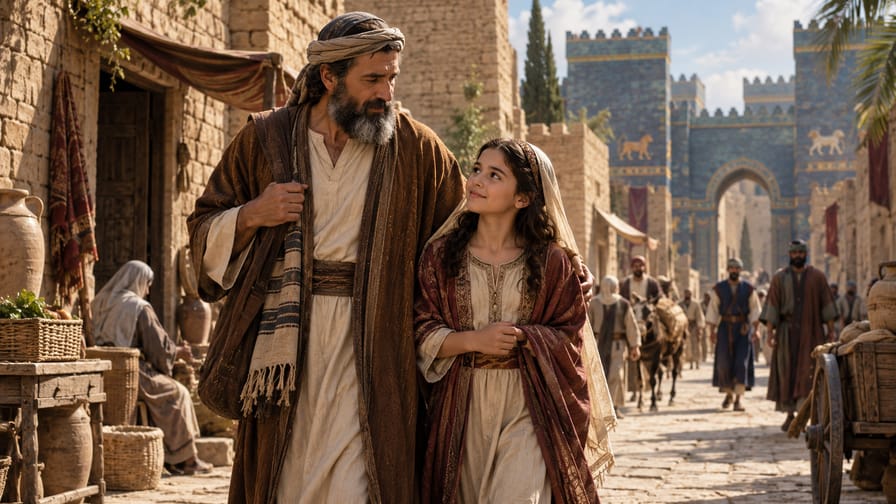
Abihail was the father of Esther, the Jewish young woman who became queen of Persia, and the uncle of Mordecai, the cousin who raised her. He belongs to one of the most dramatic books of the Old Testament, yet he never appears on stage: by the time the story begins he has already died, and Scripture mentions his name only twice, both times to identify his daughter.
Honesty requires saying clearly that the Bible tells us almost nothing about Abihail. We do not know what he did, how long he lived, when or how he died, or who his wife was. What we do know comes from a few precise lines in the book of Esther, and that is enough to place him in history and to see how God worked through the family he left behind.
This article deals only with Abihail, the father of Esther. Other people in the Bible bear the same name; they are noted briefly in section 5.
1. Etymology and meaning of the name
The Hebrew name Abihail (אֲבִיחַיִל, 'Avichayil) is formed from 'av, 'father', and chayil, a word that means strength, might or valor, and can also mean wealth or an army. The most common translation is 'my father is strength' or 'father of might'. As in other names beginning with Abi-, the 'father' may refer to God, giving the sense 'the Father is might', but this is a possible reading, not a certainty.
It is worth noting that the Old Testament also gives this name to women (1 Chronicles 2:29; 2 Chronicles 11:18), which shows it was not limited to men. The Greek Septuagint, for reasons that are not clear, calls Esther's father Aminadab instead of Abihail, and some translations that follow the Greek tradition reflect this in Esther 2:15.
2. Historical context and biblical narrative
2.1 Family origin and genealogy
The book of Esther introduces Mordecai as 'the son of Jair, son of Shimei, son of Kish, a Benjaminite' (Esther 2:5). Esther is called 'the daughter of his uncle' (Esther 2:7), and Esther 2:15 specifies that her father was Abihail, 'the uncle of Mordecai'. The Hebrew word for uncle (dod) normally means a father's brother. If that is the sense here, as most interpreters understand it, Abihail was a brother of Jair and therefore also a Benjaminite, and Esther and Mordecai were first cousins.
The family belonged to the Jewish community carried away from Jerusalem. Esther 2:6 links it to the deportation of King Jeconiah by Nebuchadnezzar (597 BC); interpreters discuss whether the verse refers to Mordecai himself or to his ancestor Kish. The events of the book take place in Susa, the Persian capital, under King Ahasuerus, usually identified with Xerxes I (486 to 465 BC). Abihail therefore lived in the Persian period, among the Jews who remained in the East after the first groups had returned to Judah.
2.2 Main events
The Bible records no action or word of Abihail. His part in the story is told through three brief notes:
His death. Esther 'had neither father nor mother', and 'when her father and her mother died, Mordecai took her as his own daughter' (Esther 2:7). The text does not say when or how Abihail died, only that it happened before Esther was taken to the palace.
His name at a decisive moment. When Esther's turn came to go in to the king, the narrator introduces her formally as 'Esther the daughter of Abihail the uncle of Mordecai' (Esther 2:15). She asked for nothing beyond what Hegai, the king's eunuch, advised, and she won the favor of all who saw her.
His name on the royal letter. After the deliverance of the Jews from Haman's plot, 'Queen Esther, the daughter of Abihail, and Mordecai the Jew gave full written authority' confirming the letter about the feast of Purim (Esther 9:29). The one who had been an orphan now signs as queen, and her father's name goes with her.
Why does the narrator mention Abihail precisely at these two points? The book does not explain. It is reasonable to think, as a hypothesis, that the full identification underlines Esther's Jewish identity and family lineage at the moment she enters the king's presence and at the moment she exercises her greatest authority.
3. Character and role in the biblical narrative
Since Scripture says nothing about Abihail's character, anything we might say about his personality, faith or feelings would be invention. His role in the narrative is real but indirect. He is the link that connects Esther and Mordecai as family, and it is this family bond that explains why Mordecai raised her, why she listened to him (Esther 2:20), and why the two acted together to save their people.
His absence also shapes the story. Esther appears as a vulnerable young woman: an orphan, a member of an exiled minority, taken into a foreign king's palace. The death of her father is part of the weakness from which God would raise her to a place of influence.
4. Theological significance
4.1 The hidden providence of God
The book of Esther famously never names God, and yet the whole story shows his hand directing events. The same is true in miniature of Abihail. He died without seeing what would become of his daughter. He could not have known that the girl he left behind would stand before the king of Persia and be used to preserve the Jewish people. God's purposes reached further than his life.
4.2 God as father to the fatherless
The law of Moses presents God as the one who 'executes justice for the fatherless' (Deuteronomy 10:18), and the psalms call him 'father of the fatherless' (Psalm 68:5). Esther's story shows this care working through ordinary means: a cousin who took an orphan into his home and treated her as a daughter. The Bible does not turn Mordecai's adoption of Esther into an explicit type, but it gives a concrete picture of what the New Testament teaches about God receiving us as sons and daughters through Christ (Galatians 4:4-7; Ephesians 1:5).
4.3 The preservation of the people of the promise
Through the daughter of Abihail, God protected the people from whom the Messiah would come according to the flesh. Jesus himself said that 'salvation is from the Jews' (John 4:22). The deliverance celebrated at Purim is one link in the long chain of God's faithfulness to his promise to Abraham.
5. Legacy and canonical references
Abihail's legacy lies entirely in his daughter. His name remains attached to hers in the permanent record of the feast of Purim, which Esther and Mordecai established to be kept 'throughout every generation' (Esther 9:28).
Abihail, the father of Esther, is named in only two verses: Esther 2:15 and Esther 9:29. He is referred to without his name in Esther 2:7, where the text speaks of Esther's father and his death.
Not to be confused with other people of the same name: Abihail the father of Zuriel, chief of the Levite families of Merari (Numbers 3:35); Abihail the wife of Abishur, of the tribe of Judah (1 Chronicles 2:29); Abihail son of Huri, of the tribe of Gad (1 Chronicles 5:14); and Abihail daughter of Eliab, son of Jesse, linked to the household of King Rehoboam (2 Chronicles 11:18).
6. Application for today
Abihail is a reminder that God's work does not end when our life does. Many parents die without seeing how their children's story will unfold. Abihail left an orphan in a foreign land, and God took care of her through a faithful relative and eventually used her to save a whole people. Believers can entrust their children and those they love to the same God, whose care goes beyond anything we can arrange.
His story also calls the church to be what Mordecai was to Esther. There are still orphans, widows and people without family support among us. Welcoming them is one of the concrete ways God shows himself as father to the fatherless (James 1:27).
Finally, the name Abihail, 'my father is strength', finds its fullest meaning in the gospel. In Christ, those who were spiritually orphaned receive the Spirit of adoption and cry, 'Abba, Father!' (Romans 8:15). Earthly fathers die; our heavenly Father remains, and his strength does not fail.