


Malchus
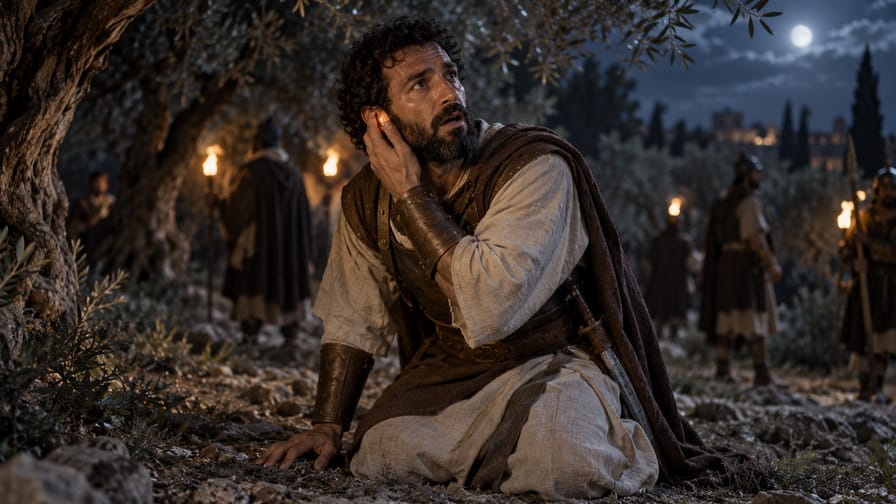
The figure of Malchus, though secondary and briefly mentioned in the Scriptures, offers a rich tapestry for biblical and theological analysis. His singular appearance in the Garden of Gethsemane, at the moment of Jesus Christ's arrest, is an event laden with meaning that illuminates crucial aspects of Christ's character, the nature of His Kingdom, and the appropriate response of disciples in the face of adversity. This analysis, from a conservative evangelical Protestant perspective, seeks to explore the etymology of the name, the historical context, the role in the narrative, the theological significance, and the canonical legacy of Malchus, underscoring biblical authority and Christ-centered typology.
1. Etymology and meaning of the name
The name Malchus (in Greek, Malchos, Μάλχος) is recorded exclusively in the Gospel of John (John 18:10). Etymologically, it is of Semitic origin, likely deriving from the Hebrew root melek (מֶלֶךְ), which means "king," "monarch," or "ruler." The name can be interpreted as "my king," "he who rules," or "counselor."
This linguistic derivation confers a notable irony upon the name, for Malchus is neither a king nor a ruler, but a servant of the High Priest Caiaphas (John 18:10). His position of servitude sharply contrasts with the royal meaning of his name. He is in the service of an earthly authority that, at that moment, opposed the true King of kings, Jesus Christ.
There are no other prominent biblical figures named Malchus in the canonical Scriptures. His uniqueness in the biblical narrative intensifies the focus on his brief, yet impactful, encounter with Jesus. The meaning of "king" or "counselor" can be seen as an unconscious prefiguration of the encounter with the sovereign counselor and eternal King, Jesus.
The theological significance of the name, therefore, lies in the juxtaposition of his social position with his name. He, a servant, is confronted by the Messiah, the promised King, who came not to be served, but to serve and to give His life as a ransom for many (Mark 10:45). This contrast highlights the inversion of values of the Kingdom of God in relation to earthly kingdoms.
He who bears a name that evokes royalty is, paradoxically, one of the most humble participants in the arrest of the divine King. This irony underscores the truth that Jesus' Kingdom is not of this world (John 18:36), and His power is manifested not by the sword, but by grace and meekness, even in the face of violence and injustice.
2. Historical context and biblical narrative
Malchus' appearance occurs at one of the most critical moments in salvation history: the night of Jesus' arrest in the Garden of Gethsemane, after the Last Supper and before His trial and crucifixion. This event is recorded in the four Gospels (Matthew 26:47-56 Mark 14:43-52 Luke 22:47-53 John 18:3-12), with John being the only one to identify the servant by the name of Malchus.
2.1. The political and religious setting
The historical period is the early 1st century A.D., under Roman occupation of Judea. The Jewish religious authority, led by the High Priest Caiaphas and the Sanhedrin, was in tacit alliance with the Romans to maintain order and, at the same time, sought to eliminate Jesus, whom they considered a threat to their own authority and political stability (John 11:48). The Jewish Passover was imminent, a period of great religious and political tension in Jerusalem, when the presence of pilgrims increased the risk of disturbances.
Malchus, as a servant of the High Priest, was part of the entourage accompanying Judas Iscariot, who betrayed Jesus with a kiss (Matthew 26:49). This entourage included temple guards (armed Levites), Roman soldiers (possibly a cohort under a tribune, as suggested by John 18:3), and other servants of the High Priest and the Pharisees. His presence indicates that he was a trusted official, tasked with carrying out his master's orders.
2.2. The narrative in Gethsemane
After Jesus' agonizing prayer and His disciples' sleep, Judas arrives at Gethsemane with the cohort and officers (John 18:3). When Jesus reveals Himself and asks whom they are looking for, the soldiers draw back and fall to the ground (John 18:6), a testament to Christ's divine power even in His voluntary humiliation. It is at this moment of tension that Simon Peter, impetuous as usual, draws a sword and attacks one of those present.
John 18:10 recounts: "Then Simon Peter, who had a sword, drew it and struck the high priest’s servant, cutting off his right ear. The servant’s name was Malchus." The other evangelists confirm the event (Matthew 26:51 Mark 14:47 Luke 22:50), but only Luke mentions that Jesus immediately touched Malchus' ear and healed it (Luke 22:51). This is the last healing miracle recorded before the crucifixion, performed during the act of His own arrest.
The geography of the event is the Garden of Gethsemane, located on the Mount of Olives, east of Jerusalem, a place of retreat and prayer for Jesus and His disciples. Its proximity to Jerusalem and the Temple, where Caiaphas exercised his authority, makes the presence of his servants and guards a direct reflection of the established power of the time.
Malchus' relationships are, therefore, with Peter (his assailant), Jesus (his healer), Judas (the betrayer), Caiaphas (his master), and the other members of the arrest party. His identity as a servant of the High Priest is crucial, as it directly links the incident to the religious authority that would condemn Jesus.
3. Character and role in the biblical narrative
The Bible offers very few details about Malchus' personal character. He is presented as a servant (doulos, δοῦλος in Greek) of the High Priest, which implies a position of service and subordination. His function in the narrative is more that of a catalyst for the actions of other characters and a canvas for the demonstration of Jesus' character, rather than that of a character with self-development.
No virtues or spiritual qualities are explicitly attributed to Malchus in the Scriptures. He is simply carrying out orders, participating in the entourage whose objective was to arrest Jesus. His presence there is not portrayed as an act of faith or personal malice, but as the performance of a duty. He is part of the religious and political system that opposed Christ.
Malchus' main "action" in the narrative is to be the victim of Peter's impetuousness. He does not speak, does not react (at least not in a recorded manner), and does not demonstrate any moral or spiritual choice after being healed. His passivity after the injury and healing is notable. He becomes a recipient of Jesus' grace and power, without any merit or request on his part.
Malchus' role is, therefore, functional. He serves to:
- Highlight the disciples' violence and Jesus' disapproval of that violence (Matthew 26:52).
- Provide the occasion for Jesus' last healing miracle before the cross, demonstrating His compassion and power even in His darkest hour (Luke 22:51).
- Illustrate the nature of the Kingdom of God, which does not advance by carnal or violent means (John 18:36).
- Underline Jesus' voluntary submission to the Father's will (John 18:11).
The fact that Malchus is a servant of the High Priest is also significant. He represents the religious establishment that, through spiritual blindness and attachment to earthly power, was arresting the Messiah. By healing him, Jesus demonstrates love and mercy even towards those aligned with His adversaries, a central principle of the gospel (Matthew 5:44).
There is no character development for Malchus throughout the narrative, as he disappears from the scene after his healing. His story is a brief, yet potent, parenthesis that highlights the glory and grace of Jesus Christ at the moment of His greatest earthly humiliation.
4. Theological significance and typology
The brief mention of Malchus and the incident of his healing carry profound theological significance for the evangelical Protestant perspective, which emphasizes biblical authority and the centrality of Christ in the history of redemption. This event, though peripheral, is rich in lessons about the character of Jesus, the nature of the Kingdom of God, and the conduct of disciples.
4.1. The demonstration of Christ's power and compassion
Jesus' act of healing Malchus' ear (Luke 22:51) is a final and powerful miracle before His crucifixion. This miracle is notable for several reasons:
- It is performed on an enemy, or at least someone who was part of the group of His captors. This demonstrates Jesus' universal compassion, which extends even to those who persecuted Him, exemplifying the commandment to love one's enemies (Matthew 5:44).
- It is performed at the moment of His own arrest, when He was about to be subjected to the greatest injustice. Even under immense pressure and pain, Jesus maintains His divine identity and His loving character.
- It is an act of sovereign power, reaffirming that Jesus was not a helpless victim, but one who willingly surrendered Himself. He could have summoned legions of angels (Matthew 26:53), but He chose the path of sacrificial obedience.
4.2. The nature of the Kingdom of God and the discipline of disciples
Jesus' reaction to Peter's act is instructive. He rebukes Peter (Matthew 26:52: "Put your sword back into its place. For all who take the sword will perish by the sword.") and affirms that His Kingdom is not of this world, not being defended by violent means (John 18:36). This is a fundamental lesson about the spiritual nature of the Kingdom of God.
The church must not advance its cause through physical force or coercion, but rather through the proclamation of the gospel, the testimony of life, and the power of the Holy Spirit. Peter's sword represents the human attempt to solve spiritual problems with carnal methods, something Jesus categorically rejects. The true battle is spiritual (Ephesians 6:12).
4.3. Typology and the history of redemption
Although Malchus is not a typological figure in the classic sense (like Adam or Melchizedek), the incident with him fits into the grand narrative of salvation history. He becomes a symbol of fallen humanity, which is in opposition to God (whether through ignorance or rebellion), but which is the object of Christ's redemptive grace.
Malchus' healing prefigures Christ's greater work on the cross, where He offers spiritual healing and reconciliation to all, including His enemies (Romans 5:10). Just as Malchus' ear was restored, humanity, wounded by sin, can be restored to communion with God through Christ's atoning work. The cutting off of the ear and its restoration can be metaphorically interpreted as humanity's inability to "hear" God due to sin, and the restoration of that capacity by Christ's grace.
The event also highlights God's sovereignty over all things, including the thoughtless acts of men and the malice of adversaries. What seemed like a random and violent incident is transformed by Jesus into a powerful demonstration of His authority and love. Even the acts of betrayal and arrest are subsumed into the divine plan for salvation (Acts 2:23).
Jesus' reference to the cup the Father had given Him to drink (John 18:11) reinforces His obedience to the divine will, even if it meant suffering and death. Malchus' healing is an epilogue to His prayer in Gethsemane, where He submitted His will to God's (Luke 22:42).
5. Biblical-theological legacy and canonical references
Malchus is not mentioned in any other biblical book, whether in the Old or New Testament. He is not the author of any canonical text, nor does he possess an extensive genealogy or history. His contribution to biblical theology resides entirely in the single incident in which he appears, but the depth of that moment is immense and resonates in several Christian doctrines.
Malchus' influence on biblical theology is indirect, but significant. He serves as an illustrative case for various themes:
- The nature of divine grace: The Malchus incident is a vivid example of unmerited grace (sola gratia). Jesus heals someone who did not seek Him, who was in opposition to Him, and who did not express faith. This highlights the proactive and unconditional nature of God's love.
- The patience and meekness of Christ: Even in the face of imminent violence and unjust arrest, Jesus demonstrates self-control, compassion, and faithfulness to the divine plan. He is the Lamb who does not resist the shearing (Isaiah 53:7).
- The rejection of violence in the propagation of the Kingdom: The rebuke to Peter is a fundamental principle for Christian ethics. The church is called to be a peacemaker and not to use violent means to achieve its ends, even if they are just (Matthew 5:9).
- God's sovereignty in Christ's suffering: The incident shows that Jesus was not an accidental martyr, but one who was in control of His destiny, voluntarily submitting to the Father's will to accomplish redemption.
In the Christian interpretive tradition, especially in Reformed and evangelical theology, the episode of Malchus is frequently cited in sermons and commentaries to illustrate the extent of Christ's love, the importance of non-violence in discipleship, and the nature of the Kingdom of God. Commentators such as Matthew Henry and Albert Barnes highlight Jesus' compassion, who not only rebukes Peter but also corrects the harm caused, demonstrating a concern for the well-being of an adversary.
Malchus' story, therefore, contributes to the understanding of the canon by reinforcing the image of Jesus as the suffering and compassionate Messiah, whose power is not manifested in earthly domination, but in service, sacrifice, and redemptive grace. He is a reminder that, even in the darkest moments of salvation history, the light of Christ's grace shines on everyone, even on those who come to arrest Him. Malchus' healing is a small, yet powerful, window into the heart of the gospel, where mercy triumphs over judgment and love over enmity.