


What Did Jesus Look Like?
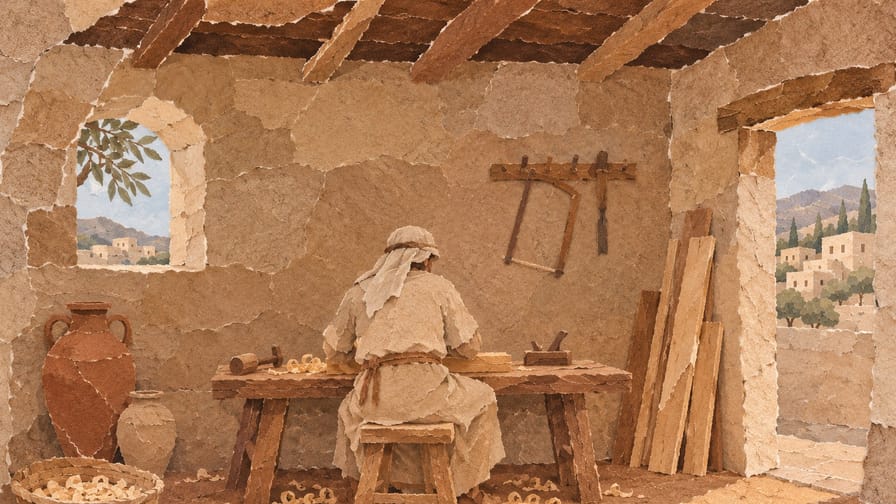
The Bible never describes what Jesus looked like: no Gospel gives his height, skin tone, eye color, hair, or whether he wore a beard. What Scripture does make clear is that he had a real human body and was a Jew from Galilee in the first century. Everything beyond that, from long flowing hair to the fair skin of European paintings, comes from artists and centuries of tradition, not from the text.
What the Gospels tell us and what they leave out
Matthew, Mark, Luke, and John record Jesus' birth, teaching, miracles, death, and resurrection, but none of them stops to describe his face. The physical clues are few and quiet. Luke 3:23 says he was about thirty years old when he began his ministry. Luke 2:52 says he grew in wisdom and in stature (the Greek word hēlikia can also mean age), which means he went through the ordinary growth of any child.
What the texts do affirm firmly is the reality of his body. John 1:14 says the Word became flesh. Hebrews 2:17 says he was made like his brothers in every way. In 1 John 1:1, the apostles testify that they heard, saw with their own eyes, and touched with their hands the one they proclaimed. Jesus was not an apparition or an idea. He was God incarnate, fully God and fully man, in a body that could be seen, touched, and wounded. Beyond that, Scripture offers no portrait.
Does Isaiah 53:2 describe the Messiah's face?
This is the verse most often cited by people who say Jesus was plain or even ugly. In Isaiah 53:2, the Servant of the Lord appears without tōʾar (form, stature) and without hādār (splendor, majesty) to draw the eye, growing up like a fragile shoot in dry ground. But this is prophetic poetry, written centuries before Jesus was born, and the subject of the chapter is rejection: the Servant would be despised, and the world would not see in him the greatness it expected (verse 3). The same poem, in Isaiah 52:14, speaks of suffering that disfigures, which points to the passion and not to the face of a young man from Nazareth.
Reading that verse as a physical portrait forces the text. What it supports with confidence is that the Messiah would not arrive with the pomp and glamour the world admires. Anyone who uses it to prove Jesus was unattractive makes the same mistake as someone who uses Psalm 45:2, the song of a royal wedding that calls the king the most handsome of men, to prove he was beautiful (Hebrews 1:8-9 applies verses 6 and 7 of that psalm to the Son, not verse 2). Both are poetry with another aim, and neither is an identity card.
A Galilean Jew, not a medieval portrait
If the Bible does not describe his face, it does place the man clearly. Jesus was born in Bethlehem (Luke 2:4-7), grew up in Nazareth of Galilee (Matthew 2:22-23), and descended from Judah and David (Hebrews 7:14; Matthew 1:1). The Samaritan woman recognizes him as a Jew (John 4:9). His neighbors in Nazareth knew him as the tektōn, a Greek word for craftsman or builder, usually translated carpenter (Mark 6:3).
One safe conclusion follows: Jesus was a first-century Galilean Jew, from the Middle East, and not someone with the face of a fifteenth-century European, as so many paintings show him. About the exact color of his skin or hair, his height, or his features, no one knows, and anyone who claims otherwise is making it up. The earliest images of Christ that we have appeared centuries later and vary widely: sometimes a beardless youth, sometimes a mature bearded man. Every age painted him in its own likeness.
Does Revelation 1 show how Jesus looked?
No. In Revelation 1:13-16, John sees one like a son of man, wearing a robe down to his feet, with hair white as wool, eyes like blazing fire, feet like glowing bronze, a voice like the roar of many waters, a sharp two-edged sword coming out of his mouth, and a face like the sun at full strength. This is a symbolic vision: no one thinks he literally has a sword in his mouth. The images reuse the vocabulary of Daniel 7:9 and 10:6 and tell us who Jesus is, not what features he had. The white hair, for example, recalls the Ancient of Days and points to eternity and wisdom, not to Jesus' age.
This is the risen and glorified Christ seen in a prophetic vision, not the carpenter who walked through Galilee. Something similar is true of the transfiguration: in Matthew 17:2, Jesus' face shines like the sun and his clothes become white as light. It was a glimpse of glory, told as something exceptional and not as his everyday look.
Why Scripture stays silent and what it puts in its place
The biblical authors had a different purpose. John explains that he wrote so that readers would believe Jesus is the Christ, the Son of God, and have life in his name (John 20:31). The Gospels give detail about what he said, what he did, how he treated people, and how he died. Even after the resurrection, recognition does not come through his face: Mary Magdalene recognizes him when he calls her by name (John 20:16), and the disciples at Emmaus when he breaks the bread (Luke 24:30-31). Among the few details of Jesus' body that the accounts highlight are the wounds of the crucifixion in his hands and side (John 20:20,27), because they identify the risen Lord as the same one who was crucified and show that his body is real (Luke 24:39-40). As a reflection, they also remind us of the love and sacrifice that took him to the cross.
Paul says he no longer knew Christ by merely human standards (2 Corinthians 5:16), and Jesus calls blessed those who believe without having seen (John 20:29). Peter writes to Christians who love Jesus without having seen him (1 Peter 1:8). Faith never depended on a familiar face, but on who he is and what he has done.
In practice, this changes two things. First, knowing Jesus comes through the Gospels, not through an image: as you read, ask what each scene reveals about him instead of projecting a face. Second, faithful Christians differ on illustrations and films: some avoid any image of Jesus because of the ban on worship images in Exodus 20:4-5, while others use them to teach, as long as no one worships them or mistakes them for an accurate portrait. What they share is this: no image replaces the Jesus of Scripture.
The Bible promises more than a portrait. According to 1 John 3:2, we will be like him, because we will see him as he is, and Revelation 22:3-4 says God's servants will see the face of God and of the Lamb. When we see him, it will be face to face, not through an image.
Key Bible references
Isa 53:2 · Luke 2:52 · Mark 6:3 · Matt 17:2 · Rev 1:13-16 · John 20:29 · 2 Cor 5:16 · 1 John 3:2