


Was the forbidden fruit an apple?
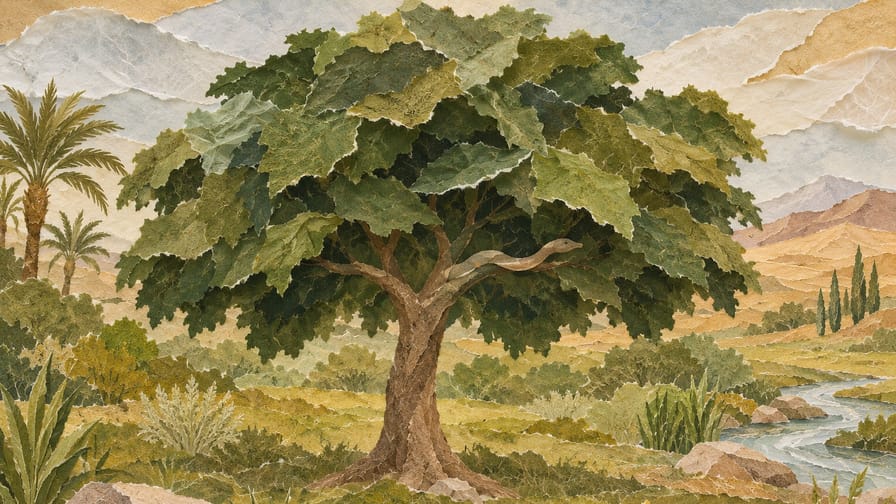
No, the Bible never says the forbidden fruit was an apple. Genesis 2 and 3 speak of “the tree of the knowledge of good and evil” and, when the woman eats, they say only “fruit,” without naming the species. The apple entered the Christian imagination centuries later, by routes we can only conjecture, and the text puts far more weight on God’s command than on the kind of fruit.
What Genesis says about the fruit, and what it leaves unsaid
The story presents the tree by its function, not its species. In Genesis 2:9 it appears alongside the tree of life, and, according to the woman, it stood in the middle of the garden (Genesis 3:3). In Genesis 2:16-17 God grants wide freedom: the man could eat freely from every tree of the garden except this one, and the warning was grave, since eating from it would bring death.
When the scene of the sin arrives in Genesis 3:6, the narrator spells out what the woman noticed: the tree was good for food, a delight to the eyes, and desirable to make one wise. She took of its fruit (in Hebrew, peri), ate, and gave some to her husband who was with her, and he ate. The description is rich in motives and silent about the species.
That silence holds through the rest of the Bible. When the New Testament returns to the episode (Romans 5:12-19; 2 Corinthians 11:3), the focus falls on transgression and deception, never on the fruit. The Bible does not name the fruit, and an answer faithful to the text has to begin by admitting that.
Where did the apple idea come from?
The most repeated explanation is a Latin pun. In the Vulgate, the Latin translation made by Jerome in the late fourth century, the tree is the lignum scientiae boni et mali, the “tree of the knowledge of good and evil.” But in Latin, “of evil” (mali) and “of the apple” (mali, from mālum) were spelled the same way; only the length of the first vowel set them apart, and the writing did not mark it. It is a plausible hypothesis that the wordplay helped fix the image, and Western painting, poetry, and popular culture did the rest. But it remains a hypothesis: nobody can demonstrate that this is how it happened.
There is also a nuance of vocabulary. In Latin, Greek, and Old English, the word for “apple” could also mean tree fruit in general; the pomegranate, for instance, was the mālum punicum, the “Punic apple.” Someone who read “apple” in an ancient language was not always picturing the fruit that now carries that name.
Biblical Hebrew, for its part, has its own word for an orchard fruit, tappuach, which appears in Song of Songs 2:3 and Joel 1:12 but never in Genesis 3. Scholars debate whether tappuach is the apple as we know it, the quince, the apricot, or the citron. Joel 1:12 even lists the vine, fig tree, pomegranate, palm, and apple tree, which shows the language had names for these trees. The author of Genesis simply used none of those names for the fruit.
Fig, grape, wheat: what about the other candidates?
Those who set the apple aside usually propose another fruit. Ancient Jewish sources, such as the Talmud and Genesis Rabbah, record differing opinions that name wheat, grape, and fig. The fig suggestion leans on Genesis 3:7, where the couple, after eating, sew fig leaves together to cover themselves. But the verse tells us what they used for clothing, not what they ate. A fig leaf is large and easy to find; it does not follow that the fruit was a fig.
All of these proposals are respectable speculation, and none can be confirmed from the text. Living with the gap is the more honest position: whoever fills the silence ends up shifting the focus away from what the author meant to highlight.
What the text really highlights: God’s word put in doubt
The serpent does not open with an offer of fruit. It opens with a question about God’s word: did God really say they could not eat from any tree in the garden? (Genesis 3:1). The question twists the generosity of Genesis 2:16, and the exchange moves on to a flat contradiction: “You will not surely die” (Genesis 3:4). The attack is not on the fruit; it is on trust in God’s truthfulness (Genesis 3:4) and, as the text suggests in Genesis 3:5, in his goodness, as if he were holding back something good.
Then the woman looks at the tree with different eyes (Genesis 3:6). In 1 John 2:16 the apostle describes what is in the world and does not come from the Father: the desire of the flesh, the desire of the eyes, and the pride of life. Many readers hear an echo of the scene there, which is a reasonable theological reading, though not a link the text makes explicitly.
The New Testament treats the episode as disobedience. Paul contrasts Adam’s disobedience with Christ’s obedience (Romans 5:19), and Philippians 2:8 says Jesus became obedient to death, even death on a cross. The apostle Peter says Christ bore our sins in his body on the tree (1 Peter 2:24). Christian tradition sees a contrast between one tree and another, an old and fruitful reading, though it is a theological resonance rather than a parallel the Genesis text declares. The heart of the story is obedience, not the species of the fruit.
Common misunderstandings about the forbidden fruit
- “It was just a piece of fruit.” The smallness of the act is exactly the point: God had given every other tree in the garden, and the disobedience revealed a distrust that God was reliable (Genesis 3:4) and, as the text suggests, that he was good (Genesis 3:5).
- “It was a sexual sin.” The story does not say so. It shows that, after eating, they realized they were naked (Genesis 3:7), which reads as shame (compare Genesis 2:25) and not as the sin itself. As a counterpoint, compare the blessing “be fruitful and multiply,” given before the fall (Genesis 1:28), and Hebrews 13:4, which calls marriage honorable.
- “The fruit had magical power or was poisonous.” The text does not describe the fruit as poison or as enchanted, and it ties death to eating from the forbidden tree (Genesis 2:17; 3:3). Because the story links eating to effects (Genesis 3:6-7; 3:22), it does not explain whether they come from the fruit, from the disobedience, or from God’s command, and readers differ. The exact sense of “knowing good and evil” is also debated.
When temptation still asks: Did God really say?
If the center of the episode is God’s word put in doubt, the temptation stays the same and only the packaging changes. It often arrives as the old question: “Did God really say?” Jesus answered temptation in the wilderness with “It is written” (Matthew 4:4), trusting the Father’s word where Adam and Eve doubted. Taking Scripture as a trustworthy word does not take freedom away from the believer; it guards it.
And the story does not end in guilt. God calls to the man (“Where are you?”, Genesis 3:9), announces that the woman’s offspring will strike the serpent’s head (Genesis 3:15), and clothes them with garments of skin (Genesis 3:21). At the end of the Bible the tree of life returns: Revelation 2:7 promises it to the one who conquers, and Revelation 22:2 shows it in the new creation, with leaves for the healing of the nations. Anyone fixated on discovering which fruit it was may miss what the text delivers: the seriousness of obedience, the grace of a God who comes looking and clothes the couple, and, read in the light of the New Testament, hope in Christ.
Key Bible references
Gen 2:9 · Gen 2:16-17 · Gen 3:1-7 · Gen 3:15 · Rom 5:12-19 · 1 John 2:16 · Rev 22:2 · Song 2:3