


Has the Bible Been Changed Over the Centuries?
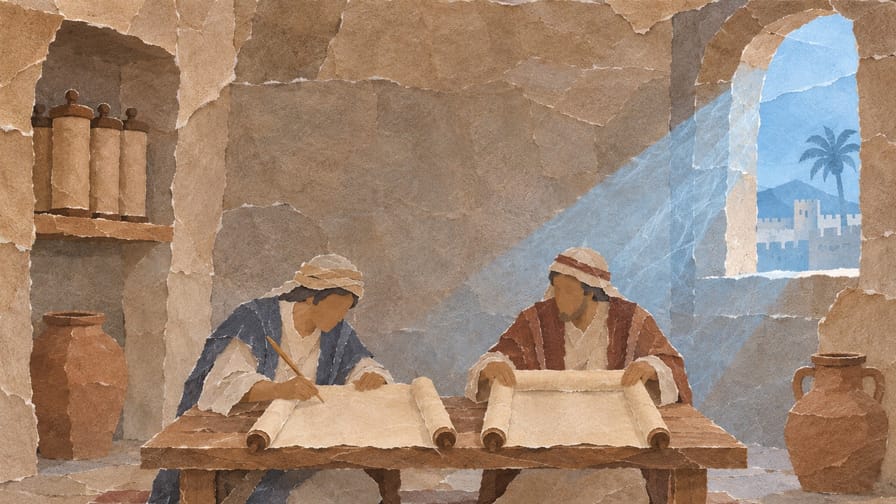
Not in any way that changes its message: the Bible has been preserved across the centuries, even though hand-made copies collected variants, that is, differences between one manuscript and another. Those variants are known and cataloged, and the vast majority are matters of spelling. Because thousands of manuscripts exist to compare, scholars can reconstruct the original text with a high degree of confidence. Only a handful of cases involve longer passages, such as the ending of Mark, and Bibles flag them in a footnote.
Why do copies of the Bible differ from one another?
Before the printing press, every copy was written by hand, and anyone who copies for centuries makes mistakes. Most are unintentional: swapped letters, a word skipped when the eye jumps to a similar line, a passage copied twice. A minority are deliberate: a scribe harmonizes two Gospels, clarifies a hard expression, or moves into the text a note that was written in the margin.
Each place where manuscripts disagree is a variant. Estimates for the New Testament run to hundreds of thousands (an approximate figure), which sounds alarming until you see how the count works: it adds up the differences of every manuscript at every point in the text, so the more copies exist, the more variants are counted. The overwhelming majority do not affect the meaning: spelling, word order (in Greek, “Jesus Christ” and “Christ Jesus” mean the same thing), a definite article before names. Only a small fraction changes the sense in a noticeable way, and smaller still is the fraction that also has a real chance of being the original reading. Comparing manuscripts to arrive at the original is called textual criticism.
What did the Dead Sea Scrolls show about the Old Testament?
Before 1947, the oldest substantial Hebrew manuscripts of the Old Testament were medieval: the Leningrad Codex, from about the year 1008, is the oldest complete one. The question remained about the thousand years before. Then the Dead Sea Scrolls came to light in caves near Qumran: about nine hundred manuscripts (an approximate figure), about a quarter of them biblical, with fragments of nearly every book of the Old Testament, Esther being the notable exception.
The most famous piece is the Great Isaiah Scroll, the whole book on more than seven meters of parchment, copied around the second century BC (an approximate date), roughly a thousand years before the medieval manuscripts. The differences from the medieval Hebrew text, known as the Masoretic Text, are mostly spelling and small details: the Isaiah we read is, in essence, the same. One footnote-level example is Isaiah 53:11, where the Qumran scrolls and the Septuagint (the ancient Greek translation) say that the servant, after his suffering, will see light, a word missing from the Masoretic Text. It is a typical variant: it matters to the translator without touching what Isaiah 53:12 teaches about the servant who bears the sin of many.
Qumran also brought some candor: before the Christian era, slightly different forms of some books were already in circulation, such as a shorter version of Jeremiah that resembles the Septuagint. That does not point to tampering; it is the map of variations scholars use to decide hard readings. In the synagogue at Nazareth, Jesus read from the scroll of Isaiah and said that this Scripture was fulfilled that day (Luke 4:16-21): a hand-made copy was, for everyone there, the Scripture.
How many New Testament manuscripts exist, and what do they show?
The New Testament is the best-documented text of the ancient world. About 5,800 Greek manuscripts are cataloged, from tiny papyrus scraps to complete Bibles, and once you add early translations into Latin, Syriac, Coptic and other languages, the total passes 20,000 (approximate figures). Papyrus 52, with verses from John 18, is usually cited as the oldest fragment and is dated to the first half of the second century (the date is approximate and debated). The great codices Sinaiticus and Vaticanus come from the fourth century. By contrast, the works of Greek and Roman authors usually depend on a handful of copies made centuries after the author died, and historians accept them without fuss.
Many people picture the transmission as a game of “telephone,” where each person's mistake piles up to the end. It was not like that. The manuscripts form many lines of transmission spread across regions and centuries, and when one copy contains an error, other independent copies make it possible to spot it. Quotations in the writings of the church fathers and the earliest translations help check the text.
Are Mark 16:9-20 and John 7:53-8:11 original?
Here the doubt is real, and honesty requires saying so. Faithful Christians disagree about these passages, and modern Bibles usually flag them with brackets or notes.
The longer ending of Mark (16:9-20) is missing from Sinaiticus and Vaticanus, and other manuscripts have a shorter ending or different endings. Most textual scholars, including many evangelicals, conclude that the passage was added later; others defend it as original. What is at stake is smaller than it seems: the resurrection of Jesus is attested in Mark 16:1-8 and also in Matthew 28, Luke 24, John 20 and 1 Corinthians 15:3-8. Prudence says not to build a practice, such as handling snakes (Mark 16:18), on a passage whose origin is debated.
The story of the woman caught in adultery (John 7:53-8:11), in which Jesus invites whoever is without sin to throw the first stone, is missing from the earliest papyri of John (P66 and P75) and from Sinaiticus and Vaticanus. It appears in later manuscripts, such as Codex Bezae (fifth century), sometimes in another place, such as after Luke 21:38. Many scholars, conservatives among them, see it as an early tradition about Jesus, which many consider historical, inserted into the Gospel later; others defend it as an original part of John.
Other well-known cases:
- Matthew 6:13: the closing doxology of the Lord's Prayer is missing from the oldest manuscripts.
- Acts 8:37: the Ethiopian eunuch's confession of faith is absent from the oldest Greek manuscripts; it appears in very few Greek manuscripts (the earliest is from the sixth century) and in some early Latin translations.
- 1 John 5:7-8: the wording about the Father, the Word, and the Holy Spirit appears in only a very few late Greek manuscripts. The Trinity does not depend on it; it rests on texts such as Matthew 28:19 and Matthew 3:16-17.
If there are variants, can we still trust the Bible?
Yes, and the reason starts with stating precisely what the Christian faith affirms and where each claim comes from. It does not claim that every copy is perfect. What the biblical text itself says is that all Scripture is inspired by God (2 Timothy 3:16), that God cannot lie (Titus 1:2), and that his word is truth (John 17:17). From these texts the evangelical tradition deduces the inerrancy of the autographs: the original writings, inspired by a God who does not lie, are without error. That formulation is a doctrinal deduction from what Scripture says about God and his word; 2 Timothy 3:16 does not mention autographs. No autograph has survived, and that is exactly why textual criticism exists. As for the copies, a common conviction among evangelicals is that God watched over the transmission so abundantly that they give us reliable access to the original; that is a conclusion of faith drawn from the history of the manuscripts, not a sentence of the Bible.
Scripture itself affirms the permanence of God's word, not the preservation of every manuscript: Isaiah 40:8 says the word of our God stands forever, and Jesus said his words would never pass away (Matthew 24:35). What history shows is that the message reached us through ordinary scribes, with its central teachings intact, even with variants we can now identify.
Two myths are worth clearing up. First, the Council of Nicaea in 325 did not pick the books of the Bible or rewrite the text: it dealt with the deity of Christ, against Arius, and the date of Easter. The 27 books of the New Testament were recognized by the churches gradually, and the first known list with exactly those 27 is in Athanasius's letter of 367. Second, a variant is not a translation: much of the difference between one Bible and another comes from how the same original text is rendered, the subject of the answer on why there are different translations.
In practice, read your Bible with confidence: what it teaches about Christ and about salvation, by grace through faith (Ephesians 2:8-9), is firmly attested in the manuscripts. When a note says some ancient manuscripts do not include a verse, take that as the edition's honesty, not as a threat. And do not rest a doctrine on a single passage whose text is debated: the great teachings of the faith stand on many secure texts.
Key Bible references
Isa 40:8 · Isa 53:11 · Luke 4:16-21 · 2 Tim 3:16 · Titus 1:2 · John 17:17 · Mark 16:9-20 · John 7:53-8:11