


Pilate
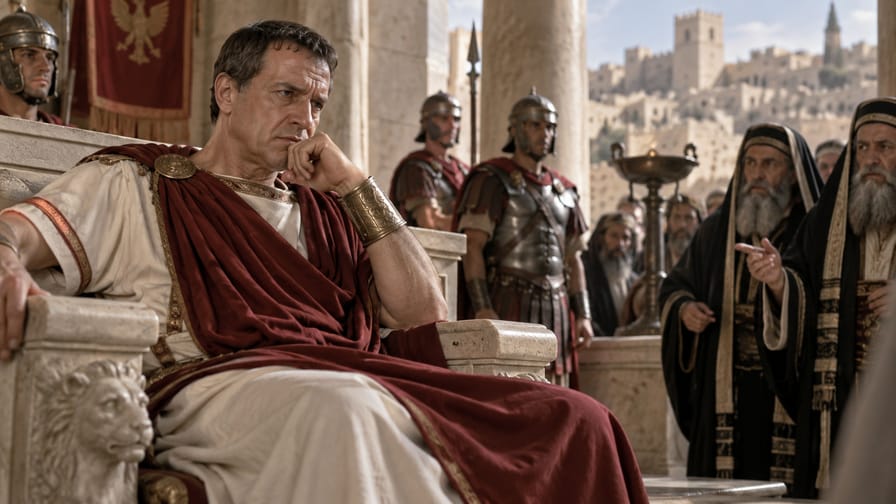
The figure of Pilate (Latin: Pontius Pilatus) emerges in the pages of the New Testament as a pivotal character in the narrative of the Passion of Christ. His actions as the Roman governor of Judea, especially in the trial and condemnation of Jesus, grant him an indelible place in salvation history and Christian theology. Although he is not a character with a positive or exemplary role, his participation is crucial for the fulfillment of God's redemptive plan, making him the object of deep historical and theological analysis from an evangelical Protestant perspective.
This study seeks to explore the etymology and meaning of his name, the historical and biblical context of his life, the complexity of his character, his theological and typological significance, and his legacy within the canon and Christian tradition. The analysis will be founded on the Scriptures, with attention to biblical authority and exegetical precision, highlighting the implications of divine sovereignty and human responsibility in the crucifixion of Jesus Christ.
1. Etymology and Meaning of the Name
The full name of Pilate, Pontius Pilatus, is of Latin origin and reflects his identity as a Roman official. The nomen (family name) Pontius indicates that he belonged to the gens Pontia, an ancient and influential Roman family, which included patricians and plebeians. This family name suggests his Roman citizenship and social position, probably of equestrian status, which was the requirement to be a procurator or prefect.
The cognomen (personal nickname) Pilatus is what has generated the most etymological speculation. The most widely accepted interpretation derives from pilum, the heavy spear used by Roman legionaries. In this sense, Pilatus could mean "skilled with a spear," "armed with a spear," or "hurled," suggesting a connection with a military career or a martial characteristic of an ancestor. This etymology resonates with the military and coercive authority that Pilate exercised as governor.
Other suggestions for the origin of Pilatus include pilus, meaning "hair" or "hairy," or pileatus, referring to the pileus, the felt cap worn by freed slaves. However, these latter suggestions are less probable in the context of a cognomen for a Roman official of his standing. The derivation from pilum is what best aligns with the function and power of a Roman governor over a turbulent province like Judea.
From a theological standpoint, Pilate's name does not possess an intrinsic prophetic meaning like many Hebrew names. However, his identity as a "man of the spear" or "man of arms" symbolizes the military and legal power of the Roman Empire, which was the human instrument for the execution of the Messiah. The name, therefore, positions him as a representative of secular power who, ironically, becomes an agent in the fulfillment of God's divine plan of salvation, albeit through an unjust and cowardly decision.
2. Historical Context and Biblical Narrative
2.1. Period and Socio-Political Context
Pilate served as prefect (or procurator, a term used later) of Judea for a period of ten years, from 26 to 36 AD, under the reign of Emperor Tiberius. His main seat of government was in Caesarea Maritima, but he resided in Jerusalem during Jewish festivals to maintain order, as evidenced in the accounts of Jesus' trial (Matthew 27:15 Mark 15:6 Luke 23:17).
Judea was a second-tier Roman province, notorious for its instability and resistance to foreign domination. Pilate's rule was marked by a series of incidents demonstrating his cultural and religious insensitivity towards the Jews, and his readiness to use force. Flavius Josephus and Philo of Alexandria report that Pilate repeatedly offended the Jews by introducing Roman standards with images of the emperor into Jerusalem and by using Temple money to build an aqueduct, resulting in riots and massacres.
The tension between Roman power and Jewish sensibilities was constant. The Sanhedrin, the Jewish ruling council, had limited religious and civil authority, but did not have the right to carry out the death penalty without the approval of the Roman governor (John 18:31). This detail is crucial for understanding why Jesus was brought to Pilate after being condemned by the Jewish leaders for blasphemy.
2.2. Main Events in the Biblical Narrative
Pilate's most prominent appearance in the Scriptures occurs in the four Gospels, where he presides over the trial of Jesus Christ. After being arrested in Gethsemane and tried by the Sanhedrin, Jesus is brought to Pilate by the Jewish leaders, who accuse him of sedition against Rome, claiming that he proclaimed himself king and forbade paying taxes to Caesar (Luke 23:1-2 John 18:28-32).
Jesus' interrogation by Pilate is detailed in the Gospels. Pilate questions Jesus about the accusation of being "King of the Jews" (Matthew 27:11 Mark 15:2 Luke 23:3 John 18:33-37). Jesus' response, "My kingdom is not of this world" (John 18:36), appears to have convinced Pilate that Jesus posed no political threat to the Roman Empire. He repeatedly declares Jesus' innocence: "I find no fault in him" (Luke 23:4, 14, 22 John 18:38 John 19:4, 6).
Despite recognizing Jesus' innocence, Pilate yields to the pressure of the crowd and the Jewish leaders. He tries to release Jesus by offering a choice between Jesus and Barabbas, a notorious criminal (Matthew 27:15-26 Mark 15:6-15 Luke 23:18-25 John 18:39-40). When the crowd demands Barabbas and the crucifixion of Jesus, Pilate attempts to appease them by scourging Jesus (John 19:1-5), hoping that would be sufficient.
The pressure mounts when the Jewish leaders threaten to report Pilate to Tiberius, saying, "If you release this man, you are no friend of Caesar" (John 19:12). Fearing to lose his position and face the emperor's wrath, Pilate, in a symbolic gesture of washing his hands, declares himself innocent of Jesus' blood and hands him over to be crucified (Matthew 27:24-26).
Another biblical event involving Pilate is the reference in Luke 13:1, where Jesus is informed about Galileans whose blood Pilate had mixed with their sacrifices. This incident corroborates the image of Pilate as a brutal and ruthless governor, as also described by secular historians.
2.3. Relationships with Other Characters
Pilate interacted with High Priest Caiaphas and the Sanhedrin, who brought Jesus to him (John 18:28). He also reconciled with Herod Antipas, tetrarch of Galilee, after a period of enmity, when he sent Jesus to Herod for trial (Luke 23:7-12). His wife, Claudia Procula (according to Christian tradition), also appears in the narrative, warning him in a dream to have nothing to do with Jesus, "that righteous man" (Matthew 27:19).
3. Character and Role in the Biblical Narrative
3.1. Character Analysis
Pilate's character, as portrayed in the Gospels and in extra-biblical historical sources, is complex and largely negative. He is described as an indecisive, cowardly, and pragmatic man, more concerned with maintaining Roman order and his own political standing than with rendering justice. His repeated declaration of Jesus' innocence, followed by his eventual condemnation, exposes a grave moral failing and a paralyzing fear of political repercussion (John 19:12-16).
Pilate demonstrates remarkable cynicism in his question to Jesus: "What is truth?" (John 18:38). This phrase reveals a posture of disinterest or disbelief in objective truth, contrasting drastically with the incarnate Truth who stood before him. He is an example of a leader who, though endowed with great power, succumbs to the pressure of the crowd and political manipulation, sacrificing justice for convenience.
His cruelty is also evident, not only in the extra-biblical accounts of massacres, but also in the scourging of Jesus (John 19:1) and the killing of the Galileans (Luke 13:1). Although he attempted, in some way, to avoid Jesus' crucifixion, his final actions reveal a moral weakness and a lack of integrity that make him complicit in one of the greatest acts of injustice in history.
3.2. Role Played
Pilate's role in the biblical narrative is that of an agent of Roman power and, paradoxically, an instrument in the divine plan of redemption. He is the secular judge who, by condemning the innocent Jesus, validates the justice of Christ's sacrifice. His authority was essential for Jesus' execution, as Jewish law did not permit the Sanhedrin to carry out the death penalty. Thus, he becomes the link between the Jewish religious condemnation and the Roman execution.
Significant actions by Pilate include Jesus' interrogation, his repeated declarations of innocence, the offer of Barabbas, the scourging, and, finally, the handing over of Jesus for crucifixion. The gesture of washing his hands (Matthew 27:24) is a symbolic attempt to exempt himself from guilt, but theologically it does not absolve him. Scripture and evangelical theology affirm his personal and moral responsibility for the unjust act.
There is no positive development of Pilate's character throughout the narrative. He remains an example of human failure in the face of divine truth, of the corruption of earthly justice, and of the inability of secular power to recognize and embrace the Kingdom of God. His story serves as a warning about cowardice and moral compromise, even when confronted with the incarnate Truth.
4. Theological Significance and Typology
4.1. Role in Redemptive History and Divine Sovereignty
Pilate's participation in Jesus' condemnation is a central element in redemptive history. Although his actions are morally reprehensible, the evangelical Protestant perspective emphasizes that they are part of God's sovereign plan for the salvation of humanity. Acts 2:23 states that Jesus was "delivered up according to the definite plan and foreknowledge of God" and crucified "by the hands of lawless men." Similarly, Acts 4:27-28 declares that Herod, Pilate, and the Gentiles gathered together to do "whatever your hand and your plan had predestined to take place."
This does not diminish Pilate's moral responsibility, but underscores divine sovereignty that uses even human wickedness to fulfill His eternal purposes. Pilate's injustice is a testimony to the need for a Savior, whose perfect righteousness is manifested in His death for sinners.
4.2. Christ's Innocence and the Confrontation of Kingdoms
Pilate's repeated declarations of Jesus' innocence (Luke 23:4, 14, 22 John 18:38 John 19:4, 6) are theologically significant. They serve to underscore Christ's purity and righteousness, who was "without sin" (Hebrews 4:15 1 Peter 2:22). The condemnation of an innocent man by a secular judge highlights the vicarious and expiatory nature of Jesus' sacrifice: He, the just, died for the unjust (1 Peter 3:18).
Jesus' trial by Pilate also represents a dramatic confrontation between the kingdom of God and the kingdoms of this world. Jesus' statement, "My kingdom is not of this world" (John 18:36), challenges Pilate's understanding of power and authority. Pilate's decision to yield to earthly pressure, instead of upholding divine justice, illustrates the fallibility and corruption of human justice when confronted with transcendent truth and political pressure.
4.3. Antithesis of Faith and Theological Themes
Pilate serves as an antithetical figure to faith and obedience. Confronted with incarnate truth, he chooses cowardice and convenience instead of justice and truth. He is an example of the unbelief and rejection of many who, even in the face of clear evidence, refuse to acknowledge Christ's authority and divinity. His story is a vivid reminder of the need for genuine faith and moral courage.
His figure connects to central theological themes such as Christ's atoning sacrifice, justification by faith, human guilt and responsibility (for sin and injustice), and divine grace that operates even through human wickedness. The crucifixion under Pilate is the historical basis of the event that makes salvation possible.
4.4. Absence of Christocentric Typology
Unlike many Old Testament figures, Pilate is not a typological figure in the sense of prefiguring Christ. On the contrary, he acts as a catalyst for prophetic fulfillment and an antagonist who, by his injustice, validates the righteousness of the "suffering righteous one." He is the agent of earthly power who, inadvertently, facilitates the climax of redemption history. His figure points to Christ's holiness by contrast, and to the inability of the natural man to discern and receive the things of God.
5. Biblical-Theological Legacy and Canonical References
5.1. Mentions in Other Biblical Books
The figure of Pilate is not limited to the Gospels. His importance for the historicity of the Passion is such that he is mentioned in other books of the New Testament. In the book of Acts of the Apostles, Peter and John make direct reference to Jesus' condemnation by Pilate as an integral part of the divine plan (Acts 3:13-15 Acts 4:27-28). These references reinforce the conviction of the Early Church that Jesus' crucifixion was not an accident, but a historically anchored and theologically preordained event.
The apostle Paul also makes a significant mention in 1 Timothy 6:13, where he exhorts Timothy to keep the commandment "until the appearing of our Lord Jesus Christ," reminding him of "the good confession that Christ Jesus made before Pontius Pilate." This reference highlights Jesus' courage and truthfulness before earthly authority, serving as a model for Christian faithfulness in the face of persecution.
5.2. Presence in Interpretative Tradition and Evangelical Theology
Pilate's presence in Christian tradition is notable. The Apostles' Creed, one of the oldest and most widely accepted declarations of faith, includes the phrase "suffered under Pontius Pilate." This inclusion is not merely a historical detail but a crucial affirmation of the historicity of Jesus' crucifixion, anchoring the redemptive event in a specific time and place in Roman and Jewish history. The phrase underscores that Christ's suffering was a real, public, and verifiable event.
In intertestamental and apocryphal literature, such as the "Acts of Pilate" (also known as the "Gospel of Nicodemus"), there are attempts to rehabilitate or deepen the figure of Pilate, often attributing greater remorse or even conversion to him. However, these works are not considered canonical and do not reflect the biblical view of his guilt and cowardice.
Reformed and conservative evangelical theology maintains a clear view of Pilate's personal responsibility. Although God used his actions to fulfill His plan, Pilate is not exempt from moral guilt. His washing of hands is seen as a false pretense his decision to condemn Jesus, despite recognizing his innocence, is an act of injustice for which he is fully responsible. He serves as a reminder of the fragility of human power and earthly justice in the face of divine truth and worldly pressure.
5.3. Importance for Understanding the Canon
The figure of Pilate is fundamental for understanding the biblical canon, especially in the New Testament, because he solidifies the historicity of the Passion of Christ. By situating Jesus' crucifixion under a historically known Roman governor, the Gospels anchor the central event of the Christian faith in a verifiable context. This is crucial for the doctrine of the incarnation, which affirms that God became man and accomplished salvation within real human history.
The mention of Pilate in the canon not only confirms the veracity of the Passion events but also highlights the universality of human sin and the need for a Savior. He represents secular authority that clashes with divine authority, and his failure to act with justice underscores the perfection of Christ's righteousness, who offered Himself as a sacrifice. Thus, Pilate, though a somber character, is indispensable for the narrative of redemption and for a full understanding of the sacrifice of Jesus Christ.