


Martha
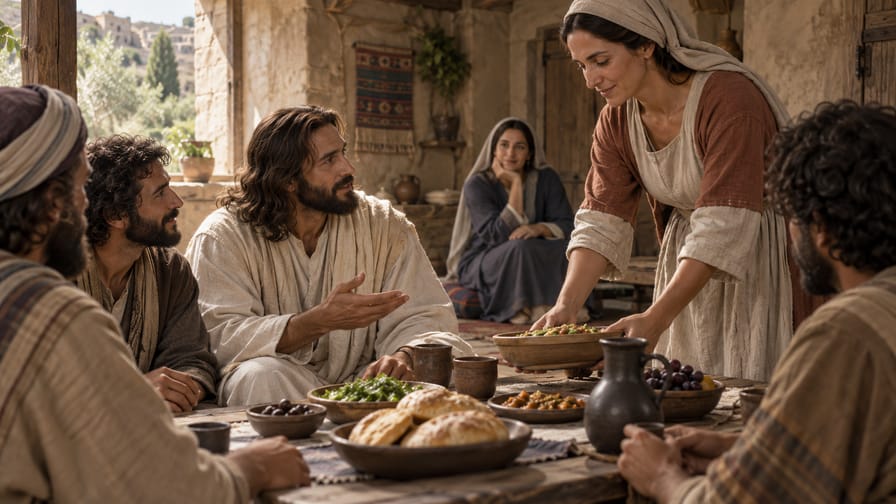
The figure of Martha, sister of Mary and Lazarus of Bethany, emerges in the Gospel narratives as one of the most vivid and theologically rich female characters in the New Testament. She is presented in crucial contexts of Jesus' life and ministry, offering valuable insights into discipleship, faith, service, and the nature of the resurrection. Her story, though brief, is profoundly instructive and has been the subject of extensive theological reflection throughout the centuries.
From a Protestant evangelical perspective, the analysis of Martha emphasizes the biblical authority, historical accuracy, and Christocentric relevance of her interactions with Jesus. She is not merely an incidental character, but a complex and multifaceted example of faith and struggle, whose experiences resonate with the challenges and hopes of believers of all ages. Her life illustrates fundamental principles of Christian living, from hospitality to the confession of faith in the midst of pain.
1. Etymology and meaning of the name
The name Martha derives from the Aramaic Mārĕṯā’ (מָרְתָא), which is the feminine form of māre’ (מָרֵא), meaning "lord" or "master." Thus, Mārĕṯā’ literally means "lady," "mistress of the house," or "patroness." This name is transliterated into Greek as Mártha (Μάρθα), and it is in this form that it appears in the Gospels of the New Testament. The etymology suggests a person of authority or responsibility within her domestic environment.
The etymological root of Martha's name, with its meaning of "lady" or "mistress," seems to reflect the personality and role she plays in the biblical narratives. She is consistently portrayed as the hostess of the house in Bethany, the person who takes responsibility for organization and service. This literal meaning of the name, therefore, harmonizes perfectly with her character and actions as described in the Scriptures.
There are no other notable biblical characters with the same name, which makes Martha a singular figure in the Scriptures. The absence of significant variations of the name in biblical languages reinforces the clarity of her identity. The name, by itself, already points to a woman with a sense of duty and leadership in the family context, characteristics that are fully developed in the Gospel passages that present her.
The theological significance of Martha's name lies in how it foreshadows her function and her struggle. Being the "mistress" of the house, she finds herself responsible for hospitality, which leads her to the initial conflict with Jesus and Mary in Luke 10:38-42. This sense of responsibility, though commendable, also becomes a source of distraction and anxiety, revealing the tension between practical service and spiritual devotion.
In a broader sense, Martha's name can symbolize the dignity and vital role of women in service and household administration, a theme valued in Protestant evangelical theology. However, her story also serves as a reminder that even the most dedicated "mistress" must learn to prioritize the "one thing necessary," which is the Word of God and communion with the Lord Jesus Christ.
2. Historical context and biblical narrative
Martha's life unfolds in the early 1st century A.D., during the period of intense public ministry of Jesus Christ in Judea. This was a time of great religious and political ferment, with the region of Judea under the dominion of the Roman Empire, yet with a strong Jewish identity and latent messianic expectations. The social context was patriarchal, but women, like Martha, played crucial roles in domestic and community life.
Martha lived in Bethany, a small village located about three kilometers east of Jerusalem, on the eastern side of the Mount of Olives. This proximity to the Jewish capital was significant, as Bethany often served as a refuge for Jesus and his disciples during their visits to Jerusalem, especially during Passover week. Martha's family — composed of her, her sister Mary, and her brother Lazarus — was evidently an intimate friend of Jesus, offering him hospitality and a place of rest.
The main biblical passages narrating Martha's life are found in the Gospels of Luke and John. Martha's first appearance occurs in Luke 10:38-42, where she receives Jesus into her home. The narrative describes Martha busy with many tasks, while her sister Mary sits at Jesus' feet to listen to his teachings. Martha, troubled, asks Jesus to rebuke Mary, but Jesus gently warns her about her anxiety and the priority of the Word.
Martha's second and more extensive appearance is in John 11:1-44, in the dramatic episode of the resurrection of her brother Lazarus. Here, Martha is portrayed in deep sorrow over Lazarus's death, but also demonstrates remarkable faith upon encountering Jesus. She expresses her belief in Jesus' power to heal and, later, makes a profound Christological confession: "Yes, Lord, I believe that you are the Christ, the Son of God, who is to come into the world" (John 11:27).
Finally, Martha is mentioned again in John 12:1-2, where she served at a supper in Bethany six days before Passover, at which Lazarus was also present and Mary anointed Jesus' feet. This last mention solidifies her image as the dedicated hostess and servant, remaining faithful to her calling of hospitality, but now with a perspective likely matured by previous lessons and the experience of her brother's resurrection.
Martha's relationship with Jesus was one of deep friendship and trust. He loved her (John 11:5), and she, in turn, trusted him as the Messiah. Her house in Bethany was not just a stopping point, but a refuge for Jesus, a place where he could find rest and companionship. This intimate relationship is fundamental to understanding the depth of their interactions and the relevance of her contributions to the Gospel.
3. Character and role in the biblical narrative
Martha's character is multifaceted and complex, revealed through her actions and dialogues with Jesus. She is primarily presented as a practical, hardworking woman zealous in her hospitality. In Luke 10:40, we read that she was "distracted with much serving," which underscores her desire to serve well and her dedication to household tasks. This virtue of hospitality was highly valued in the Jewish culture of the time.
However, this virtue also revealed a weakness: her tendency towards anxiety and excessive worry about earthly matters. Jesus' gentle rebuke in Luke 10:41-42, "Martha, Martha, you are anxious and troubled about many things, but one thing is necessary...", exposes her difficulty in prioritizing the spiritual over the material. This flaw, however, does not diminish her love for Jesus, but highlights an area of growth in her faith.
In John 11, Martha's character deepens and reveals remarkable faith. Upon encountering Jesus after Lazarus's death, she expresses a mixture of grief and belief: "Lord, if you had been here, my brother would not have died" (John 11:21). This statement, though laden with lament, also implies a strong conviction in Jesus' power. She believed that Jesus had the power to prevent death, and this conviction serves as the basis for the subsequent dialogue.
Martha's confession of faith in John 11:27 is one of the high points of her character development. Faced with Jesus' question, "Do you believe this?", she replies: "Yes, Lord, I believe that you are the Christ, the Son of God, who is to come into the world". This is a Christological confession as profound and explicit as Peter's in Matthew 16:16, revealing a clear understanding of Jesus' messianic and divine identity, even amidst her pain.
Martha's role in the biblical narrative is multifaceted: she is the dedicated hostess, the loving sister, and the disciple in the process of maturing. She represents the tension between active service and contemplative worship, a central theme for Christian discipleship. Her story shows us that faith is not static, but develops through experiences of joy, pain, questioning, and divine revelation. She is an example of how the Lord refines the faith of his followers.
Martha's significant actions include her hospitality to Jesus, her boldness in questioning Jesus about his priority and her pain, and her profound confession of faith. Each of these actions contributes to the revelation of Jesus' character and to the understanding of the principles of the Kingdom of God. The development of her character is notable, moving from an anxious and overwhelmed woman to one who, though still practical, manifests a robust faith in the resurrected Christ.
4. Theological significance and typology
Martha's theological significance is vast and multifaceted, serving as a focal point for various Christian doctrines and teachings. Her story is not just a biographical anecdote, but an integral part of the progressive revelation of the person and work of Jesus Christ. She plays a crucial role in redemptive history by illustrating principles of discipleship, the nature of faith, and the promise of resurrection.
In Luke 10:38-42, Martha's interaction with Jesus and Mary establishes a fundamental theological distinction between active service (diakonia) and listening to the Word (logos). Jesus does not condemn Martha's service, but her anxiety and lack of priority regarding the "better part" chosen by Mary. This passage teaches that, although service is essential, devotion and spiritual nourishment through the Word of God must have primacy, being the basis for all effective and joyful service.
The narrative of John 11 is perhaps the most theologically rich in relation to Martha. It serves as the catalyst for one of Jesus' most profound revelations about Himself: "I am the resurrection and the life whoever believes in me, though he die, yet shall he live and everyone who lives and believes in me shall never die" (John 11:25-26). Martha's confession in John 11:27, "Yes, Lord, I believe that you are the Christ, the Son of God, who is to come into the world", is a pillar of New Testament Christology, demonstrating that faith in the Messiah is the key to eternal life.
Although Martha is not a "type" in the strict sense of prefiguring Christ, her story typifies the believer's journey of faith. She represents humanity struggling with pain, doubt, and the distractions of life, but who, upon confronting Jesus and His Word, is led to a salvific confession. Her experience with the resurrection of Lazarus is a powerful testimony to Christ's victory over death, anticipating His own resurrection and the future hope of believers.
Martha's story connects directly with central theological themes such as salvation by faith, the importance of obedience to the Word of God, and divine grace that operates even in our weaknesses. It reminds us that true devotion is manifested not only in works, but primarily in submission to Jesus' authority and teachings. The resurrection of Lazarus, mediated by Jesus, is a prophetic fulfillment of the promise of eternal life for those who believe in Him, as taught by Jesus Himself.
In summary, Martha is an example of faith that is tested and strengthened. Her story is a living teaching about the priority of the Kingdom, the centrality of the Word of God, and Jesus' sovereignty over death and time. She invites us to examine our own priorities and to renew our confession of faith in Him as the Christ, the Son of God.
5. Biblical-theological legacy and canonical references
The figure of Martha, though mentioned in only three passages of the Gospels (Luke 10:38-42, John 11:1-44, and John 12:1-2), left a significant biblical-theological legacy that resonates deeply in Christian tradition. Her absence in other biblical books outside the Synoptic and Johannine Gospels does not diminish her importance, for her interactions with Jesus are instructive and paradigmatic for the life of faith.
Martha is not the author of any biblical book nor is she the subject of specific prophecies in the Old Testament. Nevertheless, her life and faith contribute to biblical theology in an indirect, yet powerful, way. She is a practical example of discipleship, illustrating the tension between service and devotion, and the primacy of the Word of God. Her story serves as a vivid commentary on Jesus' teachings about the priorities of the Kingdom.
In Christian interpretive tradition, especially from the Church Fathers, Martha and Mary frequently symbolize the two aspects of Christian life: the active life (vita activa) and the contemplative life (vita contemplativa). Augustine and Gregory the Great, among others, explored this dichotomy, while warning against the idea that one was inherently superior to the other, but rather that both are necessary and should be balanced, with contemplation being the "better part" that nourishes action.
Reformed and evangelical theology, in particular, has emphasized the importance of the passage from Luke 10 for the doctrine of the primacy of the Word of God (sola Scriptura) and the centrality of Christ. Mary's choice to sit at Jesus' feet to hear His Word is seen as a model for the church, where the preaching and hearing of Scripture should be the central point of worship and Christian life, grounding all service and action.
Furthermore, Martha's confession in John 11:27 is celebrated as a powerful testimony to Jesus' divinity and messiahship. She is an example of saving faith that recognizes Jesus as the Christ, the Son of God, and the Resurrection and the Life. This confession is a pillar of evangelical soteriology, which emphasizes personal faith in Christ as the only means of salvation and eternal life.
Martha's importance for understanding the canon lies in her contribution to the revelation of Jesus' person and the principles of His Kingdom. Her stories in the Gospels are not mere accounts of events, but windows into the nature of God, humanity, and the dynamics of faith. She reminds us that discipleship is a journey of learning, growth, and, at times, loving rebuke from the Master.
In retrospect, Martha remains an icon of the woman of faith who, though imperfect and subject to anxieties, demonstrates a genuine love for Jesus and a profound belief in His identity and power. Her legacy encourages believers to balance diligent service with sincere devotion to the Word, and to uphold an unwavering confession of Jesus as the Messiah and the Lord of life and death.