


Fortunatus
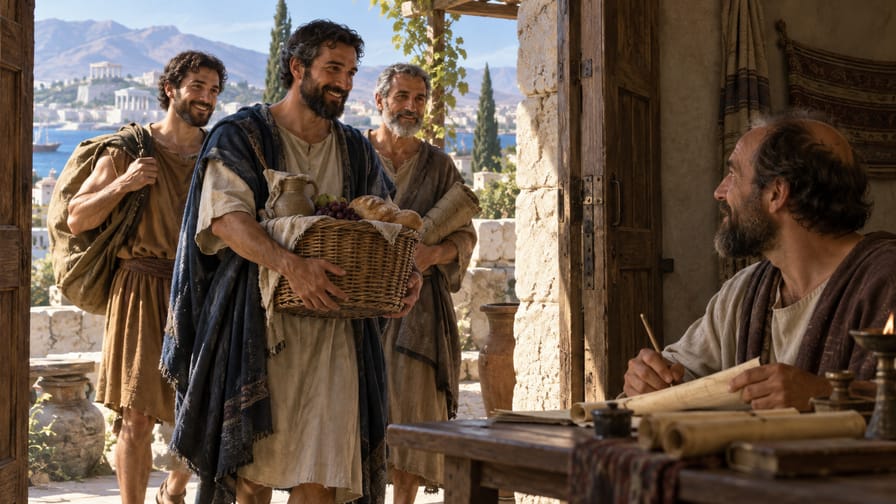
The figure of Fortunatus, though briefly mentioned in the Scriptures, offers a rich opportunity for theological reflection on service, fellowship, and the dynamics of the early church. His singular appearance in 1 Corinthians 16:17-18, alongside Stephanas and Achaicus, positions him as a valuable member of the Christian community in Corinth, highlighting the importance of each individual in the body of Christ.
This analysis will seek to explore the onomastic meaning of Fortunatus, his historical context, and the role he played, however concise it may have been, in the life of Paul and the church. We will address his inferred character, the theological significance of his contribution, and the legacy that, even in its brevity, he left for the understanding of evangelical ecclesiology.
The conservative evangelical Protestant perspective will guide this analysis, emphasizing biblical authority, exegetical precision, and Christocentric relevance. We will see how even the most secondary characters in Scripture can illustrate eternal principles of the Christian faith and community life.
1. Etymology and meaning of the name
The name Fortunatus derives from the Latin Fortunatus, which, in turn, is the Greek transliteration of Φορτουνάτος (Phortounatos). The etymological root lies in the Latin word fortuna, which means "luck," "fate," or "good fortune." The name, therefore, carries the sense of "fortunate," "blessed," or "prosperous."
There is no record of an equivalent name in Hebrew or Aramaic for this character, indicating his probable gentile origin or his adoption of a common Roman name at the time. The presence of Latin names among first-century gentile Christians was to be expected, given the influence of the Roman Empire.
The literal significance of the name, "fortunate," can be viewed from a secular perspective. However, in the context of the Christian faith, "fortune" or "blessing" is attributed to divine providence and grace, not to chance. Thus, a believer named Fortunatus could be interpreted as someone blessed by God or who brings blessings.
There are no other biblical characters explicitly named Fortunatus in the canonical Scriptures, making him unique in his mention. This gives his brief appearance a particularity that, while not elevating him to a central role, highlights his individuality in the Pauline narrative.
Theologically, the name "fortunate" can be seen as a metaphor for the condition of the believer in Christ. In Jesus, the believer is truly blessed with every spiritual blessing (Ephesians 1:3), regardless of their material or social situation. True "fortune" resides in salvation and fellowship with God.
Divine providence, a central theme in Reformed and evangelical theology, can be subtly reflected in the name. God orchestrates the events and lives of His servants, and the "good fortune" of Fortunatus can be understood as the hand of God guiding his service and making him an instrument of blessing for Paul and the church in Corinth.
2. Historical context and biblical narrative
Fortunatus is mentioned during a crucial period in the history of the early church, during the apostle Paul's third missionary journey, around 55-56 AD. Paul was in Ephesus, the capital of the Roman province of Asia, when he wrote his first epistle to the church in Corinth, Achaia.
The political and social context was that of the Roman Empire, which provided a certain stability and communication routes that facilitated the spread of the gospel. However, the religious environment in Corinth was complex, marked by syncretism, immorality, and Greek philosophies that challenged Christian doctrinal purity.
The church in Corinth faced serious problems: internal divisions (1 Corinthians 1:10-12), moral issues (1 Corinthians 5:1), disputes over spiritual gifts (1 Corinthians 12-14), and doubts about the resurrection (1 Corinthians 15:12). Paul writes to correct, instruct, and encourage this turbulent community.
The genealogy of Fortunatus is not recorded in the Scriptures, which is common for most secondary characters. However, his association with Stephanas (mentioned as the first converts of Achaia in 1 Corinthians 16:15 and baptized by Paul in 1 Corinthians 1:16) suggests that he was one of the first converts in the region or a prominent member of the Corinthian church.
The main and only appearance of Fortunatus in the biblical narrative occurs in 1 Corinthians 16:17-18: "I rejoice at the coming of Stephanas, Fortunatus, and Achaicus for what was lacking on your part they supplied. For they refreshed my spirit and yours. Therefore acknowledge such men."
These verses indicate that Fortunatus, Stephanas, and Achaicus traveled from Corinth to Ephesus to meet with Paul. It is probable that they carried a letter from the church in Corinth to Paul (mentioned in 1 Corinthians 7:1) and also news about the community's situation, which informed the content of Paul's epistle.
The geography, therefore, connects Corinth (Greece), where Fortunatus resided, to Ephesus (in modern-day Turkey), where Paul was. This journey of about 500 km, made by sea, demonstrates the dedication and commitment of these brethren to the church and to the apostle.
Fortunatus's relationship with other characters is primarily with Paul, Stephanas, and Achaicus. His presence alongside Stephanas, who was a recognized leader of the Corinthian church (1 Corinthians 16:15), suggests that Fortunatus was also a respected and reliable member of the community, perhaps one of the leaders or a dedicated servant.
3. Character and role in the biblical narrative
Although the Scriptures do not provide a detailed description of Fortunatus's character, Paul's words in 1 Corinthians 16:17-18 allow us to infer some of his qualities. Paul states that he and his companions "refreshed" (from the Greek anapsychein, ἀναψύχειν, which means "to cool," "to invigorate") the spirit of the apostle and that of the Corinthians.
This statement suggests that Fortunatus possessed virtues such as faithfulness, diligence, and a spirit of service. The willingness to travel a considerable distance to meet with Paul, in a time of difficult and dangerous communication, demonstrates courage and a profound commitment to the cause of the gospel and the church.
The ability to "refresh" Paul's spirit implies that Fortunatus and his companions brought encouraging news, comfort, and perhaps resources or practical assistance. This speaks of a character sensitive to the needs of others and capable of offering spiritual and emotional support. They supplied "what was lacking" on the part of the Corinthians (1 Corinthians 16:17), indicating that they met some deficiency in communication or support.
There is no mention of documented sins, weaknesses, or moral failures for Fortunatus, a silence that, for a character so briefly mentioned, is consistent. The absence of criticism from Paul suggests that his conduct was exemplary and worthy of praise, contrasting with many of the problems the apostle addressed in the Corinthian church.
Fortunatus's role in the biblical narrative is that of an envoy, a messenger, and a minister of the church. He acted as a vital link of communication between the church in Corinth and its founding apostle, facilitating the flow of information and pastoral care. His service was essential for the cohesion and guidance of the Christian community.
Although not explicitly called a "deacon" or "elder," his actions demonstrate a service that aligns with the diaconal function of care and assistance. He and his companions acted as "fellow workers" (synergoi, συνεργοί) in Paul's ministry, contributing to the well-being and edification of the church (cf. Philippians 4:3).
Fortunatus's significant actions include the journey to Ephesus and the ability to bring "refreshment" to Paul. This personal interaction was crucial for Paul to have an updated understanding of the situation in Corinth, allowing him to respond with divine wisdom in the epistle. He was an instrument of God for apostolic communication.
There is no character development throughout the narrative, given that his mention is unique. However, his brief appearance serves as a reminder of the importance of the anonymous or less prominent members of the church, whose faithful and often discreet service is fundamental to the advancement of the Kingdom of God.
4. Theological significance and typology
The figure of Fortunatus, though not a central character in the history of redemption, plays a significant role in the progressive revelation of New Testament ecclesiology. He illustrates the importance of fellowship, mutual service, and the interconnectedness between churches and their apostolic leaders in the formation of the early church.
There is no direct Christocentric prefiguration or typology associated with Fortunatus, as occurs with Old Testament figures. However, his service of "refreshment" and "supply" of needs can be seen as a reflection of Christ's ministry, who came to serve and give his life (Mark 10:45) and who offers refreshment to weary souls (Matthew 11:28).
The dedication of Fortunatus and his companions to the church in Corinth and to Paul points to the ideal of love and service that Christ taught. They exemplify obedience to the command to love one another (John 13:34-35) and to serve one another with the gifts received (1 Peter 4:10).
His brief mention in the New Testament is not a citation of a prophecy, but a historical evidence of the life of the church. It reinforces the authenticity of the Pauline epistles, showing that Paul was engaged in real relationships and responding to concrete situations in the communities he founded.
Fortunatus's connection with central theological themes is notable. He illustrates the doctrine of mutuality in the church, where members edify and serve one another. His journey and service are a testament to practical faith, obedience to apostolic exhortation, and the grace of God that empowers believers for ministry.
Paul's gratitude for Fortunatus and his companions (1 Corinthians 16:18) underscores the importance of recognizing and valuing service in the church. This reflects the biblical principle that "the laborer is worthy of his wages" (1 Timothy 5:18) and that those who serve faithfully should be honored.
Fortunatus's life, even in a glimpse, teaches about the theology of the body of Christ (1 Corinthians 12:12-27), where each member, regardless of their prominence, has a vital role. His service contributed to the unity and health of the Corinthian church, which was so in need of refreshment and apostolic guidance.
In summary, Fortunatus, through his faithful service, represents the truth that God uses ordinary people in seemingly small acts of obedience to accomplish great purposes in His church. He points to the importance of cooperation and mutual encouragement in the Christian life, reflecting the nature of Christ as the servant par excellence.
5. Biblical-theological legacy and canonical references
The mention of Fortunatus in 1 Corinthians 16:17-18 is the only canonical reference to him. There are no other mentions in biblical books, nor is he credited with any literary contributions, such as the authorship of Psalms, epistles, or other texts. His importance therefore lies in what his brief appearance reveals about the early church and Pauline ministry.
His influence on biblical theology, both of the New Testament and indirectly of the Old, lies in the exemplification of principles. He and his companions are a model of "those who cooperate with us" (1 Corinthians 16:16), demonstrating that the apostolic ministry was not a solitary undertaking, but a collaborative effort of many faithful servants.
In the Christian interpretive tradition, Fortunatus and his colleagues are often cited as examples of dedicated laypeople who supported the apostolic ministry. Commentators such as John Chrysostom and Augustine, though not dwelling extensively on his figure, recognized the importance of his service to the cohesion of the church.
In Reformed and evangelical theology, Fortunatus is often invoked to illustrate the dignity and necessity of lay ministry and voluntary service in the church. He represents the truth that the church is a body where all members are important and called to serve, not just the clergy or formally designated leaders.
Theologians like John Calvin, in their commentaries on 1 Corinthians, noted the importance of reciprocity and mutual support among believers and their leaders. Actions like those of Fortunatus were vital for the health of the church and the effectiveness of apostolic ministry, which depended on information and practical support.
Matthew Henry, in his Biblical Commentary, highlights that the "refreshment" that Fortunatus and his companions brought to Paul was both spiritual and moral, alleviating his concerns and strengthening his faith. This underscores the importance of fellowship and mutual encouragement as essential elements of church life.
The story of Fortunatus, though small, is a reminder of the historical authenticity of the Bible. He is not a mythical character, but a real individual who lived and served in the early church. His inclusion in the canon, even if brief, validates Paul's narrative and the reality of the personal interactions that shaped first-century Christianity.
In a broader sense, Fortunatus's importance for understanding the canon lies in his contribution to the complete image of the body of Christ. He reminds us that the history of salvation is not just about the great heroes of faith, but also about the faithful and often anonymous servants who, with their lives of dedication, build up the kingdom of God.
His legacy, therefore, is a testament to the truth that every believer is a minister, called to use their gifts and their life for the service of God and their neighbor, bringing "refreshment" and "supply" to the needs of the body of Christ, for the glory of God the Father.