


Damaris
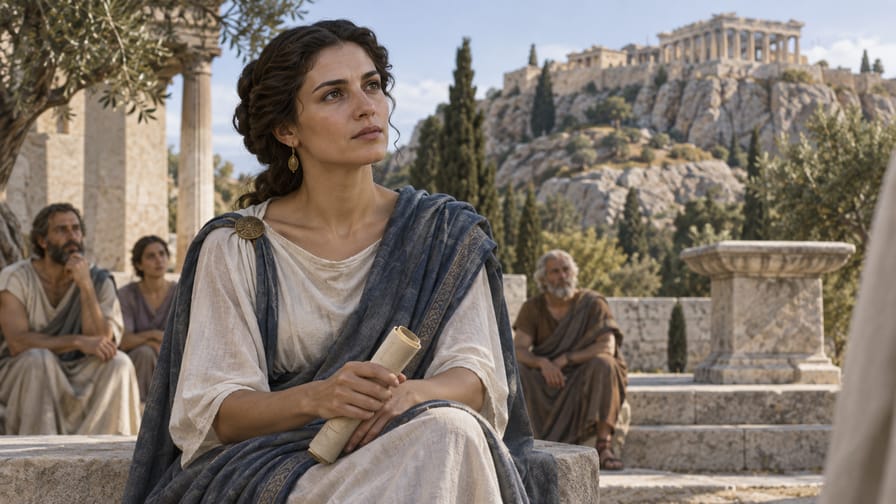
The figure of Damaris, though briefly mentioned in the Scriptures, carries a notable significance within the New Testament narrative, specifically in the context of the expansion of the Gospel among the Gentiles. Her singular appearance in Acts 17:34 positions her as one of the few named converts in Athens, a city of great intellectual and philosophical prominence. An analysis of Damaris, from a Protestant evangelical perspective, reveals not only the inclusion of women in the early church but also the sovereignty of God in election and the transformative power of the preached Word, even in the most skeptical environments.
This in-depth study aims to explore the onomastic meaning of Damaris, her historical and narrative context, inferences about her character and role, her theological relevance, and the legacy that, despite being concise, resonates through the centuries. The brevity of her mention does not diminish her importance, but rather elevates her as an example of divine grace operating in individual lives, contributing to the understanding of the universality and efficacy of the Christian message.
1. Etymology and meaning of the name
The name Damaris (in Greek: Δάμαρις) appears exclusively in Acts 17:34. Its etymological origin is Greek, and although there is no absolute consensus among linguists, the most accepted interpretations point to meanings that may have symbolic resonance with her conversion.
One of the most prominent derivations connects Δάμαρις to the Greek word δάμαρ (damar), which means "young wife" or "heifer." If interpreted as "young wife," the name could, subtly, allude to her new condition as part of the "bride of Christ," the Church, through faith in the Gospel. The image of the heifer, in turn, can evoke ideas of purity, sacrifice, or new life, although this connection is less direct and more speculative in the biblical context.
Another possible etymological root, though less defended for the name itself, is the Greek verb δαμάζω (damazo), meaning "to tame," "to subdue," or "to conquer." In this sense, the name Damaris could be interpreted as "the tamed" or "the subdued." This interpretation gains an interesting theological significance in light of her conversion in Athens, suggesting that she was "subdued" or "conquered" by the truth of the Gospel and by the Holy Spirit, in an environment of strong intellectual and philosophical resistance. The human heart, rebellious by nature, is "tamed" by the grace of God, according to Romans 6:17 and Ephesians 2:1-5.
It is important to note that there are no significant variations of the name Damaris in biblical languages, nor other characters with the same name in the canonical Bible. This makes her mention even more singular and highlights her as a specific individual whose belief was worthy of record by the author of Acts, Luke. The specificity of the name underlines the individuality of the response to Paul's preaching.
The theological significance of the name, if connected to "tamed" or "conquered," emphasizes divine sovereignty in salvation. No one can come to Christ unless the Father draws him (John 6:44). The conversion of Damaris, therefore, illustrates the work of the Holy Spirit who softens hearts hardened by philosophy and idolatry, making them receptive to the truth of the Gospel. If the interpretation is "young wife," she becomes a symbol of the Church, the bride of Christ, called to communion with Him (Revelation 19:7-9).
2. Historical and biblical narrative context
The appearance of Damaris is inserted into the context of the apostle Paul's second missionary journey, recorded in Acts 17, approximately between 50 and 52 A.D. After preaching in Thessalonica and Berea, Paul was brought to Athens, the intellectual and cultural capital of the ancient Greek world.
The Athenian scene was dominated by a rich philosophical tradition, with schools such as the Epicureans and Stoics, who frequently debated in the Areopagus (or Mars Hill), the city's main court and a place of intense public discussion. The city was also notorious for its idolatry, with numerous temples, altars, and statues dedicated to various gods, to the point where Paul observed that the Athenians were "very religious" (Acts 17:22), but in the sense of being superstitious and idolatrous.
Paul, disturbed by the widespread idolatry (Acts 17:16), began to debate in the synagogue with the Jews and in the marketplace with whoever was present. His message about Jesus and the resurrection, considered "foreign gods" by the philosophers (Acts 17:18), led him to be brought to the Areopagus to present his doctrine more formally.
In the Areopagus, Paul delivered one of his most famous sermons, beginning with the altar to the "Unknown God" as a point of cultural contact. He presented the Creator God, sustainer of all things, who does not dwell in temples made by human hands and who does not need to be served by human hands. He challenged human wisdom and idolatry, calling all to repentance, for God had determined a day in which He would judge the world with justice through a man whom He raised from the dead (Acts 17:22-31).
The reaction to Paul's preaching was mixed. Some scoffed, others said they would hear him again, but "some men, however, joined him and believed" (Acts 17:32-34). It is in this crucial verse, Acts 17:34, that Damaris is named, along with Dionysius, the Areopagite. The explicit mention of her name, alongside a member of the prestigious Areopagus council, suggests that she was a figure of some prominence or that her conversion was particularly notable.
There is no biblical information about the genealogy or family origin of Damaris. Her identity is defined solely by her response of faith to the Gospel. The geography is clearly Athens, specifically the Areopagus, the place where Paul's message was delivered and where she made her decision. Her direct biblical relationships are with Paul, the preacher of the Gospel, and with Dionysius, the Areopagite, who also converted and is often associated with her in Christian tradition, although the Bible does not specify the nature of this relationship.
3. Character and role in the biblical narrative
The brevity of Damaris's mention in Acts 17:34 means that her character and role must be inferred primarily from her context and the nature of her decision. Although the Scriptures do not provide extensive biographical details, the simple inclusion of her name in the inspired record suggests remarkable spiritual qualities and a significant, albeit symbolic, role in the narrative of the early church.
One of Damaris's most evident qualities is her receptivity to truth. In an intellectually hostile environment to the Gospel, where many scoffed or hesitated, she heard Paul's message about Jesus and the resurrection and chose to believe. This receptivity contrasts sharply with the prevailing unbelief in Athens and highlights a mind and heart open to divine revelation, according to John 3:19-21.
Her decision also demonstrates courage and discernment. Athenian society, though intellectually advanced, was conservative in its religious and philosophical traditions. Adhering to a new faith, especially one that preached a crucified and resurrected Messiah, was an act that required considerable social and intellectual courage. Her discernment allowed her to separate the truth of the Gospel from the philosophical speculations and idolatry that surrounded her (1 Corinthians 2:14).
There are no documented sins, weaknesses, or moral failures for Damaris in the Scriptures, which is common for characters with such concise mentions. Her primary role is that of a new convert, an example of the power of the Holy Spirit in persuading and regenerating hearts. She represents the "seed that fell on good ground" (Matthew 13:23), bearing fruit of faith in arid soil.
The inclusion of her name, alongside Dionysius, the Areopagite, is particularly significant. Dionysius was a member of Athens' most respected council, indicating his high social and intellectual standing. The mention of Damaris suggests that she may also have been a woman of some social prominence in Athens, or at least a person whose conversion was deemed noteworthy by Luke. Her conversion demonstrates that the Gospel transcends social and gender barriers, reaching both prominent men and women (Galatians 3:28).
Damaris's role in the biblical narrative is, therefore, that of a silent, yet powerful witness to the efficacy of the Gospel. Her most significant action was simply to believe. This decision positions her as part of the foundation of the church in Athens, a testimony that the Word of God does not return void (Isaiah 55:11), even when confronted with philosophical skepticism and ingrained idolatry. She is an example of the individual faith that constitutes the Church of Christ.
The development of Damaris's character is not detailed in the Scriptures, but her conversion marks the beginning of a new life in Christ. From then on, she would be a disciple, learning and growing in faith, and possibly participating in the life of the Christian community that would form in Athens, following the pattern established in Acts 2:42.
4. Theological significance and typology
The figure of Damaris, while not a direct type of Christ in the prophetic sense, possesses a profound theological significance that aligns with the principles of Protestant evangelical theology. Her conversion in Athens illustrates several fundamental truths of the Christian faith and her role in redemptive history.
Firstly, Damaris serves as an example of the efficacy of the Gospel and the sovereignty of God in election. In a city where the majority rejected Paul's message, she, along with Dionysius and others, "joined him and believed" (Acts 17:34). This demonstrates that salvation does not depend on human persuasion or worldly wisdom, but on the power of God (1 Corinthians 1:21-25). Her faith is a testimony to the work of the Holy Spirit, who enlightens hearts and minds to receive the truth (John 16:8-11).
Her conversion also underscores the universality of divine grace and the inclusion of all people in the plan of salvation. As a woman in a patriarchal society and in a context of philosophical debate dominated by men, the mention of Damaris is significant. It demonstrates that the Gospel is for "everyone who believes" (Romans 1:16), without distinction of gender, social status, or intellect (Galatians 3:28). God calls His elect from all walks of life, fulfilling the Great Commission to reach all nations (Matthew 28:19-20).
The story of Damaris also reinforces the doctrine of the necessity of repentance and faith. Paul called the Athenians to repent (Acts 17:30), and Damaris's response was one of genuine faith. She represents those who, hearing the preaching of the Word, respond with a heartfelt submission to the truth of Christ. Her faith is not based on philosophical arguments, but on the conviction of Jesus' resurrection, the point of contention for most Athenians (Acts 17:32).
She is, therefore, a symbol of the power of Christ's resurrection as the foundation of Christian faith. Paul's central message in Athens culminated in the resurrection (Acts 17:31), and Damaris's belief in it is crucial. Jesus' resurrection is not just a historical event, but the guarantee of God's justice and the hope of eternal life (1 Corinthians 15:13-20).
Although there are no specific covenants, promises, or prophecies related to Damaris, her life fits into the fulfillment of God's promises to redeem a people for Himself from "every tribe and language and people and nation" (Revelation 5:9). She is living proof that progressive revelation culminated in Christ and that the Gospel would expand to the ends of the earth, reaching even the most improbable hearts in centers of human wisdom like Athens.
In summary, the theological significance of Damaris lies in her representation of God's saving grace, the individual response of faith, the inclusion of women in the community of faith, and the victory of the Gospel over worldly wisdom. She is a reminder that God chooses the humble and those who are willing to believe, regardless of their social or intellectual position, to manifest His glory (1 Corinthians 1:27-29).
5. Biblical-theological legacy and canonical references
Despite her sole mention in Acts 17:34, Damaris's legacy is significant for biblical theology and the understanding of the canon, especially from a Protestant evangelical perspective. Her presence, even if brief, validates crucial principles of faith and church history.
There are no mentions of Damaris in other biblical books, nor literary contributions attributed to her. Her importance does not lie in documented great works or deeds, but in her example of faith and obedience to the Gospel. She is a testimony to the truth that salvation is a personal and individual experience, and that every person who believes is valuable in God's eyes and worthy of record in the history of redemption.
In biblical theology, Damaris reinforces the doctrine of irresistible grace and sovereign election. Her conversion in Athens, an environment hostile to the Gospel, demonstrates that God has His elect everywhere and that His Word does not return void (Isaiah 55:11). She is an example of how the Holy Spirit works to convince and convert hearts, even those living amidst idolatry and secular philosophy. Her inclusion in the canon, even if minimal, serves as a reminder of God's faithfulness in calling a people for Himself.
Christian interpretive tradition, though non-canonical, has at times expanded the figure of Damaris. Some ancient writers, such as Eusebius of Caesarea in his Ecclesiastical History, and Pseudo-Dionysius, in their works, associate Damaris with Dionysius the Areopagite, speculating about their relationship (e.g., as wife or a prominent woman from the same family). However, it is crucial for the Protestant evangelical perspective to clearly distinguish between biblical revelation and extrabiblical tradition, maintaining the exclusive authority of the Scriptures.
In Reformed and evangelical theology, Damaris is often cited as an example of the inclusion of women in ministry and the community of faith. While her role is not one of formal leadership in the apostolic or presbyterial sense, her named mention among the first converts in Athens underscores the value and dignity of women in the Kingdom of God. She demonstrates that Christian faith breaks down social and cultural barriers that marginalized women, as expressed in Galatians 3:28: "There is neither Jew nor Gentile, neither slave nor free, nor is there male and female, for you are all one in Christ Jesus."
The importance of Damaris for understanding the canon lies in her function as a historical and theological checkpoint. Her existence confirms the veracity of the Acts narrative concerning Paul's missionary expansion and the formation of the first Christian communities. She represents the faithful "remnant" that God always preserves, even amidst opposition. Her short, but powerful, story serves to inspire believers to be receptive to God's Word and to demonstrate courage in their faith, regardless of the environment.
In summary, Damaris, the Athenian woman who believed, is a perennial reminder of the Gospel's power to transform lives, of the sovereignty of God's grace in calling His elect from all spheres of society, and of the full inclusion of men and women in the communion of the Church of Christ. Her legacy is the silent, yet eloquent, testimony of genuine faith that echoes through the centuries.