


Carpo
1. Etymology and Meaning of the Name
The name Carpo (in Greek, Κάρπος, Karpos) is of Greek origin and derives directly from the word καρπός, meaning "fruit," "harvest," or "product." This etymological root is widely used in the New Testament and in Greek literature to describe both the literal fruit of a plant and the result or effect of an action or condition.
In the biblical context, the word καρπός acquires a deep theological significance. It is frequently employed to denote the "fruit of the Spirit" (Galatians 5:22-23), which are the virtues produced in the life of the believer by the Holy Spirit, such as love, joy, peace, patience, kindness, goodness, faithfulness, gentleness, and self-control.
Furthermore, the term "fruit" is used to refer to the "fruit of righteousness" (Philippians 1:11 James 3:18), which are the good works and moral conduct that flow from genuine faith. Christ Himself taught that a tree is known by its fruit (Matthew 7:16-20), implying that the true nature of a person or movement is revealed by their actions and results.
There are no significant variations of the name Carpo in biblical languages, nor evidence of other prominent biblical figures with the same name. However, the intrinsic meaning of "fruit" can, symbolically, suggest a person who was productive in ministry or who demonstrated Christian virtues in their life, although the Scriptures do not provide direct details about the character of Carpo.
The theological significance of the name, therefore, lies in its connection with spiritual fruitfulness and productivity in service to God. Although we cannot affirm that **Carpo**'s name was prophetic of his character, it resonates with a central theme of evangelical Christian theology: the importance of a life that produces fruit for the glory of God, as exhorted by Jesus in John 15:8.
2. Historical Context and Biblical Narrative
The figure of Carpo is mentioned only once in the Holy Scriptures, in Paul's Second Epistle to Timothy (2 Timothy 4:13). This epistle was written by Paul during his second and final imprisonment in Rome, likely between 66 and 67 A.D., shortly before his martyrdom. The period is marked by intense persecution of Christians under Emperor Nero and by internal challenges in the nascent church.
The socio-political context of the time was one of great instability for Christians. The Roman Empire viewed Christianity as a threat to its order and its gods, resulting in severe persecutions. Within the church, there was a need to consolidate doctrine, combat heresies, and strengthen leadership, as evidenced by Paul's counsels to Timothy.
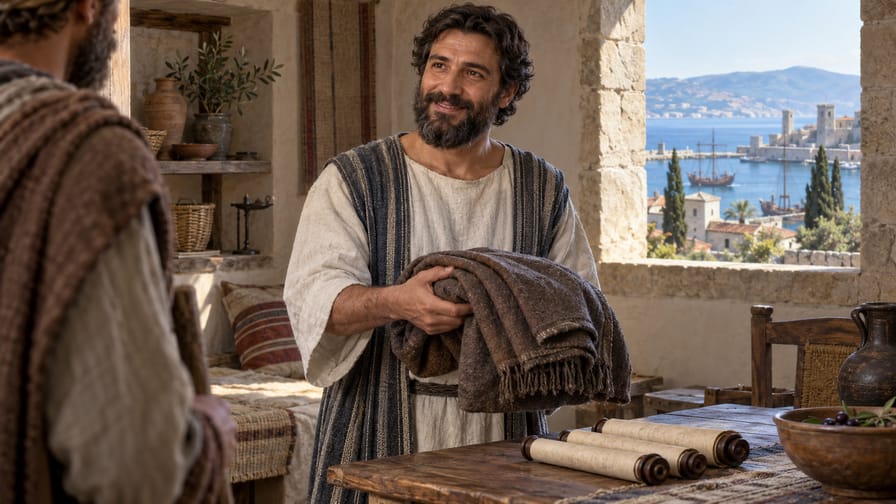
There is no information about **Carpo**'s genealogy or family origin in the Scriptures. His mention is brief, but significant: Paul asks Timothy to bring his cloak, books, and parchments that he left at **Carpo**'s house, in Troas. This single reference places us geographically and gives us a glimpse into Paul's relationships.
Troas (in Greek, Τρῳάς, Troas) was an important port city in the Roman province of Asia, located in the region of Mysia, on the northwestern coast of Asia Minor. It was a strategic point for sea and land travel, and Paul visited it on several occasions during his missionary journeys (Acts 16:8-11 Acts 20:5-6).
The mention of **Carpo** in 2 Timothy 4:13 suggests that he was a faithful and reliable believer, possibly a leader in the church at Troas or, at the very least, a hospitable individual of good repute. The fact that Paul entrusted him with his personal belongings and, more crucially, his "books" and "parchments" indicates a relationship of deep trust and friendship.
This relationship is a testament to the network of support and fellowship that existed among early Christians. Paul, even in prison and facing death, depended on this network for his practical needs and for the continuation of his ministry, which included the preservation and dissemination of teachings and scriptures.
2.1 The Importance of Troas in Paul's Ministry
Troas was not merely a transit port, but a place of spiritual significance for Paul. It was there that he had the vision of the "man of Macedonia" pleading for help, which prompted him to take the Gospel to Europe (Acts 16:9-10). Paul also spent seven days in Troas on his third missionary journey, preaching extensively and raising Eutychus (Acts 20:6-12).
The choice of **Carpo** as the guardian of Paul's belongings in Troas, a city where the apostle had a significant ministry history, reinforces the idea that **Carpo** was a respected figure integrated into the local Christian community. Paul's trust in him was, therefore, based on prior knowledge and his reputation for faithfulness.
Paul's request to Timothy to retrieve these items, especially the "books" and "parchments," reveals the urgency and importance the apostle ascribed to them in his final days. This practical request, made from a prison cell, highlights Paul's humanity and the mutual dependence among believers in the early church.
3. Character and Role in the Biblical Narrative
Although the Bible does not offer a detailed description of **Carpo**'s character, we can infer some notable qualities from the single mention made of him. The fact that Paul entrusted him with items of personal and ministerial value suggests that **Carpo** was a person of unquestionable **reliability** and **integrity**.
Hospitality is a prominent Christian virtue in the New Testament (Romans 12:13 Hebrews 13:2), and the mention of "**Carpo**'s house" as the place where Paul's belongings were left indicates that he likely practiced this virtue. He must have offered Paul shelter in Troas, and this hospitality extended to the safekeeping of his possessions.
Faithfulness is another implicit quality. Paul, at the end of his life and ministry, was concerned with the continuation of the Gospel. Entrusting **Carpo** with his "books" and "parchments" – which likely included copies of Old Testament Scriptures and perhaps drafts or copies of his own letters – demonstrates that **Carpo** was seen as a **faithful guardian** of valuable resources for ministry.
There is no record of documented sins, weaknesses, or moral failures for **Carpo**. His image in the Scriptures is that of an an exemplary believer in his supporting role. He represents the many "co-workers" of Paul who, though not prominent apostles or evangelists, were essential for the advancement of the Christian mission.
**Carpo**'s specific vocation or function is not explicitly stated. He may have been an influential member of the church in Troas, an elder, or simply an ordinary believer who had the means and willingness to host and assist the apostle. His role, however, was crucial as a link in the chain of support for the apostolic ministry.
**Carpo**'s significant actions, though indirect, were receiving and safeguarding Paul's belongings. This simple act of care and responsibility, mentioned in one of the apostle's last writings, highlights the importance of each individual in the body of Christ and the interdependence of its members (1 Corinthians 12:12-27).
Character development is not applicable to **Carpo**, given the brevity of his mention. Nevertheless, his presence in the epistle serves as a reminder of the value of every person who contributes, even discreetly, to the great work of God. His silent faithfulness is a model for all believers.
4. Theological Significance and Typology
The figure of Carpo, though of such a brief appearance, holds relevant theological significance within the evangelical Protestant perspective, especially concerning redemptive history and progressive revelation. He personifies the importance of the "small" and seemingly insignificant in the biblical narrative, those who faithfully serve behind the scenes.
There is no direct Christocentric typology associated with **Carpo**, in the sense that he explicitly prefigures Christ. However, his role as guardian and his presumed hospitality reflect principles taught by Christ: faithfulness in little (Luke 16:10), hospitality to strangers (Matthew 25:35), and humble service that is great in the eyes of God (Matthew 20:26-28).
**Carpo**'s theological relevance manifests primarily in his connection with central themes such as divine providence, the Christian community, and the preservation of the Scriptures. Paul's mention in 2 Timothy 4:13 is not a mere logistical detail, but a window into the operation of God's providence through ordinary people.
Paul's request for Timothy to bring the cloak, books, and parchments from **Carpo**'s house in Troas is one of theologically most rich points. The cloak (φελόνης, phelonēs) was a practical necessity for the harsh winter, humanizing Paul and reminding us of the physical conditions God's servants faced (2 Timothy 4:21).
However, the "books" (βιβλία, biblia) and "parchments" (μεμβράνας, membranas) are of extreme importance. Evangelical commentators such as John Stott and William Barclay suggest that the "books" were likely copies of Old Testament Scriptures, perhaps in the Septuagint, essential for Paul's study and teaching.
The "parchments," in turn, could have been personal notes, sermons, drafts of letters, or even legal documents related to his Roman citizenship. Paul's urgency in having them before winter and his impending death underscores the importance of these materials for the continuation of his theological legacy and for Timothy's ministry.
This episode, involving **Carpo** as the guardian of these materials, highlights the doctrine of the **divine preservation of the Word of God**. God used individuals like **Carpo** to protect and retain the writings that would become an integral part of the biblical canon or that would influence its formation. It is a testament to God's faithfulness in ensuring that His revelation reaches us.
**Carpo**'s life, though sparsely documented, serves as an example of the importance of **faithfulness** and **hospitality** in the Christian community. His willingness to care for Paul's belongings demonstrates practical love and a commitment to the apostolic ministry, reinforcing the theme of interdependence and mutual service among believers (Galatians 6:2 Ephesians 4:16).
He thus represents the support base of the early church – those who, without great visibility, contributed essentially to the expansion of the Gospel. The mention of **Carpo** reminds us that every believer has a vital role in God's redemptive plan, and that faithfulness in small things is highly valued by the Lord (Matthew 25:23).
5. Biblical-Theological Legacy and Canonical References
**Carpo**'s legacy in biblical theology is paradoxically profound, despite his single canonical mention in 2 Timothy 4:13. He is not the author of any biblical book, nor a central figure in prophetic or historical narratives. His importance lies in what his brief appearance reveals to us about the structure of the early church, the apostolic life, and the preservation of the Word of God.
**Carpo**'s most significant contribution, though indirect, is linked to the **preservation of the biblical canon**. The "books" and "parchments" he guarded were, as already mentioned, likely copies of Old Testament Scriptures and possibly original writings or copies of Paul's letters. Paul's request for these items to be brought to him in Rome underscores their importance to the apostle in his final days.
Evangelical theologians, such as D.A. Carson and Douglas Moo, emphasize that the transmission and preservation of biblical texts were processes that involved the faithfulness of many individuals. **Carpo** is an example of this chain of faithfulness. Without people like him, who cared for the apostles' study and writing materials, the process of compiling and canonizing the Scriptures would have been much more challenging.
In Reformed and evangelical theology, **Carpo** is often cited as an example of the "anonymous hero" of faith. He represents the truth that every service, no matter how small it may seem, is valuable and necessary in the Kingdom of God. His story serves to illustrate the doctrine of the universal vocation of believers, where each member of the body of Christ has an indispensable role (1 Peter 4:10-11).
Christian interpretive tradition, although it has not developed many extrabiblical narratives about **Carpo**, generally views him in a positive light, as a model of selfless service. He is remembered as one of many "saints" who, through acts of hospitality and faithfulness, supported the ministry of the apostles, ensuring the propagation and stability of the nascent church.
**Carpo**'s importance for understanding the canon lies not in a direct literary contribution, but in his role as a link in the transmission of apostolic and Old Testament literature. He reminds us that biblical authority is not merely a matter of divine inspiration, but also of a providence that worked through faithful people for its preservation and dissemination.
In summary, **Carpo**'s legacy is that of a figure who embodies the virtue of **practical faithfulness** and **Christian hospitality**. His life, though briefly sketched in the Scriptures, serves as a powerful reminder that the advancement of the Gospel depends not only on great preachers and apostles, but also on many ordinary believers who, in their discretion, serve God with integrity and love.
He teaches us that **faithfulness in small things**, like guarding an apostle's belongings, can have eternal implications, contributing to the preservation of documents that would shape the course of salvation history and the faith of millions. His mention in 2 Timothy, Paul's last letter, grants him a place of honor in the pantheon of the apostle's co-workers.