


Olympas
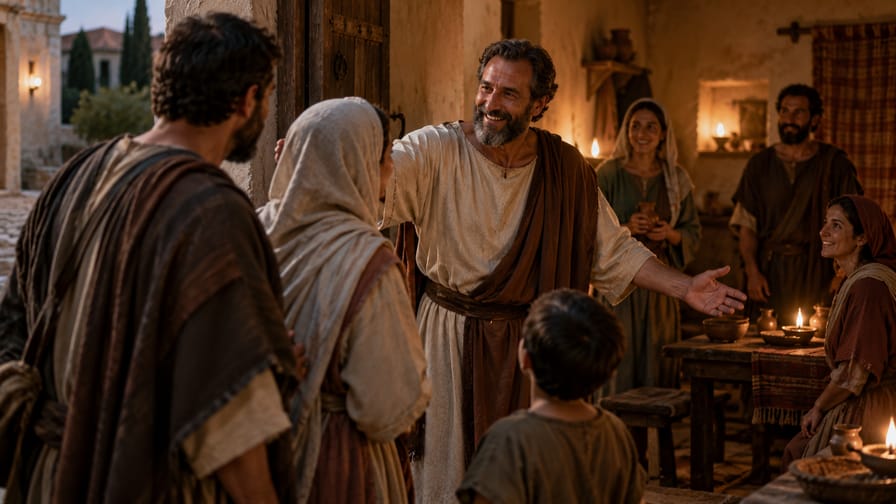
The figure of Olimpas, though briefly mentioned in the Scriptures, offers a rich opportunity for deep biblical and theological analysis. His singular appearance in Romans 16:15, at the end of Paul's epistle to the believers in Rome, places him in a context of great significance for understanding the early church and apostolic pastoral care.
This study aims to explore the etymology of the name Olimpas, the historical context in which he lived, the character inferred from his inclusion in the canon, his theological significance, and the legacy that, despite his apparent obscurity, contributes to evangelical Protestant theology.
The perspective adopted will be conservative evangelical Protestant, emphasizing the inerrant authority of the Scriptures, historical accuracy, and the Christ-centric relevance of all biblical revelation. The analysis will seek to extract valuable lessons even from seemingly minor details, recognizing that every inspired word has its divine purpose.
1. Etymology and Meaning of the Name
The name Olimpas (in Greek: Ὀλυμπᾶς, Olympias) is of Greek origin and does not have a direct equivalent or a Hebrew or Aramaic etymological root. This initial observation already suggests that Olimpas was likely a Gentile or a Hellenized Jew, reflecting the cultural diversity of the church in Rome in the first century.
The etymological root of Olympias is linked to Mount Olympus, the highest mountain in Greece and, in Greek mythology, the dwelling place of the Olympian gods. Consequently, the name means "celestial," "divine," or "from Olympus." It was a relatively common name in the Greco-Roman world of the time, for both men and women.
Although the literal meaning of the name does not have a direct connection with a personal characteristic of Olimpas in the biblical narrative, it fits into the panorama of the dominant culture of the time. His popularity among Gentiles reinforces the idea that the church in Rome was composed of a vibrant mixture of ethnicities and social backgrounds, as evidenced in Romans 1:16 and Romans 3:29-30.
There are no other biblical characters with the name Olimpas. His singularity in the canon, though in a brief mention, ensures that any analysis focuses exclusively on this figure mentioned by Paul. The absence of variations of the name in the original biblical languages also simplifies his identification.
From a theological point of view, the meaning of the name "celestial" or "divine" is intriguing, although there is no indication that Paul used it with symbolic intent. However, for the believer in Christ, true citizenship is heavenly (Philippians 3:20), and life is lived in union with Christ in the heavenly places (Ephesians 2:6). Thus, the name, by mere coincidence, resonates with a profound spiritual truth about the Christian's identity.
For the people of God, the name can, so to speak, indirectly point to the new reality in Christ, where the believer is called to a life that transcends the earthly and aligns with divine purposes. This is the true "heavenly" to which believers are called, according to Colossians 3:1-2.
2. Historical Context and Biblical Narrative
The mention of Olimpas occurs in the context of Paul's epistle to the Romans, written around A.D. 57-59, likely from Corinth, during his third missionary journey (Acts 20:2-3 Romans 15:25-26). This letter is one of the most important theological documents of the New Testament, outlining the doctrine of justification by faith and the sovereignty of God in salvation.
The Roman Empire, under Nero's rule, was a political and cultural power dominating the Mediterranean world. Rome, the capital, was a cosmopolitan metropolis, a melting pot of cultures, religions, and philosophies. Christianity had reached Rome before Paul's visit or the writing of his letter, likely through converted Jews who returned to the city after Pentecost (Acts 2:10).
The church in Rome was composed of both Jewish Christians and Gentile Christians, which generated tensions and pastoral challenges, addressed by Paul in his epistle (cf. Romans 14:1-15:7). The absence of a clear apostolic founder for the Roman church meant that it was an organically formed community, likely through various house churches scattered throughout the city.
The genealogy and family origin of Olimpas are not provided in the Scriptures. This is a common characteristic for many of the names listed in Romans 16. The lack of specific biographical details does not diminish his importance, but rather highlights it: he is one among many ordinary, yet valued, believers in the vast tapestry of the early church.
The only key biblical passage where Olimpas appears is Romans 16:15: "Greet Philologus, Julia, Nereus and his sister, and Olimpas, and all the saints who are with them." This greeting is part of an extensive list, which includes about 26 people, in addition to groups of believers and house churches.
The geography related to Olimpas is the city of Rome. He was part of the Christian community in that imperial metropolis. The mention of "all the saints who are with them" suggests that Olimpas was part of a particular group of believers, possibly a house church that met in his home or in the home of one of the other individuals mentioned in the same verse.
His relationships with other biblical characters are inferred only by his inclusion in the same list of greetings. He is greeted along with Philologus, Julia, Nereus, and Nereus's sister. This indicates that these individuals formed a circle of fellowship and service within the Roman church. The practice of greeting specific people shows Paul's network of relationships and the pastoral care he had for individuals, even those he had not yet personally met.
The inclusion of Olimpas in Paul's list of greetings is significant. It demonstrates the breadth of Paul's apostolic network and his knowledge or recognition of the believers in Rome, some of whom were likely known to him through third parties, such as Phoebe, the letter carrier (Romans 16:1-2), or Priscilla and Aquila (Romans 16:3-5), who had worked with Paul previously.
3. Character and Role in the Biblical Narrative
Given the extremely brief mention of Olimpas, the analysis of his character and role in the biblical narrative is, by necessity, inferential. Nevertheless, his inclusion in Paul's epistle allows us to draw significant conclusions about his identity and commitment as a believer in Christ.
Olimpas' primary virtue and spiritual quality is his status as a "saint" (hagios, ἅγιος). In the New Testament, this term does not refer to canonized individuals, but to all who are set apart by God and for God through faith in Jesus Christ (1 Corinthians 1:2 Ephesians 1:1). Being called a saint implies a life of faith, obedience, and dedication to the Lord.
There is no record of documented sins, weaknesses, or moral failures for Olimpas, which is expected for such a briefly mentioned character. The absence of such details is not a statement about his perfection, but about Scripture's focus on his identity as a member of the community of faith.
Olimpas' specific vocation, calling, or function is not explicitly stated. He is not described as an apostle, prophet, evangelist, pastor, or teacher. Nor is he identified as a deacon or deaconess. He appears to be an ordinary, though valued, believer in the Roman congregation, which highlights the importance of each member in the body of Christ, regardless of a formal "title."
His primary role, therefore, is that of a faithful member of the church in Rome. Paul's greeting to Olimpas and "all the saints who are with them" suggests that he was part of a fellowship cell, possibly a house church. Meeting in homes was the predominant form of Christian congregation in the first century (cf. Romans 16:5 Colossians 4:15 Philemon 1:2).
Olimpas' significant actions and key decisions are not recorded. His greatest "action" in the biblical narrative is, ironically, his very existence as a believer in Rome, known and greeted by Paul. This simple mention serves as a testimony to the expansion of the gospel and the formation of Christian communities throughout the Empire.
The development of Olimpas' character is not traceable, as he appears only once. Nevertheless, his inclusion in Paul's list is a testament to the depth of the Christian community. He represents the myriad of anonymous or little-known believers who formed the backbone of the early church, sustaining it with their faith, fellowship, and service.
The evangelical Protestant perspective deeply values the "priesthood of all believers" (1 Peter 2:9). Olimpas embodies this truth: he is not a prominent leader, but a believer whose value lies in his relationship with Christ and his participation in the community. His mention by Paul is a recognition of his importance before God and the church.
4. Theological Significance and Typology
The theological significance of Olimpas, though derived from a brief mention, is profound and multifaceted, especially from an evangelical Protestant perspective. He serves as a vivid reminder of several central truths of the Christian faith.
Firstly, Olimpas plays a role in redemptive history and progressive revelation by illustrating the universality of the gospel. His presence in Rome, a Gentile city, and his mention by Paul, the apostle to the Gentiles (Romans 11:13), demonstrate that salvation in Christ is not restricted to one ethnicity or nation, but extends to all people who believe (Galatians 3:28).
He is not a Christ-centric prefiguration or typology in the classical sense, as there are no events or characteristics in his life that directly point to Christ. However, his existence as a "saint" in Rome is a testament to the work of Christ that redeems and transforms individuals, integrating them into a new community, the Church, the body of Christ (Ephesians 4:15-16).
There are no covenants, promises, or prophecies directly related to Olimpas. His theological relevance lies more in his representation and the context in which he is mentioned. He is part of the fulfillment of Jesus' Great Commission (Matthew 28:19-20), demonstrating that the gospel was indeed reaching "all nations."
The only citation or reference to Olimpas is in Romans 16:15, in the New Testament. This mention, however, is rich in implications for central theological themes. The inclusion of his name by Paul underscores the importance of fellowship and pastoral care. Paul, even without having visited the church in Rome, demonstrates a deep knowledge of and concern for its individual members.
Olimpas is connected with theological themes such as salvation, faith, and obedience. His identity as a "saint" implies that he had received salvation through faith in Jesus Christ, which resulted in a life of sanctification and obedience. He is an example of God's grace in action, transforming ordinary lives into vessels for His purpose (Ephesians 2:8-10).
He symbolizes the truth that every believer, however anonymous in human history, is known and valued by God. His inclusion in the inspired Word of God underscores the intrinsic value of every member of the body of Christ (1 Corinthians 12:22-25). It is not only the leaders or those who perform great deeds who matter, but every faithful follower of Christ.
The mention of Olimpas also reinforces the doctrine of the church as a community of believers. The greeting to him and "all the saints who are with them" points to the reality of house churches and the importance of fellowship. The church is not a building, but a people gathered in the name of Christ, sharing their lives and their faith (Hebrews 10:24-25).
In summary, Olimpas, as one of the anonymous "saints," represents the vast multitude of believers who, through their faith and participation in the community, contribute to the building up of the Kingdom of God. He is a silent testimony to God's faithfulness in calling people from all walks of life to Himself.
5. Biblical-Theological Legacy and Canonical References
The biblical-theological legacy of Olimpas is paradoxically significant, given his sole and brief mention in the canon. He made no literary contributions, founded no movements, nor led nations. Nevertheless, his presence in Romans 16:15 is a canonical reference that speaks volumes about the nature of the early church and the comprehensiveness of apostolic pastoral care.
The mention of Olimpas, like that of many other names in Romans 16, reinforces the historicity and granularity of the New Testament. It is not an abstract work, but a real letter, addressed to real people, with specific names and identities. This underscores the historical accuracy of the biblical narrative, even in its most minute details.
Olimpas' influence on biblical theology lies in his representation of the ordinary believer, one who does not hold a prominent leadership position, but who is vital to the life and witness of the church. He personifies the truth that the church is built upon the faith of all its members, not just the charismatic or the extraordinarily gifted.
In the Christian interpretive tradition, especially in Reformed and evangelical theology, Olimpas and similar figures are often used to illustrate the value of each individual in the body of Christ and the importance of local fellowship. Commentators such as John Murray, in his work on Romans, and F.F. Bruce, in his analysis of the Epistle to the Romans, frequently highlight the relevance of the list of greetings for understanding the sociology of the early church.
Douglas Moo, in his commentary on Romans, also observes that the greetings in Romans 16 are more than mere formalities they reveal the depth of Paul's relationships with believers and the interconnectedness of Christian communities throughout the empire. Olimpas is part of this vital network.
Olimpas' importance for understanding the canon lies in his contribution to the complete picture of the church. He reminds us that the Kingdom of God is composed of millions of "saints" whose names may never be known in human history, but who are eternally recorded in the Book of Life (Revelation 20:15).
His inclusion also serves as a reminder of humility and service. Many of those who contribute significantly to God's work do so behind the scenes, without public recognition. Paul's mention of Olimpas is, in itself, an act of divine and apostolic recognition for those who faithfully serve in their spheres of influence.
In an era that often values heroism and prominence, Olimpas invites us to appreciate the beauty and strength of common faith, lived daily by millions of believers. He is a testament that God uses ordinary people for His extraordinary purposes, and that each one is precious in His eyes (Psalm 139:13-16).
Thus, Olimpas' legacy is not one of great recorded deeds, but of a silent and faithful presence in the community of Christ in Rome. His mention by Paul ensures that, even in brevity, he continues to speak about the nature of the church, the grace of God, and the invaluable worth of every "saint."