


Gamaliel
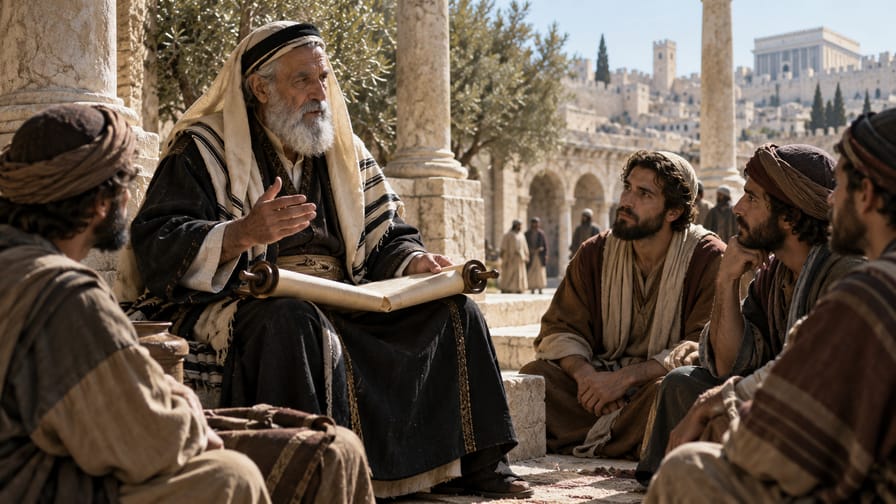
The figure of Gamaliel, though briefly mentioned in the New Testament, emerges as a character of profound importance for understanding the historical and theological context of early Christianity. His wisdom and prudence, recorded in the book of Acts, not only saved the apostles from summary execution but also reveal divine providence at work even through religious leaders who did not embrace faith in Christ.
This study aims to analyze Gamaliel from an evangelical Protestant perspective, exploring his onomastic meaning, the historical setting of his actions, the nuances of his character, his theological relevance, and the legacy he left for both Judaism and Christianity. The analysis will be founded on the Scriptures, with attention to the original languages and biblical exegesis.
1. Etymology and meaning of the name
The name Gamaliel (Greek: Gamaliel, transliterated from Hebrew: גַּמְלִיאֵל, Gamli'el) is of Hebrew origin and carries an intrinsic theological meaning. The root of the name is composed of two distinct parts that reveal a profound declaration of faith and divine dependence.
The first part, gamal (גָּמַל), means "to reward," "to repay," "to nurse," or "to do good." This verb frequently appears in the Scriptures to describe God's action in repaying or blessing, as in Psalm 13:6, where the psalmist declares that God has rewarded him.
The second part is El (אֵל), which is the abbreviated form for "God" or "Mighty One," one of the oldest and most common names for the Creator in the Old Testament. The combination of these two parts results in "recompense of God," "my reward is God," or "God has rewarded."
This meaning reflects a theology of divine providence and sovereignty, where God is seen as the giver of all good things and the provider of rewards. For a man of Gamaliel's stature, a renowned teacher of the Law, the name may have been a constant reminder of the source of his wisdom and position.
There are no other notable biblical figures named Gamaliel in the Protestant biblical canon, although the name was relatively common in Jewish culture at the time. The uniqueness of the Gamaliel in Acts highlights his importance within the New Testament narrative.
The theological significance of the name, "recompense of God," can be seen as an echo of how God used Gamaliel to preserve the lives of the apostles, granting them a "recompense" of time and opportunity for the propagation of the gospel, even though Gamaliel himself was not a believer in Jesus Christ.
2. Historical context and biblical narrative
Gamaliel lived at the beginning of the first century CE, a time of intense transformations and tensions in the Jewish world. He is traditionally identified as Gamaliel I, or Rabban Gamaliel the Elder, grandson of Hillel, one of the greatest teachers of Jewish Law of all time and founder of the school of Hillel.
The political context was one of Roman domination over Judea, with Roman procurators exercising authority, which generated a feeling of oppression and messianic longing among the Jews. The Sanhedrin, the highest Jewish religious and legal court, operated under Roman supervision but maintained considerable autonomy over internal and religious matters.
Socially, Jewish society was divided into various factions, with the Pharisees and Sadducees being the most prominent. The Pharisees, to whom Gamaliel belonged, were known for their strict observance of the Torah and oral traditions, enjoying great popular respect. The Sadducees, on the other hand, were more conservative in their interpretation of the Law and tended to be the priestly and aristocratic elite.
The biblical narrative presents Gamaliel at a critical moment in the early church, recorded in Acts 5:34-40. The apostles had been arrested for preaching about Jesus Christ and performing miracles, challenging the authority of the Sanhedrin, which had forbidden them to speak in the name of Jesus (Acts 5:28).
After being miraculously freed from prison by an angel and continuing to preach in the temple, they were again captured and brought before the Sanhedrin. It is in this scenario of anger and desire to execute the apostles that Gamaliel intervenes.
The passage describes Gamaliel as "a Pharisee, a teacher of the Law, honored by all the people" (Acts 5:34). He stood up in the Sanhedrin, ordered the apostles to be taken outside for a short while, and then addressed the members of the council with prudent advice.
His argument was based on historical precedents of messianic or religious movements that failed by themselves, such as those of Theudas and Judas the Galilean (Acts 5:36-37). He suggested that if the apostles' movement was of human origin, it would come to nothing, but if it was from God, it would be impossible to stop it, and they would run the risk of "even fighting against God" (Acts 5:39).
This intervention by Gamaliel was decisive. The Sanhedrin accepted his advice. Although the apostles were still flogged and again forbidden to preach, their lives were spared, allowing them to continue their mission of proclaiming the gospel (Acts 5:40-42).
In addition to Acts 5, Gamaliel is mentioned again in Acts 22:3, where the apostle Paul, in his defense speech in Jerusalem, declares: "I am a Jew, born in Tarsus of Cilicia, but brought up in this city. I was educated at the feet of Gamaliel in strict conformity to the law of our fathers, being just as zealous for God as any of you are today."
This declaration by Paul is crucial, as it establishes Gamaliel as the teacher of one of the most influential apostles of Christianity. The main geographical location of Gamaliel's activity was Jerusalem, the religious and political center of Judaism at the time, where the Sanhedrin met and where the events of Acts unfolded.
His most important relationships in the Bible are with the Sanhedrin, as a prominent member, and with the apostles, as their unexpected defender. The relationship with Paul is that of master-disciple, indicating the high quality of the Pharisaic training Paul received under Gamaliel's tutelage.
3. Character and role in the biblical narrative
Gamaliel's character, as revealed in the Scriptures, is marked by remarkable wisdom, prudence, and a deep respect for the Law and order. He is presented as a man of great intellectual and moral stature, whose opinion was highly valued by his contemporaries.
One of his most evident qualities is moderation. In a council where anger and a desire for violence against the apostles predominated, Gamaliel stood out for his calm and objectivity. He did not allow himself to be carried away by passion or prejudice but sought a more thoughtful and just approach.
His argument in Acts 5:38-39 reveals a faith in God's sovereignty: "If this plan or this undertaking is of man, it will fail but if it is of God, you will not be able to overthrow them—you might even be found opposing God!" This perspective demonstrates an understanding that God can act in unexpected ways and that it is dangerous to oppose His will.
Despite being a Pharisee and, therefore, a guardian of Jewish tradition, Gamaliel does not appear to have been a fanatic. His approach suggests a mind open enough to consider the possibility that the Christian movement could, in fact, have divine origin, even if he himself did not explicitly accept it at that moment.
He played the role of a mediator and counselor within the Sanhedrin. His function was not merely that of a judge or legislator but that of a wise man who guided his peers to avoid hasty actions that could have disastrous consequences, both for them and for the reputation of the council.
Gamaliel's key decision was to propose a "wait and see" strategy. Instead of reacting with immediate violence, he advised observing the fruits of the movement. This decision saved the lives of the apostles and allowed early Christianity to continue to grow and spread, fulfilling the prophecy that God's work cannot be stopped by men.
There is no biblical record of documented weaknesses or moral failings for Gamaliel. The narrative presents him consistently positively, as a model of prudence and legal wisdom. His character is a testament to an individual's ability to exert positive influence, even in a hostile environment.
Gamaliel's vocation was that of a teacher of the Law (nomodidaskalos in Greek), a role of immense responsibility and prestige in Jewish society. He was an interpreter and guardian of the Torah, whose authority was unquestionable. His influence extended beyond the Sanhedrin, shaping the education of future generations of religious leaders, such as Paul himself.
The character's development is not extensively detailed in the Bible, as he appears in only two specific contexts. However, his intervention in Acts demonstrates a maturity and depth of character that distinguishes him from many of his colleagues in the Sanhedrin, who were more inclined to violent repression.
4. Theological significance and typology
The theological significance of Gamaliel lies primarily in his role in redemptive history as an instrument of divine providence. Although not a believer in Jesus, God used him to protect the nascent movement of Christianity, ensuring that the gospel could continue to be preached.
His intervention in Acts 5 is a clear example of how God's sovereignty manifests itself, using even those who do not share the faith to accomplish His purposes. The lives of the apostles were spared, and the early church was preserved from more severe persecution in its initial stages, allowing for its expansion.
From the perspective of evangelical Protestant theology, Gamaliel is not a typological figure that prefigures Christ in a direct sense, like Moses or David. He does not point to the Messiah through his person or work in a symbolic way. However, he is an example of God's common grace, which grants wisdom and discernment to individuals, even outside the covenant of saving faith.
Gamaliel's connection to central theological themes is notable. He illustrates the doctrine of divine providence, which governs all things for the good of His people and for the advancement of His kingdom (Romans 8:28). Gamaliel's decision, though based on human prudence, was divinely orchestrated to protect the church.
His attitude also raises questions about the relationship between human wisdom and divine wisdom. While Gamaliel demonstrates great earthly wisdom in analyzing the situation, he still lacked the spiritual wisdom that comes from faith in Christ (1 Corinthians 1:18-25). He observed the movement but did not join it, remaining within the structure of Judaism.
The mention of Paul as his disciple in Acts 22:3 has profound theological significance. It shows that Paul received the best education available in his time in Jewish Law, under the tutelage of one of the greatest teachers. This rigorous training, though it did not initially lead him to Christ, was fundamental for his later understanding of the Torah and, by contrast, of God's grace in Christ (Philippians 3:4-8).
Paul's instruction at the feet of Gamaliel prepared him to be an unparalleled apologist and theologian, capable of dialoguing with Jews and Gentiles, and of explaining the superiority of righteousness by faith over righteousness by works of the Law (Romans 3:20-22). The depth of his knowledge of the Law, acquired from Gamaliel, allowed him to deconstruct the foundations of legalism and exalt the redemptive work of Christ.
Thus, Gamaliel, even without being a protagonist of the Christian faith, is an integral part of the narrative of progressive revelation. His action facilitated the advancement of the gospel, and his influence on Paul indirectly contributed to the formation of the apostolic theology that would come to shape Christianity.
The doctrine of God's sovereignty is particularly emphasized through Gamaliel. God can use anyone, in any position, to fulfill His plans, regardless of their faith or unbelief. Gamaliel's counsel is proof that "the counsel of the Lord stands forever, the plans of his heart to all generations" (Psalm 33:11).
5. Biblical-theological legacy and canonical references
Gamaliel's legacy, although concentrated in a few passages of the New Testament, is significant for both Jewish history and Christian theology. His canonical mentions are limited to the book of Acts of the Apostles, specifically in Acts 5:34-40 and Acts 22:3.
There are no literary contributions attributed to Gamaliel within the biblical canon, nor is he mentioned in other biblical books beyond Acts. His influence, therefore, is perceived through his actions and his role as Paul's teacher.
In Jewish interpretive tradition, Gamaliel is highly revered as Rabban Gamaliel the Elder. He is one of the Tannaim, the rabbinic sages whose views and teachings are recorded in the Mishnah and the Talmud. He is credited with the development of many laws and customs that shaped Rabbinic Judaism.
His reputation in Jewish tradition is that of an incomparable scholar and a wise leader. The Mishnah, in Pirkei Avot 2:16, states: "Since Rabban Gamaliel the Elder died, there has been no more reverence for the Torah, and purity and separation have died." This highlights the high esteem in which he was held by his peers and by later generations of Jews.
For Reformed and evangelical theology, Gamaliel is seen as an example of God's common providence. His wisdom and moderation served to protect the early church, demonstrating that God can use even those who are not believers to fulfill His redemptive purposes.
He is also crucial for understanding Paul's formation. Paul's education "at the feet of Gamaliel" (Acts 22:3) is often cited to illustrate the depth of Paul's knowledge of Jewish Law, which made his subsequent conversion and defense of the gospel of grace even more impactful.
Gamaliel's importance for understanding the canon lies in his contribution to the narrative of the book of Acts, which describes the birth and expansion of the church. His intervention is a turning point that allows the apostles' mission to continue, rather than being abruptly interrupted by persecution.
Furthermore, the figure of Gamaliel serves as a counterpoint to the more zealous and violent religious leaders of the time. He represents a facet of Judaism that, while not embracing Christianity, was capable of exercising discernment and moderation, allowing truth to be tested by time, according to his own argument.
Finally, Gamaliel's legacy reinforces the evangelical belief in God's sovereignty over history. He reminds us that, even amidst opposition and hostility, God has His instruments and means to protect His church and advance His kingdom, often in unexpected ways and through individuals whom, humanly speaking, we would not expect.