


Apostelgeschichte
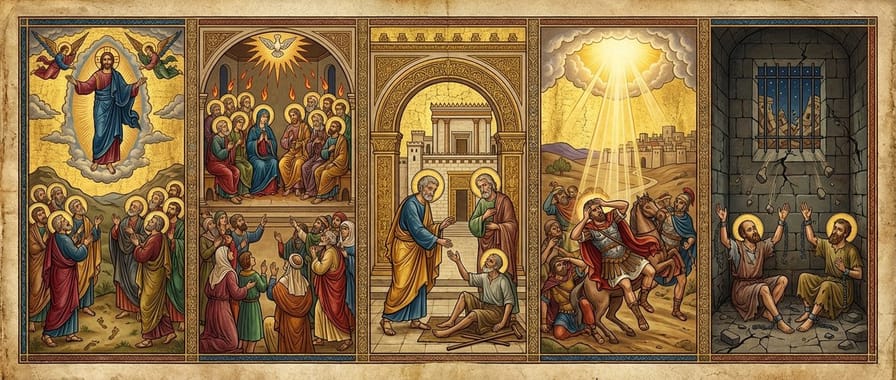
Illustration of the Book of Acts, one of the 27 books of the New Testament (Nano Banana Pro).
The introduction to any book of Holy Scripture is an indispensable gateway for a deep and theologically informed understanding of its message. It paves the way for faithful exegesis, relevant application, and spiritual edification, anchoring the reader in the fertile ground of divine revelation. In the context of the conservative evangelical Protestant tradition, an introduction is not merely an academic exercise but an act of reverence for the Word of God, which we believe to be inspired, inerrant, and infallible. As we approach the book of Acts of the Apostles, we encounter a vibrant and foundational narrative that serves as the historical and theological bridge between the Gospels and the Epistles, documenting the birth and initial expansion of the Church of Christ under the sovereign power of the Holy Spirit.
Acts is not merely a historical chronicle; it is a dynamic testimony to the fulfillment of God's promises in Christ, to the universality of His salvation, and to the missionary call that propels His followers. For the evangelical reader, it offers a model of apostolic fervor, community life, and resilience in the face of persecution, all permeated by a profound dependence on the Spirit. This introduction will, therefore, seek to unfold the contextual, structural, thematic, canonical, and hermeneutical layers of Acts, providing an analytical framework that can be replicated for any book of the Bible. Our objective is to equip the student of the Word with the necessary tools for a reading that honors biblical authority, celebrates the centrality of Christ, and submits to the guidance of the Holy Spirit, reaffirming the eternal truths of the Reformed faith.
In an often skeptical academic landscape, it is imperative that the evangelical perspective defends the historical integrity and doctrinal authenticity of Acts, responding to criticisms with scholarship and faithfulness. We believe that Luke's account is not a mere late theological construction but a trustworthy record of the events that inaugurated the era of the Church and demonstrated the unstoppable progression of the gospel to the ends of the earth. Thus, we will delve into the details of authorship, dating, structure, themes, relevance, and interpretive challenges, always with a Christocentric outlook and a mind submissive to revealed truth, seeking to extract the richness that Acts has to offer for the faith and practice of the Church today.
1. Historical Context, Dating, and Authorship
Understanding the book of Acts of the Apostles, like any biblical text, begins with a rigorous investigation into its historical context, the date of its composition, and the identity of its author. Christian tradition, consistently and with strong support, attributes the authorship of Acts to Luke, the beloved physician, Paul's companion on several of his missionary journeys. This attribution is not merely a convention but a pillar that sustains the credibility and historical authority of the book, especially for the conservative evangelical Protestant perspective, which values traditional authorship and the historical trustworthiness of biblical accounts.
1.1 Lukan Authorship and Internal and External Evidence
The defense of Lukan authorship for Acts is robust and multifaceted. Internally, the book of Acts is a clear continuation of the Gospel of Luke, both addressed to Theophilus (Luke 1:1-4; Acts 1:1-2). The stylistic and thematic unity between the two volumes is notable, evidencing the same hand behind both. Luke demonstrates an exceptional command of the Greek language, with a rich vocabulary and sophisticated syntactical construction, characteristics that remain consistent in both books. Furthermore, the presence of the so-called "we sections" (Acts 16:10-17; 20:5-15; 21:1-18; 27:1-28:16) is crucial internal evidence. In these passages, the narrator switches from the third person to the first person plural, indicating that he himself was present with Paul during these specific portions of the journeys. Given that Luke is the only companion of Paul mentioned in the epistles (Colossians 4:14; 2 Timothy 4:11; Philemon 1:24) who is not identified as the author of another New Testament book, the conclusion that he is the author of the "we sections" and, by extension, of the entire book, is the most reasonable and widely accepted.
Luke's mention as a physician (Colossians 4:14) also finds resonance in the text of Acts, where there is notable precision and detail in the descriptions of healings and medical conditions, although this point is more subtle and should not be overemphasized in isolation. Externally, the unanimous testimony of the Early Church is overwhelming. Church Fathers such as Irenaeus (c. A.D. 180), Tertullian (c. A.D. 200), and the Muratorian Canon (late 2nd century) consistently attribute Acts to Luke. There is no ancient tradition that attributes the book to any other author. This convergence of internal and external evidence offers a solid foundation for traditional authorship, which the evangelical perspective faithfully upholds.
1.2 Dating of the Book and its Historical-Political Context
The dating of Acts is a point of debate, but the conservative evangelical position favors an early dating, generally in the early A.D. 60s. The book concludes abruptly with Paul under house arrest in Rome, preaching unhindered (Acts 28:30-31), without mentioning his final trial, his death (traditionally dated around A.D. 64-68), Nero's persecution of Christians (which began in A.D. 64), or the destruction of Jerusalem (A.D. 70). The absence of mention of these crucial events strongly suggests that the book was written before they occurred, or at least before Luke had knowledge of them. This early dating confers greater proximity to the narrated events, strengthening the author's claim of historical reliability.
The political and social context of the Greco-Roman world is vital for understanding Acts. The Roman Empire, under the period of the Pax Romana, provided relative stability, well-constructed roads, a comprehensive legal system, and a common language (Koine Greek), all elements that, paradoxically, facilitated the rapid spread of the gospel. However, this same imperial structure represented a potential source of persecution, as seen in Paul's repeated arrests and trials. The interaction between early Christianity and Roman authorities (proconsuls, tribunes, kings) is a recurring theme in Acts, with Luke often portraying Christianity as a legally harmless religion, an important apologetic aspect for the original audience.
The cultural context was a complex mixture of Judaism (with its synagogues and the Law), Hellenism (the dominant Greek culture, with its philosophy and polytheism), and Roman pragmatism. The gospel spread from the Jewish center of Jerusalem, through the diaspora synagogues, to Hellenistic centers like Athens and Corinth, and finally to the capital of the empire. Luke demonstrates a remarkable knowledge of local titles (e.g., "politarchs" in Acts 17:6, "proconsul" in Acts 13:7), geography, and customs, which has been repeatedly confirmed by archaeology, refuting many skeptical criticisms.
1.3 Response to Higher Criticism
Modern higher criticism has frequently questioned the historicity of Acts, alleging inaccuracies, anachronisms, or a theological agenda that distorts the facts. Critics point to alleged discrepancies between Acts and Paul's epistles (e.g., the account of Paul's conversion or the details of the Jerusalem Council). However, the evangelical perspective argues that these are, in most cases, differences in emphasis or selection of material, not contradictions. Luke, as an ancient historian, had the freedom to select and organize his material for a specific theological purpose, without compromising the veracity of the events. Sir William Ramsay, a renowned archaeologist who was initially skeptical, eventually became an advocate for Luke's historical accuracy after extensive archaeological investigations in Asia Minor, concluding that Luke was a first-rate historian.
The alleged geographical or official title inaccuracies have been consistently refuted by archaeological and epigraphic discoveries. Luke demonstrates a precision that goes beyond what would be expected from a late writer without direct access to the events or primary sources. The evangelical defense of biblical inerrancy does not require Luke to have recorded every detail of every event, but that what he recorded is true and trustworthy. The narrative of Acts, therefore, is not a pious fiction but a divinely inspired historical testimony to the foundation and expansion of the Church, providing the indispensable backdrop for understanding the rest of the New Testament.
2. Structure, Division, and Main Content
The book of Acts of the Apostles is not a random collection of events but a carefully structured literary work, designed to communicate a powerful theological message through an engaging historical narrative. Luke, as a skilled historian and insightful theologian, organizes his material to demonstrate the unstoppable progression of the gospel, from its Jewish origins in Jerusalem to its arrival in the capital of the Roman Empire. The structure of Acts is fundamental for grasping its narrative flow and the author's intent.
2.1 Literary Organization and Narrative Flow
Acts is predominantly a historical narrative, but it incorporates elements of biography (focusing on Peter and Paul), speeches (which occupy a significant part of the text and are crucial for Luke's theology), travel accounts, and even periodic summaries that punctuate the growth of the church (e.g., Acts 2:42-47; 4:32-35; 6:7; 9:31; 12:24; 16:5; 19:20; 28:30-31). Luke's language is elegant and fluid, demonstrating a command of Koine Greek that distinguishes him from many other New Testament writers. The narrative flow is linear and progressive, following Christ's commission in Acts 1:8, which serves as a prophetic outline for the entire book: "But you will receive power when the Holy Spirit has come upon you, and you will be my witnesses in Jerusalem and in all Judea and Samaria, and to the end of the earth."
This geographical progression is the skeleton of Acts' narrative. The story begins in Jerusalem, radiates to Judea and Samaria, and then expands to the Gentile world, culminating in Rome. This structure is not accidental; it underscores the universal nature of the gospel message and God's sovereignty in its dissemination, overcoming ethnic, cultural, and geographical barriers. The narrative is marked by significant transitions, such as the martyrdom of Stephen, which catalyzes the dispersion of believers (Acts 8), the conversion of Cornelius, which opens the doors for the Gentiles (Acts 10), and the establishment of Antioch as the missionary center for the Gentile world (Acts 11:19-26).
2.2 Main Divisions and Synthetic Outline of Content
The book of Acts can be divided into two main sections, reflecting the geographical progression and the focus on the two central apostles: Peter and Paul. However, a more detailed division that follows the commission in Acts 1:8 is more useful for in-depth study:
- The Church in Jerusalem (Acts 1:1-8:3):
- Introduction and the Ascension of Jesus (Acts 1:1-11)
- Waiting for the Spirit and the Election of Matthias (Acts 1:12-26)
- The Day of Pentecost and the Outpouring of the Holy Spirit (Acts 2:1-47)
- Miracles and Initial Growth of the Church (Acts 3:1-5:42)
- Internal Conflicts and the Choice of Deacons (Acts 6:1-7)
- Stephen: His Ministry, Martyrdom, and the Dispersion of the Church (Acts 6:8-8:3)
- The Church in Judea and Samaria (Acts 8:4-12:25):
- Philip and the Evangelization of Samaria and the Ethiopian Eunuch (Acts 8:4-40)
- The Conversion and Call of Saul (Paul) (Acts 9:1-31)
- Peter: Miracles and the Conversion of Cornelius, the First Gentile (Acts 9:32-11:18)
- The Church in Antioch and Gentile Expansion (Acts 11:19-30)
- Herod's Persecution and Peter's Deliverance (Acts 12:1-25)
- The Church to the Ends of the Earth (Acts 13:1-28:31):
- Paul and Barnabas' First Missionary Journey (Acts 13:1-14:28)
- The Jerusalem Council and the Gentile Question (Acts 15:1-35)
- Paul's Second Missionary Journey (Acts 15:36-18:22)
- Paul's Third Missionary Journey (Acts 18:23-21:16)
- Paul's Imprisonment in Jerusalem and Caesarea (Acts 21:17-26:32)
- Paul's Journey to Rome and His Arrival (Acts 27:1-28:31)
This outline clearly demonstrates the narrative's progression and the focus on how the gospel, through human agency and divine power, transcends boundaries and establishes communities of faith throughout the known world. The emphasis on Peter in the early parts of the book and on Paul in the later parts reflects the transition of the gospel's focus from Judaism to the Gentile world, always under the sovereign direction of God.
2.3 The Importance of Speeches in Acts
The speeches in Acts are more than mere records of speeches; they are primary vehicles for Luke's theology and the book's purpose. There are about twenty-four main speeches, delivered by Peter, Stephen, Paul, and others. These speeches are not verbatim transcripts, but summaries and paraphrases that Luke, as a historian, composed with faithfulness to the essential content of what was said. They serve several purposes:
- Proclamation of the kerygma: The apostolic speeches (e.g., Peter in Acts 2, 3, 10; Paul in Acts 13) consistently present the central message of the gospel: Jesus is the promised Messiah, crucified, raised by God, exalted as Lord and Christ, and He offers forgiveness of sins and the gift of the Holy Spirit to all who believe.
- Apologetics: The speeches defend the Christian faith against Jewish and Roman accusations, showing that Christianity is the fulfillment of the Jewish Scriptures and a legitimate, non-revolutionary religion.
- Theological instruction: They offer insights into the early church's understanding of God, Christ, the Holy Spirit, salvation, and the Kingdom.
- Advancement of the narrative: The speeches often mark crucial moments in the progression of the mission, leading to conversions and church growth.
The structure of Acts, with its geographical progression and strategically placed speeches, reveals Luke's intent to present a coherent and theologically rich history of the foundation and expansion of the Church. He not only recounts what happened but also interprets its meaning, demonstrating the sovereign hand of God guiding His people in their mission to be witnesses of Christ to the ends of the earth.
3. Central Theological Themes and Purpose
The book of Acts is a theological goldmine, replete with foundational doctrines that have shaped and continue to shape the Church's understanding of its identity and mission. For the conservative evangelical perspective, the central themes of Acts are not merely historical but normative, offering timeless principles for faith and practice. Understanding the primary purpose of the book for its original audience, combined with a deep analysis of its themes, is essential for a faithful and edifying reading.
3.1 The Sovereignty of God and the Divine Plan
One of the most prominent themes in Acts is the sovereignty of God over history and human destinies. Luke consistently portrays God as the main actor behind all events, orchestrating the fulfillment of His redemptive plan through Christ and the Church. Jesus' crucifixion, though an act of human wickedness, is presented as part of God's "definite plan and foreknowledge" (Acts 2:23). The prayers of believers recognize that God is the one "who made the heaven and the earth and the sea and everything in them," and that "the kings of the earth set themselves, and the rulers were gathered together, against the Lord and against his Anointed" to do "whatever your hand and your plan had predestined to take place" (Acts 4:24-28).
This theme of divine providence permeates the entire narrative. God opens doors for the gospel (e.g., Peter's vision in Acts 10, the vision of the Macedonian man in Acts 16), closes others (e.g., the Spirit hindering Paul from going to Asia and Bithynia in Acts 16:6-7), protects His servants (e.g., Peter's deliverance in Acts 12, Paul's in Acts 16), and ensures the advancement of His Word "without hindrance" (Acts 28:31). For Reformed theology, this theme resonates deeply with the doctrine of divine sovereignty and predestination, understanding that God is in control of all things, including the salvation and mission of His Church. Faith in a sovereign God offers comfort and confidence to the Church, even amidst persecution and adversity.
3.2 The Central Role of the Holy Spirit
Acts is often called "the book of the Holy Spirit," and rightly so. The Spirit is not a supporting actor but the dynamic force that propels the Church and the gospel. The book begins with Jesus' promise concerning baptism in the Spirit (Acts 1:5) and the reception of power (Acts 1:8), which is dramatically fulfilled at Pentecost (Acts 2). The Spirit empowers the apostles to witness, grants spiritual gifts (tongues, prophecy, miracles), guides the Church's decisions (e.g., Acts 13:2; 15:28; 16:6-7), and anoints preachers with boldness (e.g., Acts 4:31).
The presence of the Holy Spirit is the seal of the new covenant, the fulfillment of Old Testament prophecies (e.g., Joel 2:28-32, quoted in Acts 2:17-21). He is the agent of regeneration, sanctification, and empowerment for mission. For evangelical ecclesiology, this theme is vital for understanding the Church's life and ministry. We recognize that the Church does not operate by its own strength but by the energy and direction of the Holy Spirit. The pneumatology of Acts emphasizes the continual need to be filled with the Spirit for effective witness and for authentic Christian life.
3.3 The Nature and Mission of the Church
Acts is the book that narrates the birth and infancy of the Church, revealing its essential nature and divinely ordained mission. The Church is presented as the community of believers in Jesus Christ, characterized by:
- Fellowship: The first believers "devoted themselves to the apostles' teaching and the fellowship, to the breaking of bread and the prayers" (Acts 2:42). They shared their possessions (Acts 2:44-45; 4:32-35) and lived in unity.
- Worship and teaching: The Church met regularly for apostolic teaching, worship, and the celebration of the Lord's Supper.
- Witness and evangelism: The main mission of the Church is to be a witness for Christ (Acts 1:8), proclaiming the gospel to all people. The proclamation of the kerygma is central to the life of the Church in Acts.
- Perseverance in persecution: The Church in Acts faces constant opposition and persecution, but responds with faith, prayer, and boldness, seeing this as part of its identification with Christ.
The ecclesiology of Acts is, therefore, missionary and communal. The Church does not exist for itself but for the glory of God and for the expansion of His Kingdom. It is the body of Christ on earth, continuing His work through the power of the Spirit. The missiology of Acts is a model for the contemporary Church, calling us to a life of bold witness, dependence on the Spirit, and genuine fellowship.
3.4 The Universality of the Gospel and the Fulfillment of Scripture
Acts dramatically demonstrates the universality of the gospel, overcoming the ethnic and cultural barriers that separated Jews and Gentiles. The conversion of Cornelius (Acts 10) and the Jerusalem Council (Acts 15) are theological landmarks that establish that salvation in Christ is for all peoples, without the need for Gentiles to observe the Mosaic Law. God "shows no partiality" (Acts 10:34), and the Holy Spirit is poured out on Gentiles in the same way as on Jews. This theme is crucial for covenant theology, showing that the new covenant in Christ transcends the distinctions of the old covenant, fulfilling the Abrahamic promise to bless "all the families of the earth" (Genesis 12:3).
Luke emphasizes that everything that happens in the Church is the fulfillment of Old Testament Scriptures. The speeches in Acts are replete with OT quotations, showing that Jesus is the promised Messiah, that the resurrection was prophesied (e.g., Psalm 16 in Acts 2), and that the inclusion of the Gentiles was foretold (e.g., Amos 9:11-12 in Acts 15). This Christocentric typology is fundamental for evangelical hermeneutics, which sees Christ as the pinnacle of all biblical revelation and the fulfillment of all God's promises.
3.5 Primary Purpose of the Book
The primary purpose of Acts for its original audience (likely Theophilus and other Gentile believers) was multifaceted:
- Historical-apologetic: To demonstrate that Christianity is not a dangerous or revolutionary sect but the legitimate continuation of God's salvation history, which spread by peaceful means and was, in many cases, tolerated by Roman authorities. Luke consistently shows Paul acquitted of accusations.
- Theological-instructional: To explain how the Church, initially a Jewish movement, became a predominantly Gentile movement, and how this transition was divinely orchestrated and sanctioned by the apostles.
- Missiological-inspirational: To inspire believers to bold witness and participation in God's mission, showing the power of the Holy Spirit to empower believers to be effective witnesses of Christ to the ends of the earth.
- Pastoral: To offer encouragement to believers who were facing persecution, showing that the early Church also suffered, but that God was faithful to protect and cause it to prosper.
In summary, Acts is the narrative of God's faithfulness in fulfilling His promises in Christ, through the Holy Spirit, in the formation and expansion of His Church. Its themes are timeless and central to the evangelical understanding of systematic theology, ecclesiology, missiology, and Christian life.
4. Relevance and Canonical Connections
The book of Acts of the Apostles is not an island in the biblical canon but a vital architectural piece that connects, contextualizes, and illuminates vast portions of Scripture. Its relevance transcends mere historical curiosity, making it indispensable for a complete understanding of God's progressive revelation. For the evangelical perspective, Acts is the narrative link that unites the Gospels to the Epistles, offering the historical and theological backdrop for the life and teachings of the early Church and, by extension, for the Church today. The Christocentric reading of Acts reveals how God's plan, centered on Jesus Christ, unfolds in history through the work of the Holy Spirit and the agency of the Church.
4.1 Importance of the Book within the Complete Canon
Acts serves as the narrative and theological bridge between the life, ministry, death, resurrection, and ascension of Jesus (recorded in the Gospels) and the doctrinal and pastoral exposition of the Christian faith (found in the Epistles). Without Acts, the transition from the community of Jesus' disciples to the global and multiethnic Church would be incomprehensible. It shows us how the promise of the Holy Spirit was fulfilled, how the gospel began to be preached, and how the first Christian communities were formed and faced their challenges. Acts provides the vital context for understanding most of the Pauline Epistles, explaining the circumstances of the churches to which Paul writes (e.g., Corinth, Ephesus, Philippi, Thessalonica) and the events of his missionary journeys.
Furthermore, Acts demonstrates the continuity of God's work from the Old Testament to the New. It shows how the prophecies and promises of the OT found their fulfillment in Christ and the Church. The history of God's people does not end with Israel but expands to include all who believe in Jesus, Jews and Gentiles, forming a new people, the Church. Acts, therefore, is crucial for understanding salvation history and covenant theology, showing God's faithfulness through the ages.
4.2 Typological Connections and the Christocentric Reading
Although Acts is a narrative about the apostles and the Church, it is fundamentally Christocentric. Jesus Christ is the central subject of apostolic proclamation. The speeches in Acts consistently point to Jesus as the promised Messiah, the resurrected and exalted Lord, the Savior and Judge. Peter and Paul, in their preaching, do not promote themselves but magnify Christ (e.g., Acts 2:22-36; 3:13-26; 4:10-12; 13:26-41).
The typological connections also are evident:
- The Church as the body of Christ: The apostles continue the work of Christ on earth, driven by the Spirit whom Christ sent. The Church is the extension of Christ's presence and ministry in the world.
- The suffering of the apostles: The persecutions and sufferings faced by Peter, Paul, and other believers are an extension of Christ's suffering. They identify with their Lord in His passion, and their witness is strengthened by this.
- The power of the resurrection: The miracles and healings performed by the apostles are a testimony to the power of Christ's resurrection and the authority He conferred upon them.
The Christocentric reading of Acts reminds us that the mission of the Church is not about human glory, but about the exaltation of Jesus Christ as Lord over all. It is the story of what Christ continues to do through His Spirit and His people.
4.3 Fulfillments of Old Testament Prophecies and Allusions in Other Books
Acts is a book that resonates with the Old Testament, demonstrating how God's promises are fulfilled in Christ and the Church. The apostles frequently turn to the Hebrew Scriptures to validate their claims about Jesus. Notable examples include:
- Peter's quotation from Joel 2:28-32 in Acts 2:17-21 to explain the outpouring of the Spirit at Pentecost.
- References to Psalms 16 and 110 to prove the resurrection and exaltation of Christ (Acts 2:25-36).
- The quotation from Isaiah 53 to describe the suffering Messiah (Acts 8:32-33).
- James' reference to Amos 9:11-12 at the Jerusalem Council (Acts 15:16-18) to justify the inclusion of Gentiles into the people of God.
These connections demonstrate that Christianity is not a new and disconnected religion but the climax of the salvation history that God began with Israel. The New Testament, therefore, does not contradict the Old but fulfills and reveals it in its fullness. Acts also serves as a backdrop for the Epistles. Paul's letters, for example, gain depth when read in light of the events in Acts that describe his journeys, the challenges of the churches founded, and his interactions with authorities. The Epistle to the Galatians, with its defense of Christian freedom for Gentiles in relation to the Law, is deeply understood through the debate and resolution of the Jerusalem Council in Acts 15. Likewise, the conditions of the churches in Corinth, Philippi, and Thessalonica, to which Paul writes, are clarified by the accounts of their founding in Acts.
4.4 Relevance for the Contemporary Church
The relevance of Acts for the contemporary Church is immense and multifaceted:
- Model for missions and evangelism: Acts presents a dynamic model for how the gospel should be proclaimed and how the Church should engage in cross-cultural mission. Apostolic boldness, dependence on the Spirit, and contextual adaptation of the message are crucial lessons.
- Practical Pneumatology: The book teaches about the indispensable role of the Holy Spirit in the life of the Church and the believer, from empowerment for witness to guidance in crucial decisions.
- Ecclesiastical Life and Fellowship: Acts offers a glimpse into the communal life of the early Church, with its emphasis on fellowship, teaching, breaking of bread, and prayer, challenging the modern Church to seek deeper and more authentic fellowship.
- Facing Persecution: In a world where Christianity is often marginalized or persecuted, Acts offers encouragement and an example of how believers should respond with faith and perseverance.
- Unity and Diversity: The book addresses the question of unity between Jews and Gentiles, offering principles for overcoming ethnic and cultural divisions within the body of Christ.
In summary, Acts is a timeless book that continues to inspire, instruct, and challenge the Church of all generations. It reminds us that God's mission is a global mission, propelled by the Holy Spirit, and that the Church is the chosen instrument to carry the message of Christ to all corners of the earth, until His return.
5. Hermeneutical Challenges and Critical Issues
The interpretation of any biblical text always involves challenges, and the book of Acts of the Apostles is no exception. Its narrative nature, its distinct cultural context, and the theological discussions it raises require a careful and biblically grounded hermeneutical approach. For the conservative evangelical perspective, it is crucial to address these difficulties with intellectual integrity and faithfulness to the inerrancy and infalibility of Scripture, responding to skeptical criticisms without compromising revealed truth.
5.1 Specific Interpretive Difficulties of the Book
One of the greatest hermeneutical difficulties in Acts is discerning what is descriptive (what happened in the early Church) from what is prescriptive (what should be normative for the Church today). Not every event in Acts is necessarily a command or a model for contemporary practice. For example:
- The community of goods (Acts 2:44-45; 4:32-35): Although a beautiful example of generosity and fellowship, the practice of selling property and sharing everything is not explicitly commanded for all churches in all ages. It is a description of a particular response to a specific context, driven by radical love, but not a universal law.
- Supernatural manifestations and spiritual gifts: The outpouring of the Spirit at Pentecost (Acts 2), tongues, prophecies, and miracles are frequent in Acts. The question is whether these manifestations are continuous for the Church today or whether they were characteristics of a unique foundational period. The evangelical perspective varies, but generally emphasizes that the Spirit remains active, although the form and frequency of certain manifestations may differ.
- Experiences of conversion and baptism in the Spirit: Acts records dramatic conversions and experiences of baptism in the Spirit that may seem separate from initial conversion in some cases (e.g., the Samaritans in Acts 8, John's disciples in Acts 19). Evangelical hermeneutics generally understands baptism in the Spirit as a single event that occurs at conversion, though there is the possibility of being "filled with the Spirit" repeatedly for empowerment.
The key is to distinguish the underlying theological principles (e.g., the importance of fellowship, the necessity of the Spirit, the power of God) from the specific cultural and historical forms in which these principles were manifested. What is normative are the principles, not necessarily all of their historical expressions.
5.2 Issues of Literary Genre and Cultural Context
Acts belongs to the genre of Greco-Roman historiography, but with a distinct theological purpose. Luke, as a historian, selects and organizes his material to present a coherent narrative that defends Christianity and demonstrates God's faithfulness. This means that he does not intend to be an exhaustive chronicle of all events, but a selective and purposeful account. Understanding this nature of the genre helps to respond to criticisms about "gaps" in the narrative or differences in emphasis compared to other sources.
The cultural context of the first century, with its Jewish, Greek, and Roman dynamics, is crucial. Understanding Roman laws, Jewish customs (e.g., vows, purification rituals), Greek philosophies (e.g., Stoicism and Epicureanism in Acts 17), and social practices (e.g., slavery, gender roles) is vital for correctly interpreting the actions and words of the apostles. Without this understanding, we run the risk of anachronisms and distorted readings.
5.3 Apparent Ethical or Theological Problems
Some events in Acts may raise ethical or theological questions for the modern reader:
- Ananias and Sapphira (Acts 5:1-11): The couple's instantaneous death for lying to the Holy Spirit about the sale of property seems excessively severe to some. The evangelical response emphasizes that this event occurred at the beginning of the Church, when God was establishing the holiness and integrity of His new community. It was an exemplary judgment against hypocrisy and deceit that threatened to corrupt the purity of the nascent Church, serving as a solemn warning about the gravity of sin within the body of Christ.
- Paul's vow (Acts 18:18) and his participation in the purification ritual (Acts 21:23-26): These actions, which appear to involve practices of the Mosaic Law, may seem inconsistent with Pauline doctrine of freedom from the Law. The evangelical interpretation understands that Paul, being "all things to all people" (1 Corinthians 9:22), was acting in a culturally sensitive way to avoid offending Jewish believers and to demonstrate that faith in Christ did not require a total renunciation of Jewish heritage, as long as it was not for justification. It was not a return to legalism but a strategic adaptation.
5.4 Faithful Evangelical Response to Skeptical Criticisms
Modern higher criticism frequently questions the historicity of Acts, alleging that Luke distorted events for theological purposes, created speeches that were never delivered, or presented a Paul different from the Paul of the Epistles. The evangelical response to these criticisms is categorical in defending biblical inerrancy:
- Historical reliability: As mentioned earlier, Luke's precision in geographical, political, and cultural details has been repeatedly confirmed by archaeology. The alleged "inaccuracies" are often based on skeptical assumptions, not concrete evidence.
- Speeches: Luke, as an ancient historian, had the prerogative to compose speeches that faithfully reflected the content and spirit of what was said, even if they were not literal transcriptions. The theological substance of the speeches is consistent with apostolic doctrine.
- Harmonization with the Pauline Epistles: The differences between Acts and Paul's Epistles are better understood as complementary, not contradictory. Luke and Paul had distinct literary purposes and audiences, leading to different selections and emphases in the material. There is no evidence that Luke misrepresented Paul's theology or biography.
- Supernatural events: For the skeptic, miracles and divine interventions are problematic. For the evangelical, they are essential elements of Acts' narrative, demonstrating God's power and the veracity of the gospel. Faith in Christ's resurrection and the supernatural work of the Holy Spirit is fundamental to the Christian worldview.
5.5 Hermeneutical Principles for Correct Interpretation
For a correct interpretation of Acts, the evangelical perspective adheres to sound hermeneutical principles:
- Historical-grammatical reading: Understand the meaning of the text in its original context, taking into account grammar, vocabulary, literary genre, and historical-cultural background.
- Theological reading: Integrate the message of Acts into the broader biblical and systematic theology, recognizing its place in salvation history and its coherence with the rest of Scripture.
- Christocentric reading: Interpret all events and teachings in Acts in light of the person and work of Jesus Christ, recognizing Him as the Lord and the fulfillment of all God's promises.
- Distinction between descriptive and prescriptive: Carefully discern which aspects of Acts' narrative are descriptions of unique events and which establish normative principles for the Church of all ages.
- Contextualized application: Once the original meaning is understood, apply the timeless truths of Acts to the life and mission of the contemporary Church, always with wisdom and discernment, under the guidance of the Holy Spirit.
By applying these principles, the evangelical Church can extract the rich message of Acts, honoring its divine authority and allowing it to continue to inspire and guide God's mission in the world.