


Micha
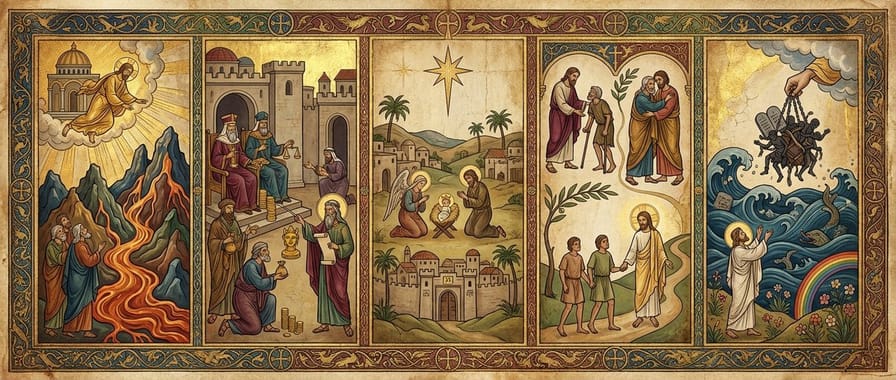
Illustration of the Book of Micah, one of the 39 books of the Old Testament (Nano Banana Pro).
The primary objective of this introduction is to offer a robust exegetical and theological analysis of the prophetic book of Micah, founded upon a conservative evangelical Protestant perspective. Far from being a mere academic formality, a profound understanding of the context, structure, themes, and hermeneutical challenges of any biblical book is an imperative for faithful preaching, biblical teaching, and authentic Christian living. In this model of analysis, we will seek to establish a comprehensive structure that can be replicated for the study of other books of the Holy Scriptures, always with a keen eye on the inerrancy, divine inspiration, and authority of the Word of God.
The book of Micah, though one of the "minor prophets" in terms of length, is a giant in its theological depth and prophetic relevance. Situated in a tumultuous period of Israel and Judah's history, Micah emerges as a courageous voice of God, denouncing social injustice, religious corruption, and idolatry, while simultaneously proclaiming messianic hope and future restoration. His message resonates with an urgency that transcends centuries, challenging the contemporary church to confront its own failings and to embrace justice, mercy, and humility before God.
We will navigate the historical and literary complexities of the book, defending traditional authorship and firmly situating Micah in his time. We will explore the ingenuity of its structure, unveiling the divisions that organize its multifaceted content. We will delve into the theological themes that form the heart of his message, connecting them to Reformed systematic theology and the grand narrative of redemption. More crucially, we will build bridges between Micah and the rest of the canon, highlighting his typological connections to Christ and his fulfillment in the New Testament, reaffirming the Christocentric nature of all Scripture.
Finally, we will address the hermeneutical challenges and critical questions that arise in the study of Micah, offering evangelical responses that uphold the integrity and truthfulness of God's Word. Our goal is to equip the reader with the necessary tools for a responsible interpretation and a transformative application of the book of Micah, ensuring that his prophetic voice continues to echo with power and clarity in the hearts and minds of those who seek divine truth.
1. Historical Context, Dating, and Authorship
Understanding the historical context, dating, and authorship of a biblical book is the foundation for solid exegesis and contextualized theology. In the case of the book of Micah, faithfulness to tradition and critical analysis of internal and external evidence lead us to a deeper appreciation of its prophetic message. The evangelical Protestant perspective, by affirming the inerrancy and plenary verbal inspiration of Scripture, seeks to defend traditional authorship whenever the evidence corroborates it, while also engaging with academic questions in a thoughtful and biblical manner.
1.1 Traditional Authorship and the Prophet Micah
The book of Micah is traditionally attributed to the prophet Micah of Moresheth. The book itself begins with the declaration: "The word of the Lord that came to Micah of Moresheth in the days of Jotham, Ahaz, and Hezekiah, kings of Judah, which he saw concerning Samaria and Jerusalem" (Micah 1:1). This declaration of authorship is clear and direct, establishing Micah as the author and the period of his prophetic activity. Moresheth-Gath, his hometown, was a small village in the Shephelah of Judah, about 35 km southwest of Jerusalem, which afforded him a unique perspective on rural life and the injustices that afflicted the common people, in contrast to the urban elite.
Micah's authorship is also confirmed by a notable extrabiblical reference within the canon itself, in the book of Jeremiah. In Jeremiah 26:18-19, the elders of Judah quote Micah as a prophet who prophesied in the days of King Hezekiah, saying: "Micah of Moresheth prophesied in the days of Hezekiah, king of Judah, and spoke to all the people of Judah, saying: 'Thus says the Lord of hosts: Zion shall be plowed like a field; Jerusalem shall become a heap of ruins, and the mountain of the temple a wooded height.' Did Hezekiah, king of Judah, and all Judah put him to death? Did he not fear the Lord and entreat the favor of the Lord? And did not the Lord relent concerning the disaster that he had pronounced against them? Thus we would bring great disaster upon ourselves". This quotation not only attests to Micah's historical existence but also to the authenticity and impact of his prophetic message in his own time, serving as powerful external evidence supporting traditional authorship.
1.2 Dating of Micah's Prophetic Period
The dating of Micah's ministry is precisely provided in the opening verse: "in the days of Jotham, Ahaz, and Hezekiah, kings of Judah". These reigns cover a significant period in the late 8th century B.C.: Jotham (c. 750-735 B.C.), Ahaz (c. 735-715 B.C.), and Hezekiah (c. 715-686 B.C.). This period was one of the most volatile and threatening for the kingdoms of Israel and Judah, dominated by the growing shadow of the Assyrian Empire.
Micah's ministry coincides with that of other prominent prophets like Isaiah, Hosea, and Amos. He witnessed crucial events such as the Syro-Ephraimite War (c. 734-732 B.C.), in which Judah, under King Ahaz, sought Assyrian aid against Israel and Syria, and the subsequent destruction of Samaria, the capital of the Northern Kingdom (Israel), by the Assyrians in 722/721 B.C. under Sargon II. Micah also witnessed Sennacherib's campaign against Judah in 701 B.C., which devastated many Judean cities and threatened Jerusalem, during Hezekiah's reign. His prophecies directly reflect these geopolitical realities, with explicit condemnations of Samaria (Micah 1:5-7) and Jerusalem, as well as the promise of deliverance from Assyria (Micah 5:5-6).
1.3 Political, Social, and Cultural Context of the Ancient Near East
The political landscape of Judah and Israel during Micah's ministry was one of instability and constant threat. The Assyrian Empire, with its kings Tiglath-Pileser III, Shalmaneser V, Sargon II, and Sennacherib, was the dominant superpower, expanding relentlessly westward. Israel and Judah, small buffer kingdoms, were constantly forced to choose between submission, alliance, or rebellion, often with disastrous results. Foreign policy was a complex web of intrigues and dependencies, and the leadership of both kingdoms often failed to trust in the Lord, seeking alliances with foreign powers instead of seeking God.
Socially, Micah denounced deep corruption and injustice. The elites in Jerusalem and Samaria, including rulers, judges, priests, and false prophets, exploited the poor and vulnerable. The wealthy accumulated lands and goods at the expense of the peasants, who were stripped of their inheritances and sold into slavery. "Woe to those who devise wickedness and work evil on their beds! When the morning dawns, they perform it, because it is in the power of their hand. They covet fields and seize them, and houses, and take them away; they oppress a man and his house, a man and his inheritance" (Micah 2:1-2). This economic and social exploitation was a flagrant violation of the Covenant Law and the principles of justice and equity established by God for His people.
Religiously, the situation was no less bleak. Although there was formal worship in the Temple, it was often devoid of true devotion and justice. Idolatry was prevalent, both in Israel and Judah, with the worship of Canaanite and Assyrian gods. The priests and prophets, who should have been spiritual guides, were corrupted, prophesying for money and approving the people's transgressions. Micah directly confronts these false prophets: "Thus says the Lord concerning the prophets who lead my people astray, who cry 'Peace!' when they have something to eat, but declare war against him who puts nothing in their mouths" (Micah 3:5). The people had forgotten what the Lord truly required of them: "He has told you, O man, what is good; and what does the Lord require of you but to do justice, and to love kindness, and to walk humbly with your God?" (Micah 6:8).
1.4 Response to Higher Criticism and Evidence for Traditional Authorship
Modern higher criticism often questions the unity and traditional authorship of prophetic books, including Micah. Common arguments include the presence of different literary styles, the alleged impossibility of predictive prophecies (especially messianic and restoration prophecies), and the idea that oracles of salvation would be later additions, contrasting with prophecies of judgment. Some scholars propose that sections like chapters 4-5 and 7, with their promises of hope and restoration, are post-exilic interpolations, as they would not fit the ministry of a pre-exilic prophet focused on judgment.
However, a conservative evangelical perspective defends the unity and traditional authorship of Micah based on several pieces of evidence. First, the explicit declaration of authorship in Micah 1:1 and the confirmation in Jeremiah 26:18-19 are strong historical testimonies. Ignoring this explicit evidence requires a skeptical presupposition that does not align with a high view of Scripture. Second, the alternation between oracles of judgment and promises of salvation is not uncommon in prophetic literature. Prophets like Isaiah and Amos also employ this dynamic, reflecting the nature of God's character – both just in His wrath against sin and merciful in His desire for redemption. This "oscillation" is an integral part of the prophetic message, which seeks both to warn and to offer hope, calling to repentance.
Third, the thematic and theological coherence of the book, despite shifts in tone, is notable. The themes of justice, judgment, remnant, and messianic hope are interconnected and develop organically throughout the book. Micah's vision was not only for destruction but also for the restoration that God would bring through a faithful remnant and a coming Messiah. The messianic prophecy of Bethlehem in Micah 5:2, for example, is as integral to the book as the condemnations of injustice, and its authenticity is crucial for Christocentric typology. The idea that precise prophecies are impossible is a philosophical presupposition, not an exegetical conclusion, and is refuted by the very nature of divinely inspired biblical prophecy. Internal evidence, such as vocabulary, poetic style, and consistent historical references, supports the view of a single author, Micah, operating under the inspiration of the Holy Spirit.
2. Structure, Division, and Main Content
The literary structure of a prophetic book like Micah is fundamental for unraveling its message. Far from being a random collection of oracles, the book demonstrates careful organization, reflecting the mind of the prophet and divine direction. While different proposals for division exist, most scholars recognize a pattern of cycles of judgment and salvation, often introduced by exhortations to "hear." This structure facilitates understanding Micah's narrative and argumentative flow, which moves between severe condemnation and glorious promise.
2.1 Literary Organization and Prophetic Genre
The book of Micah belongs to the genre of prophetic literature, characterized by rich poetic language, vivid metaphors, symbolism, and often, an oracular structure. As a prophet, Micah acts as God's spokesperson, delivering messages that frequently alternate between accusation (against the people's sin), condemnation (announcing divine judgment), and consolation (offering hope and promises of restoration). Micah's style is direct and powerful, with a notable use of puns, wordplays, and parallelisms, which heighten the intensity of his message.
His poetry is vivid and impactful, utilizing images from nature, rural life, and historical events to communicate profound truths. For example, the image of Samaria and Jerusalem becoming a "heap of ruins" (Micah 1:6, 3:12) or the description of God as a judge descending from the heights to judge the earth (Micah 1:3-4) are characteristic of his style. Micah's language is, at times, abrupt, with rapid shifts in theme and tone, which can be a hermeneutical challenge, but also reflects the prophet's urgency and passion.
2.2 Main Divisions and Their Characteristics
A common and widely accepted division for the book of Micah organizes it into three main sections, each beginning with an exhortation to "hear" (Hear or Listen), and each containing a cycle of judgment followed by a promise of salvation:
2.2.1 First Section: Imminent Judgment and Lament (Chapters 1-2)
- Introduction to Judgment (Micah 1:1-7): Micah begins with an impressive theophany, where God descends to judge Samaria and Judah. Samaria is condemned for its idolatry and will be reduced to ruins.
- The Prophet's Lament and Judgment on Judah (Micah 1:8-16): The prophet expresses his sorrow before the judgment that extends to Judah. He describes the Assyrian invasion as a divine punishment, using wordplays with the names of cities to illustrate the disaster.
- Denunciation of Social Injustice (Micah 2:1-11): Micah condemns the rich and powerful who oppress the poor, stealing their lands and houses. He denounces the false prophets who promise peace and prosperity in exchange for money, in contrast to the true divine message.
- Promise of Restoration for a Remnant (Micah 2:12-13): Amidst the judgment, a glimpse of hope emerges. God promises to gather a remnant of Israel, like sheep in their fold, and a "breaker of roads" will lead them out of captivity, with the Lord at their head.
2.2.2 Second Section: Condemnation of Leaders and Messianic Hope (Chapters 3-5)
- Condemnation of Corrupt Leaders (Micah 3:1-12): This section begins with a new "Hear" (Micah 3:1). Micah fiercely attacks the leaders of Israel and Judah – princes, judges, priests, and prophets – who pervert justice, exploit the people, and prophesy for profit. The consequence will be the fall of Jerusalem and the destruction of the Temple.
- The Future Glory of Zion (Micah 4:1-5): In a dramatic contrast, the prophet describes the future messianic era, when the temple mountain will be raised above the others, and all nations will stream there to learn the ways of the Lord. It will be a time of universal peace and justice.
- Restoration and Deliverance of the Remnant (Micah 4:6-13): God promises to restore the wounded remnant, bringing them back from exile. Jerusalem, though destined to be taken by Babylon, will be delivered and triumph over its enemies.
- The Birth of the Messiah in Bethlehem (Micah 5:1-15): After the humiliation of the people, Micah prophesies the birth of a ruler in Bethlehem Ephrathah, who will be the true shepherd of Israel. This Messiah, whose origin is from ancient times, will bring peace and deliver the people from Assyria. The section ends with the removal of idolatry and false securities.
2.2.3 Third Section: The Covenant Lawsuit, Lament, and Mercy (Chapters 6-7)
- God's Covenant Lawsuit with Israel (Micah 6:1-8): Beginning with a "Hear" (Micah 6:1), this section presents a courtroom scene where God summons the mountains as witnesses to His complaint against Israel. He recalls His past faithfulness and asks what He requires of His people, culminating in the famous declaration of Micah 6:8 about justice, mercy, and humility.
- The Accusation of Continuing Injustice (Micah 6:9-16): Despite God's call, the prophet continues to denounce the corruption, commercial dishonesty, and violence that persisted in Judah. The result will be judgment and desolation.
- The Prophet's Lament and Plea for God's Mercy (Micah 7:1-10): Micah expresses a profound lament over the moral depravity of his time, where there is no righteous man and betrayal is widespread. Nevertheless, he expresses his hope in the Lord, awaiting God's salvation and triumph over his enemies.
- Prayer for Restoration and Covenant Faithfulness (Micah 7:11-20): The section and the book conclude with a powerful prayer for the restoration of Zion and a reaffirmation of God's covenant faithfulness. The prophet trusts in God's compassion and forgiveness, who will cast the people's sins into the depths of the sea, fulfilling His promises to Abraham and Jacob.
2.3 Synthetic Outline of Content
- Chapters 1-2: God's judgment on Samaria and Judah due to idolatry and social injustice, culminating in the promise of a remnant.
- Chapters 3-5: The condemnation of Israel and Judah's corrupt leaders, contrasted with the glorious hope of a future era of peace and the birth of the Messiah in Bethlehem.
- Chapters 6-7: God's covenant lawsuit with His people, a call to justice and mercy, followed by the prophet's lament over depravity and his prayer and trust in God's compassion and faithfulness.
3. Central Theological Themes and Purpose
The theological richness of the book of Micah is profound and multifaceted, weaving a tapestry of eternal truths that reveal God's character, the nature of humanity, and the redemptive plan. Micah's central themes are not only relevant to his original context but continue to speak powerfully to the church today, offering both a prophetic challenge and an unwavering hope. A Reformed perspective emphasizes the sovereignty of God, human depravity, and divine grace as fundamental pillars.
3.1 Social Justice and Divine Righteousness
One of the most prominent themes in Micah is God's passion for social justice and righteousness. The prophet repeatedly denounces the oppression of the poor, the exploitation of the vulnerable, and the widespread corruption among the elites of Judah and Israel. Micah does not hesitate to expose the hypocrisy of a religion that contents itself with rituals but ignores the moral demands of God's Law. The famous passage in Micah 6:8 encapsulates this theme: "He has told you, O man, what is good; and what does the Lord require of you but to do justice, and to love kindness, and to walk humbly with your God?".
This passage is not merely an ethical summary but a profound theological declaration. Justice and mercy are not mere human concepts but attributes of God Himself, who desires His people to reflect His character. The lack of social justice is not just an ethical failing; it is a violation of the covenant with God and an affront to His name. Reformed theology underscores that true faith manifests itself in works of justice and love for one's neighbor, not as a means of salvation, but as the fruit of genuine faith and a heart transformed by grace. The justice that God demands is a distributive justice, which guarantees the dignity and rights of all, especially the marginalized, and a retributive justice, which punishes iniquity.
3.2 God's Judgment and Divine Sovereignty
Micah tirelessly proclaims God's imminent judgment upon Samaria and Jerusalem. He emphasizes that God is the sovereign Lord of history, who uses empires like Assyria as instruments of His wrath to discipline His sinful people. Judgment is not arbitrary, but a just and inevitable response to idolatry, injustice, and unfaithfulness to the covenant. The vivid descriptions of Samaria's destruction (Micah 1:6-7) and the threat to Jerusalem (Micah 3:12) serve as severe warnings.
This theme highlights God's sovereignty over all nations and over the destinies of Israel and Judah. Nothing happens outside His providential control. Even suffering and exile are part of His plan to purify and restore His people. Reformed theology affirms God's absolute sovereignty over all creation and over human history. God's judgment is an expression of His holiness and righteousness, and serves to demonstrate that sin has serious consequences, but also to prepare the way for redemption. Understanding divine judgment in Micah reminds us of the seriousness of sin and the need for repentance.
3.3 Covenant Faithfulness and Messianic Hope
Despite severe denunciations and the announcement of judgment, Micah is equally a book of hope, rooted in God's covenant faithfulness. The Lord will not completely abandon His people. He will remember His promises made to Abraham and David. This theme culminates in glorious messianic hope, especially in the prophecy of Micah 5:2: "But you, O Bethlehem Ephrathah, who are too little to be among the clans of Judah, from you shall come forth for me one who is to be ruler in Israel, whose coming forth is from of old, from ancient days."
This prophecy is a pillar of Old Testament Christocentric typology, pointing directly to the birth of Jesus Christ. The coming Messiah will not be merely an earthly king, but one with eternal origins, a true shepherd who will shepherd His people with the strength of the Lord (Micah 5:4). God's faithfulness to His covenant is the guarantee that, even after judgment, there will be restoration and a glorious future under the Messiah's rule. For Reformed theology, the covenant is the framework of divine revelation, and the messianic promise is the apex of God's faithfulness, culminating in the person and work of Jesus Christ, the fulfiller of all promises.
3.4 The Faithful Remnant and Eschatological Restoration
A recurring theme in Micah is the idea of a faithful remnant that will survive judgment and be the object of divine restoration. Although most of the people will be corrupted and face exile, God will preserve a group that will be purified and through whom His promises will be fulfilled. "I will surely assemble all of you, O Jacob; I will gather the remnant of Israel; I will set them together like sheep in a fold, like a flock in its pasture; they shall be a noisy multitude" (Micah 2:12).
This remnant is the seed of future eschatological restoration, when Zion will be glorified, and all nations will stream to the mountain of the Lord to learn His ways (Micah 4:1-5). It will be an era of universal peace, where swords will be hammered into plowshares (Micah 4:3). This theme highlights God's patience and grace, who does not give up on His people, but purifies and restores them to fulfill His redemptive purpose. Reformed theology views the concept of the remnant as a testament to God's sovereign election and His perseverance in saving those He has chosen, forming the church, the spiritual Israel, which awaits the consummation of the Kingdom of God.
3.5 Human Depravity and Divine Grace
Micah paints a dark picture of human depravity, revealing the extent of sin in all spheres of society, from leaders to common people. The moral and spiritual corruption is so profound that the prophet exclaims: "Woe is me! For I am as when the summer fruit has been gathered, as when the grapes have been gleaned: there is no cluster to eat, no first-ripe fig that my soul desires. The godly man has perished from the earth, and there is no one upright among mankind" (Micah 7:1-2). This perception of the radical sinfulness of humanity, which Reformed theology calls total depravity, is a prerequisite for understanding the need for divine grace.
Nevertheless, the book does not end in despair, but in a powerful declaration of divine grace and God's mercy: "Who is a God like you, pardoning iniquity and passing over transgression for the remnant of his inheritance? He does not retain his anger forever, because he delights in steadfast love. He will again have compassion on us; he will tread our iniquities underfoot; you will cast all our sins into the depths of the sea" (Micah 7:18-19). This is the essence of the gospel in the Old Testament – a God who delights in showing mercy, forgiving sins, and restoring His people, not based on their merits, but on His own gracious and covenant-keeping nature. Micah's primary purpose, therefore, is to call the people to repentance, warn them of judgment, and offer the hope of salvation through God's unwavering faithfulness and grace.
4. Relevance and Canonical Connections
The importance of the book of Micah transcends its original historical context, finding its vital place within the complete canon of Scripture. His prophetic message is not an end in itself, but points to the grand narrative of redemption, culminating in the person and work of Jesus Christ. The conservative evangelical perspective emphasizes the organic unity of the Bible and the Christocentric reading of the entire Old Testament, where Micah shines as a star guiding to the Messiah.
4.1 Importance of the Book within the Complete Canon
Micah is one of the twelve "minor prophets," a collection that, though shorter in length than the "major prophets" (Isaiah, Jeremiah, Ezekiel), is equally fundamental for biblical theology. Together, these twelve books form a cohesive unit, known as "The Book of the Twelve" in the Hebrew tradition, and function as a commentary on the history of Israel and Judah, from the 8th to the 5th centuries B.C. Micah stands out for his powerful voice in the Assyrian era, complementing and, at times, echoing the messages of his contemporaries, such as Isaiah and Hosea.
His contribution to the canon is multifaceted: he offers one of the clearest condemnations of social injustice, a profound reflection on what God truly requires of His people (Micah 6:8), and one of the most specific and direct messianic prophecies in the Old Testament (Micah 5:2). He serves as a crucial link between the Davidic promises and their fulfillment in Christ, and between divine judgment and the eschatological hope of the restoration of the Kingdom of God.
4.2 Typological Connections to Christ and Christocentric Reading
A Christocentric reading of Micah reveals how the prophet points to Jesus Christ in significant ways. Typology is the art of seeing Old Testament persons, events, and institutions as prefigurations of greater and fuller realities in Christ. In Micah, this connection is especially vivid:
- The Messiah of Bethlehem (Micah 5:2): This is, without doubt, the most explicit connection. The prophecy that the ruler of Israel would come from Bethlehem Ephrathah is one of the pillars of messianic expectation. Jesus Christ, born in Bethlehem (Matthew 2:1-6), is the literal and glorious fulfillment of this prophecy. Micah's text not only locates the Messiah's birth but also describes His eternal nature ("whose coming forth is from of old, from ancient days"), pointing to the preexistent divinity of Christ.
- The Shepherd of Israel (Micah 5:4): Micah describes the Messiah as one who will shepherd His people "in the strength of the Lord, in the majesty of the name of the Lord his God". Jesus presents Himself as the Good Shepherd (John 10:11, 14), who lays down His life for His sheep and guides them with divine authority. The image of the Messiah as shepherd is central to understanding Christ's care and leadership over His church.
- The Righteous Judge and the King of Peace: Micah portrays God as the Judge who comes to judge injustice. Christ is the final Judge (John 5:22, Acts 17:31) who will bring perfect justice. At the same time, Micah's Messiah will bring peace (Micah 5:5), and Jesus is the Prince of Peace (Isaiah 9:6), who establishes peace between God and humanity through His redemptive work.
- The Forgiver of Sins (Micah 7:18-20): The glorious declaration of God's mercy that pardons iniquity and casts sins into the depths of the sea is fully realized in Christ. Only through Jesus' atoning sacrifice on the cross can the sins of humanity be truly forgiven and forgotten by God. Christ is the ultimate manifestation of God's grace and covenant faithfulness.
4.3 New Testament Fulfillments and Quotations
The most explicit connection of Micah to the New Testament occurs in Matthew 2:4-6, where the chief priests and scribes, in answering Herod about where the Christ was to be born, directly quote Micah 5:2 (and 2 Samuel 5:2). This quotation is crucial, as it demonstrates that Micah's prophecy was recognized and expected as a messianic prediction in Jesus' time. The precision of the fulfillment of the Bethlehem prophecy is powerful evidence of the inspiration and inerrancy of Scripture.
Beyond this direct quotation, there are allusions and themes that resonate between Micah and the New Testament. Jesus' emphasis on justice and mercy (e.g., Matthew 23:23, Luke 11:42) reflects the spirit of Micah 6:8. Micah's call for genuine worship and not merely ritualistic observance finds a parallel in Jesus' criticisms of the Pharisees and His emphasis on worship in spirit and in truth (John 4:23-24). The vision of all nations streaming to Zion (Micah 4:1-2) finds its fulfillment in the Great Commission (Matthew 28:19-20) and in the apocalyptic vision of a multitude from every nation worshiping God (Revelation 7:9-10).
4.4 Quotations and Allusions in Other Biblical Books
As previously mentioned, the quotation in Jeremiah 26:18-19 serves as ancient evidence of Micah's acceptance and authority within the Jewish prophetic canon. Micah's message about judgment on Jerusalem and the restoration of the remnant aligns with themes found in other major and minor prophets. There are notable parallels with Isaiah, especially in the eschatological visions of Zion's future glory and universal peace (cf. Micah 4:1-3 with Isaiah 2:2-4), suggesting that both prophets may have shared a common prophetic tradition or even an initial oracle that they adapted. Micah's denunciations of injustice echo those of Amos and Hosea, showing a consistent prophetic concern for covenant ethics.
4.5 Relevance for the Contemporary Church
Micah's message is profoundly relevant for the contemporary church. First, his call to social justice and righteousness challenges the church not to conform to injustice in its own communities and in the world. In an era of growing economic and social inequality, Micah's voice reminds us that authentic faith demands action on behalf of the oppressed and a defense of human dignity, reflecting God's character. Second, Micah's warning against empty religion and hypocrisy serves as a constant reminder that God desires a transformed heart and a life of obedience, not mere meaningless rituals. The church must continually examine itself to ensure that its worship and practice are genuine and Christ-centered.
Third, Micah's messianic hope strengthens the church's faith in the coming of Christ and His coming Kingdom. Amidst the difficulties and challenges of the present, the promise of universal peace and perfect justice under Christ's rule offers comfort and motivation to persevere. Finally, the declaration in Micah 7:18-20 about God's mercy and forgiveness resonates with the heart of the gospel. The church is called to proclaim this message of forgiveness and restoration through Jesus Christ, offering hope to a depraved world in need of divine grace. Micah, therefore, is not merely a book of ancient history, but a living prophetic voice that continues to shape the mission and theology of the church.
5. Hermeneutical Challenges and Critical Issues
The interpretation of any ancient text, especially a prophetic one, presents inherent challenges. The book of Micah, with its rich poetic language, abrupt transitions, and theological depth, is no exception. A faithful evangelical hermeneutical approach seeks to navigate these complexities with academic rigor, reverence for Scripture, and a firm conviction in inerrancy and divine inspiration. It is crucial to address the critical questions raised by modern higher criticism, offering responses that uphold the integrity of the biblical text.
5.1 Specific Interpretive Difficulties of the Book
The book of Micah presents several interpretive difficulties. One of them is the poetic nature of the text, which employs metaphors, symbolism, parallelisms, and wordplays (as in Micah 1:10-15, where city names are used punningly to illustrate their fate). A rigid literalist interpretation can miss the nuance and expressive power of Hebrew poetry, while an excessively allegorical approach can deviate from the intended meaning. The interpreter must seek a balance, recognizing figurative language without neglecting the historical and theological sense.
Another difficulty lies in the abrupt transitions between oracles of judgment and promises of salvation. At one moment, Micah announces imminent destruction; in the next, he proclaims the future glory of Zion. These shifts in tone may seem disconnected to the modern reader, but they are characteristic of prophetic literature, reflecting the dynamic of God's character (justice and mercy) and the hope that permeates even the most severe warnings. Understanding the rhetorical purpose of these transitions is essential.
Furthermore, the historical and cultural distance requires a conscious effort to contextualize Micah's message. Understanding the social, political, and religious practices of the 8th century B.C. is vital to fully appreciate the prophet's denunciations and the significance of his promises. For example, the reference to "mountains and hills" as witnesses (Micah 6:1-2) is a powerful image within the Ancient Near Eastern covenant context, which can easily be lost without proper cultural knowledge.
5.2 Issues of Literary Genre and Cultural Context
As discussed, Micah is primarily a book of prophetic literature, which combines elements of oracle, lament, legal dispute (rib), and exhortation. Understanding the genre is crucial for hermeneutics. Prophetic oracles are not mere predictions of the future, but divine messages that confront the present, call to repentance, and reveal God's plan. They often employ prophetic perspective, where distant future events are seen as if they were near, without necessarily indicating time intervals.
The cultural context of the Ancient Near East is indispensable. Understanding suzerain-vassal relationships, which served as a model for God's covenant with Israel, helps in understanding the "legal dispute" in Micah 6. The sacrificial rituals, idolatrous practices, and social structures of the time provide the background for Micah's denunciations. Studying Canaanite and Assyrian religion, for example, illuminates the gravity of the idolatry that Micah condemns. The use of agricultural and pastoral imagery reflects the daily life of the people to whom Micah spoke, making his message vivid and comprehensible to them.
5.3 Apparent Ethical or Theological Problems
Some modern readers may find apparent ethical or theological problems in Micah. The severity of God's judgment, for example, may seem excessive or cruel to a contemporary mindset that prioritizes mercy over justice. Micah describes God as one who "comes down" to judge (Micah 1:3-4) and who will "tread down" enemies (Micah 7:10). The evangelical response is that God's justice is an essential attribute of His holiness. Judgment is not capricious, but a just response to deliberate and persistent covenant transgression and the oppression of the vulnerable. The gravity of judgment reflects the seriousness of sin and the holiness of God, who cannot tolerate iniquity. Furthermore, judgment is often a means of purification and redemption, preparing the way for restoration.
Another apparent problem can be the tension between judgment and salvation. How can a God who announces total destruction be the same one who promises forgiveness and restoration? This tension is resolved by understanding the covenantal nature of God. God is faithful to His covenant. He disciplines His people for their unfaithfulness, but His faithfulness guarantees that He will not abandon them forever. God's wrath is temporary, but His mercy endures forever (Micah 7:18-20). Reformed theology sees this as a demonstration of God's sovereign grace, who elects a remnant for salvation even in the midst of judgment.
5.4 Faithful Evangelical Response to Skeptical Criticisms
Skeptical criticisms, especially from higher criticism, frequently question the unity of the book and the authenticity of predictive prophecies, such as Micah 5:2. The faithful evangelical response is based on solid principles:
- Unity of the book: While recognizing the literary complexity and different sections, the evangelical perspective defends the unity of Micah based on thematic coherence, the interlinking of judgment and salvation, and the internal evidence of a single prophetic author. The supposed "post-exilic additions" are seen as an integral part of the prophet's original message, who, under divine inspiration, could foresee both imminent judgment and future restoration. The alternation of tone does not indicate multiple authors, but the richness of the prophetic genre.
- Authenticity of predictive prophecies: The denial of the authenticity of Micah 5:2 (and other messianic prophecies) is based on a naturalistic philosophical presupposition that genuine prophecies are impossible. Evangelical faith, however, affirms God's ability to reveal the future through His prophets. The precision of the fulfillment of Micah 5:2 in Jesus Christ is powerful evidence of divine inspiration and the veracity of the prophecy. The quotation of this prophecy in the New Testament (Matthew 2:6) by the very religious leaders of Jesus' time, without questioning its authenticity, reinforces its acceptance as a genuine prophecy.
- Dating and authorship: The declaration of authorship in Micah 1:1 and the confirmation in Jeremiah 26:18-19 are robust historical evidences that must be taken seriously. The attempt to redate sections of the book to later periods is often motivated by a refusal to accept predictive prophecy or by an interpretation that the historical context suggests a later dating, ignoring the prophetic capacity to anticipate events.
5.5 Hermeneutical Principles for Correct Interpretation
For a correct interpretation of Micah, a historical-grammatical approach is fundamental, combined with a theological and Christocentric reading:
- Historical-grammatical interpretation:
- Historical context: Understanding the period of kings Jotham, Ahaz, and Hezekiah, the Assyrian threat, and the social, political, and religious conditions of Judah and Israel.
- Literary genre: Recognizing Micah as poetic prophetic literature, with its own characteristics of figurative language, symbolism, and oracular structure.
- Grammatical and lexical analysis: Studying the original Hebrew to understand the precise meaning of words and the structure of sentences, identifying wordplays and parallelisms.
- Internal coherence: Interpreting passages in light of the immediate context of the book, as well as its general message.
- Theological and Christocentric reading:
- Biblical theology: Viewing Micah as part of the grand history of redemption, connecting its themes to the theology of the Old Testament as a whole (covenant, kingdom, remnant).
- Christocentrism: Interpreting Micah's prophecies and themes in light of their fulfillment in Jesus Christ. Recognizing the typology and direct prophecies that point to the Messiah.
- Theological application: Extracting eternal truths about God's character (His holiness, justice, sovereignty, mercy, and faithfulness) and human nature (depravity and need for redemption).
- Humility and dependence on the Holy Spirit: Finally, every interpreter must approach Scripture with humility, recognizing human limitation and depending on the Holy Spirit for illumination, for He is the divine author of the Word.
By applying these principles, the church can continue to hear Micah's voice with clarity, receiving his warning, embracing his hope, and being transformed by his eternal message, always pointing to the Lord Jesus Christ, the fulfiller of all promises.