


2 Korinther
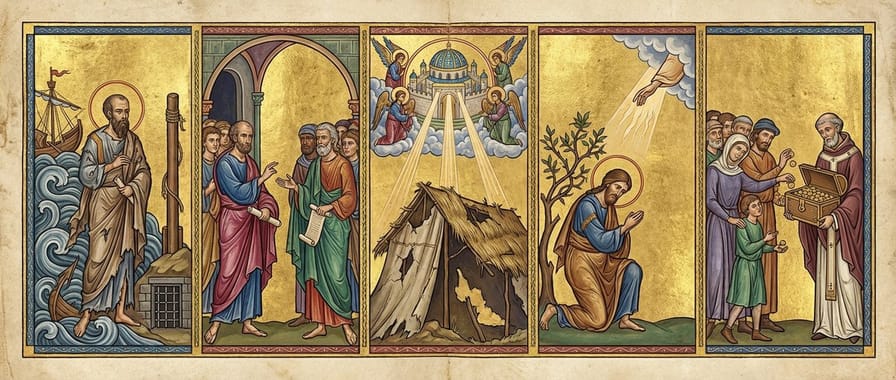
Illustration of the Book of 2 Corinthians, one of the 27 books of the New Testament (Nano Banana Pro).
1. Historical Context, Dating, and Authorship
1.1 Pauline Authorship and the Testimony of the Early Church
The Second Epistle to the Corinthians, one of the most personal and revealing documents in the New Testament, is universally attributed to the apostle Paul. This attribution is not merely a late tradition but a firmly established consensus since the earliest centuries of the Christian era. The early church fathers, such as Clement of Rome, Polycarp, Irenaeus, Clement of Alexandria, and Tertullian, cite or allude to 2 Corinthians as a genuinely Pauline work, without any trace of doubt or controversy. This unanimous testimony of the patristic tradition is a cornerstone for defending traditional authorship, reflecting an unquestioning acceptance of the letter in the ancient Christian community.
In addition to external testimony, the letter itself offers robust internal evidence corroborating Paul's authorship. The literary style, vocabulary, theological themes, and pastoral concerns are distinctly Pauline, aligning perfectly with his other canonical epistles. The letter begins with the explicit identification of Paul as the author (2 Corinthians 1:1), a common practice in his epistles. The detailed biographical references to his travels, sufferings, and interactions with the Corinthian church (such as the "painful visit" and the "severe letter") are consistent with what we know of his life and ministry through the Acts of the Apostles and his other letters.
The theological depth, pastoral passion, and rhetorical complexity of 2 Corinthians are unmistakable marks of Paul's apostolic genius. The letter reveals a pastoral heart torn by accusations and misunderstandings, but also an apostle resolute in defending the truth of the gospel and the integrity of his ministry. To attempt to disassociate Paul from this epistle would be, in essence, to dismantle a crucial part of the biblical portrait of the apostle, ignoring both the external and internal evidence that confirms it as an authentic and inspired work.
1.2 Dating and the Turbulent Corinthian Context
The dating of 2 Corinthians is relatively precise, placing it at the end of Paul's third missionary journey, likely between late 55 and early 56 A.D. The epistle was written after the First Epistle to the Corinthians and before the Epistle to the Romans, a period when Paul was in Macedonia (probably in Philippi or Thessalonica), on his way to Jerusalem. This chronology is crucial for understanding the letter's dynamics and urgency, which reflects an intense and emotionally charged phase in Paul's relationship with the Corinthian church.
The historical context immediately preceding the writing of 2 Corinthians was one of turbulence and crisis. After sending 1 Corinthians, Paul made a "painful visit" to Corinth (2 Corinthians 2:1; 12:14; 13:1-2), which did not resolve the problems but, on the contrary, seems to have exacerbated tensions. During this visit, Paul was publicly offended by an individual, and the church failed to act in defense of apostolic authority. In response to this situation, Paul sent a "severe letter," or "letter of tears" (2 Corinthians 2:4; 7:8,12), possibly a lost letter, or, as some suggest, a section of 2 Corinthians (such as 2 Corinthians 10-13) that was sent separately or represents the culmination of his argument.
Titus was the messenger of this severe letter, and after a period of anxiety for Paul in Troas, he finally met Titus in Macedonia. The news brought by Titus was mixed: the majority of the Corinthian church had repented and reaffirmed their love and respect for Paul, punishing the offender. However, a faction of opponents, often called "super-apostles" or "false apostles," persisted in undermining Paul's authority, questioning his integrity, rhetoric, physical appearance, and even his apostolic authenticity, while also distorting the gospel. It is against this complex backdrop of relief, gratitude, defense, and confrontation that 2 Corinthians emerges.
1.3 The Greco-Roman World and Criticisms of Authorship
The Greco-Roman world of the 1st century A.D. provided the cultural and social backdrop for the Corinthian church and for Paul's communication. Corinth was a cosmopolitan port city, known for its wealth, cultural diversity, and loose morality, but also for its appreciation of rhetoric, philosophical wisdom, and social status. The "super-apostles" who opposed Paul were likely charismatic orators, who boasted of their credentials, spiritual visions, and rhetorical skill, contrasting themselves with Paul's "weakness" and "simplicity."
The letter of 2 Corinthians intensely reflects this context, with Paul defending his ministry not based on worldly standards of rhetoric and power, but on weakness, suffering, and the transformative power of Christ. He confronts empty rhetoric with the message of the cross, human wisdom with the foolishness of God, and ostentation with the glory that comes from humble service. The epistle is, therefore, a valuable document for understanding the tensions between Hellenistic culture and the values of the nascent gospel.
Amidst this wealth of evidence and context, modern "higher criticism," in some of its branches, has raised questions about the unity of 2 Corinthians, suggesting that it could be a compilation of several Pauline letters or fragments. The main reason for this theory is the abrupt change in tone between 2 Corinthians 1-9 (where Paul expresses relief and reconciliation) and 2 Corinthians 10-13 (where he becomes severely confrontational and apologetic). Some propose that 2 Corinthians 1-9 is the "letter of reconciliation" and 2 Corinthians 10-13 is the previously mentioned "severe letter."
However, the conservative evangelical perspective firmly defends the literary unity of 2 Corinthians. The changes in tone can be explained by the complexity of the situation in Corinth, where Paul was simultaneously dealing with a repentant majority and a recalcitrant, hostile minority. It is plausible that Paul was writing in a state of great emotion and that the transition from one topic to another reflected the fluidity of his thoughts and feelings, as well as the need to address all pending issues in a single communication. The absence of any ancient manuscript evidence for fragmentation and the underlying theological coherence throughout the book reinforce the view that 2 Corinthians is a cohesive, though multifaceted, letter from the apostle Paul.
2. Structure, Division, and Main Content
2.1 The Epistolary Nature and Argumentative Flow
The Second Epistle to the Corinthians is, by its nature, a personal and pastoral letter, a common literary genre in the New Testament. However, it transcends mere personal communication, taking on characteristics of an apostolic apology (defense), a theological treatise on suffering and ministry, and an ethical exhortation to generosity and holiness. The letter does not follow a purely logical or systematic structure but rather an argumentative flow that reflects Paul's emotions and the complex dynamics of his relationship with the Corinthian church, oscillating between tenderness, relief, exhortation, and incisive confrontation.
The argumentative flow of 2 Corinthians can be understood as a response to multiple layers of problems. Paul begins by expressing his relief and gratitude for the good news brought by Titus, which allows for a warmer, more conciliatory opening. However, he cannot ignore the persistent accusations against his ministry, which leads him to a passionate defense of his apostolic authenticity and the nature of true Christian ministry. Finally, he directly confronts the "super-apostles" and their followers, who still threatened the integrity of the church and the purity of the gospel.
This oscillation of tone and themes is one of the most striking characteristics of the epistle, and it is precisely this complexity that makes it so rich and human. Far from being a patchwork of fragments, 2 Corinthians is an intricate tapestry that reveals Paul's mind and heart at a moment of intense pastoral challenge. The letter is a testament to Paul's ability to deal with multiple issues simultaneously, maintaining a central focus on the glory of Christ and the defense of the gospel.
2.2 Main Divisions and Their Characteristics
The epistle can be divided into three main sections, each with a distinct focus, but interconnected by Paul's overall purpose of restoring his relationship with Corinth and defending his apostleship:
1. The defense of Paul's apostolic ministry and the joy of reconciliation (2 Corinthians 1-7): This section begins with a greeting and a hymn of praise to God for comfort in suffering. Paul defends his sincerity and the steadfastness of his plans, explaining why he did not visit Corinth as planned. He emphasizes the glorious nature of the New Covenant ministry, which is a ministry of reconciliation and life in Christ, contrasting it with the Old Covenant ministry that brought condemnation. He addresses the issue of the offender, commending the repentance of the majority and urging them to forgive him. The climax of this section is Paul's passionate appeal for the Corinthians to be fully reconciled with him and to live in purity, separated from being unequally yoked with unbelievers.
2. Exhortation to generosity and the collection for Jerusalem (2 Corinthians 8-9): In these two sections, Paul shifts the focus from personal defenses to a practical and ethical matter: the collection for the poor saints in Jerusalem. He uses the example of the generosity of the churches of Macedonia, who, despite their own poverty, contributed abundantly. Paul does not impose the collection but presents it as an opportunity for grace, a test of genuine love, and an imitation of Christ's sacrifice (2 Corinthians 8:9). He explains the principles of joyful, proportional, and God-blessed giving, assuring that God will supply all the needs of the givers and that the collection will result in gratitude and praise to God.
3. The more vehement defense of apostolic authority against the "super-apostles" (2 Corinthians 10-13): This section, characterized by a more severe and confrontational tone, is where Paul directly responds to his detractors in Corinth. He defends his apostolic authority against accusations of personal weakness and rhetorical ineffectiveness. Paul boasts in his "foolishness" (ironically), listing his sufferings and sacrifices in contrast to the self-exaltation of the false apostles. He warns the Corinthians about the dangers of being deceived by those who preach "another Jesus," "another spirit," and "another gospel." He concludes with serious warnings and an appeal for self-assessment, stating that he will come to them with apostolic authority if the situation is not resolved.
2.3 Synthetic Outline of Content
- 1:1-11: Greeting, thanksgiving, and God's comfort in Paul's suffering.
- 1:12-2:13: Defense of Paul's sincerity and changes in plans; forgiveness for the offender.
- 2:14-3:18: The triumph of Christ and the ministry of the New Covenant in contrast to the Old Covenant.
- 4:1-6:10: The treasure in jars of clay; the hope of resurrection; the ministry of reconciliation.
- 6:11-7:16: Appeal for purity, separation from the world, and joy over the Corinthians' repentance.
- 8:1-9:15: Exhortation to generosity in the collection for the saints in Jerusalem, based on Christ's example.
- 10:1-18: Defense of Paul's apostolic authority and power against his adversaries.
- 11:1-15: Paul boasts in his "foolishness" and warns against false apostles.
- 11:16-12:10: The list of Paul's sufferings and the "thorn in the flesh" as a demonstration of Christ's power in weakness.
- 12:11-13:10: Paul's concerns for the church, final warnings, and the promise of a visit.
- 13:11-14: Final exhortation and apostolic blessing.
This outline reveals the thematic progression of the letter, from the expression of relief and reconciliation to the vigorous defense of apostolic authority and the confrontation of opponents. Each part contributes to Paul's greater purpose of restoring order in the Corinthian church, reaffirming his apostleship, and guiding believers to maturity in Christ.
3. Central Theological Themes and Purpose
3.1 The Nature and Power of Christian Ministry
One of the most prominent theological themes in 2 Corinthians is the nature and power of Christian ministry. Paul defends his apostleship not by human credentials, eloquent rhetoric, or demonstrations of worldly power, but by his authenticity, sincerity, and, paradoxically, by his weakness and suffering. He presents himself as a servant of Christ, a "jar of clay" that contains an "invaluable treasure" (2 Corinthians 4:7). Power in ministry does not reside in the individual, but in the Spirit of God working through him.
Paul contrasts the New Covenant ministry with that of the Old Covenant. The Old Covenant ministry, inscribed on stone, was a ministry of condemnation and death, though glorious. The New Covenant ministry, inscribed on hearts by the Spirit, is a ministry of the Spirit and righteousness, far surpassing the glory of the former (2 Corinthians 3:6-11). This ministry is characterized by boldness, transparency (without veils), continuous transformation into the image of Christ, and the proclamation of the gospel. Paul's true credential is not human letters of recommendation, but the Corinthian church itself, transformed by his ministry (2 Corinthians 3:2-3).
This theme is fundamental to Reformed theology, which emphasizes God's sovereignty in calling and empowering for ministry. The minister is an instrument in God's hands, and the effectiveness of their service depends entirely on the power of the Holy Spirit. Humility, dependence on God, and faithfulness to the Word are the true marks of authentic ministry, contrasting with the pursuit of prestige, power, and human recognition that Paul combats in Corinth.
3.2 Suffering and Weakness as Vehicles of Divine Grace
A second central theme, intrinsically linked to ministry, is the theology of suffering and weakness. In 2 Corinthians, Paul reveals more about his own sufferings than in any other epistle. He lists a series of adversities, persecutions, and dangers he faced in his service to Christ (2 Corinthians 6:4-10; 11:23-27). Far from being signs of weakness or lack of divine favor, these sufferings are presented as the mark of the true apostle and the means by which the power of Christ is manifested.
Paul's "thorn in the flesh" (2 Corinthians 12:7-10) is the epitome of this theology. Although he pleaded with God to remove it, the divine response was: "My grace is sufficient for you, for my power is made perfect in weakness." This statement is one of the most profound revelations about the nature of God's grace and power. Human weakness is not an impediment but a vehicle for the manifestation of Christ's glory and power. When we are weak, then we are strong, because the strength of Christ dwells in us.
This perspective directly contradicts the worldly mindset and prosperity theology that often permeates modern thought, where success and the absence of suffering are seen as signs of divine blessing. For Paul, suffering is an integral part of the Christian experience and a means of identification with the crucified Christ. It is through weakness that God's glory shines most intensely, a central principle of the theology of the cross, so dear to the Reformed tradition. The Christian does not seek their own glory, but the glory of God, which is manifested in humility and sacrificial service.
3.3 Reconciliation, New Creation, and Christian Generosity
The doctrine of reconciliation is another theological pillar of 2 Corinthians. Paul declares that "all this is from God, who reconciled us to himself through Christ and gave us the ministry of reconciliation" (2 Corinthians 5:18). God, in Christ, took the initiative to reconcile the world to himself, not counting their trespasses against them. Believers are, therefore, ambassadors for Christ, with the task of imploring people to be reconciled to God. This reconciliation is not only with God but also among believers, as evidenced by Paul's appeal for the restoration of his relationship with the Corinthian church.
Linked to reconciliation is the idea of new creation. "Therefore, if anyone is in Christ, the new creation has come: The old has gone, the new is here!" (2 Corinthians 5:17). Union with Christ results in a radical transformation, a new identity, and a new way of life. This new creation is the foundation for the sanctification and purity that Paul exhorts the Corinthians to seek, separating themselves from pagan influences (2 Corinthians 6:14-7:1).
Finally, Christian generosity is a practical yet deeply theological theme. Paul instructs the Corinthians about the collection for the poor saints in Jerusalem, basing the exhortation not on a legalistic requirement, but on the grace of Christ: "For you know the grace of our Lord Jesus Christ, that though he was rich, yet for your sake he became poor, so that you through his poverty might become rich" (2 Corinthians 8:9). Generosity is a tangible expression of faith and love, a fruit of grace that produces praise to God and promotes the unity of the body of Christ. It is an act of worship, performed with joy and proportionally to what one has, and God promises to supply abundantly those who sow generously.
The primary purpose of 2 Corinthians, therefore, is multifaceted: 1) To express Paul's relief and gratitude for the repentance of the majority of the Corinthian church and to fully restore his relationship; 2) To defend his apostolic authority and integrity against the false apostles and their followers; 3) To exhort the Corinthians to complete the collection for the saints in Jerusalem, demonstrating their faith and love; and 4) To prepare the church for his imminent third visit, establishing the necessary order and discipline. All these purposes converge toward the edification of the church and the glory of God in Christ.
4. Relevance and Canonical Connections
4.1 The Importance of 2 Corinthians in the Biblical Canon
The Second Epistle to the Corinthians holds a prominent place in the biblical canon, not only for being one of the most autobiographical and personal documents of the apostle Paul but also for its profound contribution to apostolic theology and the understanding of Christian life. It offers a unique window into Paul's heart and mind, revealing his struggles, joys, pains, and unwavering dedication to the gospel of Christ. The epistle is a vivid testament to the humanity of the apostle, while simultaneously reiterating the divinity and sovereignty of God in his ministry.
Within the Pauline corpus, 2 Corinthians serves as a crucial bridge between the rebuke and instruction of 1 Corinthians and the systematic exposition of the doctrine of justification in Romans. It shows Paul's pastoral work in action, dealing with a complex and problematic church, and his resilience in the face of opposition. The letter validates the authenticity of his apostleship through the evidence of his suffering and the manifestation of God's power in his weakness, establishing a model for faithful ministry in all ages.
The emphasis on new creation and reconciliation positions 2 Corinthians as a fundamental epistle for understanding Christ's redemptive work and the Church's mission in the world. It reminds us that the essence of the gospel is not just individual salvation, but the restoration of all things in Christ, making believers active ambassadors of that reconciliation. The epistle, therefore, is indispensable for a complete understanding of Pauline theology and the dynamics of the Kingdom of God.
4.2 Typological Connections and the Christocentric Reading
The reading of 2 Corinthians is profoundly Christocentric, though in a more implicit and experiential way than dogmatic, as in Romans or Colossians. Paul constantly points to Christ as the foundation, model, and source of all his ministry and of Christian life. The grace of Christ is the paradigm for generosity (2 Corinthians 8:9), the death of Christ is the basis for new life (2 Corinthians 5:14-15), and the power of Christ is perfected in human weakness (2 Corinthians 12:9).
Paul's theology of suffering finds its prototype and fulfillment in the suffering of Christ. Just as Christ was crucified in weakness, but lives by the power of God, so too Paul and believers experience the life of Christ in their mortal bodies through suffering (2 Corinthians 4:10-11). The glory of the New Covenant is the glory of Christ, who is the image of God (2 Corinthians 4:4). The removal of the veil in reading the Old Testament is only possible in Christ, for "the Lord is the Spirit; and where the Spirit of the Lord is, there is freedom" (2 Corinthians 3:17).
Paul's allusions to the Old Testament, though not direct typologies in the sense of events prefiguring Christ, are used to illuminate the superiority of the New Covenant in Christ. For example, the glory of Moses' face when he descended from Mount Sinai (Exodus 34) is contrasted with the far superior and permanent glory of the ministry of the Spirit in Christ (2 Corinthians 3:7-11). The veil that covered Moses' face is analogous to the veil that prevents understanding the Old Testament without Christ (2 Corinthians 3:14-16). Thus, Christ is the hermeneutical key to a full understanding of God's revelation.
4.3 Relevance for the Contemporary Church and Intertextual Connections
The relevance of 2 Corinthians for the contemporary church is immense and multifaceted. In an era of constant search for self-affirmation and visible success, Paul's epistle reminds us that true ministerial and spiritual strength lies in dependence on God and in the acceptance of human weakness. It challenges prosperity theology and the gospel of success, which often distort the message of the cross, presenting a model of leadership and discipleship founded on humility, sacrificial service, and the glorification of Christ, even amidst adversity.
The letter also offers vital principles for dealing with internal conflicts in the church, the importance of forgiveness, reconciliation, and proper discipline. It serves as a manual for defending the truth of the gospel against false teachers and ideologies that seek to corrupt the faith. The emphasis on purity and separation from the world (2 Corinthians 6:14-7:1) is a perennial reminder for believers to live lives that honor God in a secularized world.
In terms of intertextual connections, 2 Corinthians echoes and deepens themes found in other Pauline epistles. The theology of reconciliation in Colossians 1:19-22 and Romans 5:10-11 finds a practical and ministerial expression in 2 Corinthians. The doctrine of new creation resonates in Galatians 6:15. The instructions on the collection for the saints in Jerusalem connect with the exhortations to generosity in Romans 15:25-27 and 1 Corinthians 16:1-4, showing Paul's concern for unity and mutual care among the churches. The defense of his apostleship and the struggle against the "super-apostles" parallel his warnings against the Judaizers in Galatians and the incipient Gnostics in Colossians, demonstrating the constant battle for the purity of the gospel. The epistle, thus, is not an isolated text, but an integral and vital piece of the great mosaic of biblical revelation, with resonances throughout the canon.
5. Hermeneutical Challenges and Critical Issues
5.1 Specific Interpretation Difficulties of the Book
The Second Epistle to the Corinthians, with its theological depth and personal, apologetic character, presents several hermeneutical challenges. One of the most notable difficulties lies in accurately identifying the "severe letter" or "letter of tears" (2 Corinthians 2:4; 7:8,12) and the "painful visit" (2 Corinthians 2:1; 12:14; 13:1-2). While most scholars agree that these references fit within the narrative of 2 Corinthians between 1 Corinthians and 2 Corinthians itself, the exact nature of these events remains a point of debate. Some suggest that the "severe letter" is 2 Corinthians 10-13, while others contend it was a lost letter. The interpretation of the epistle's unity, already addressed, is directly linked to these questions, requiring a careful understanding of the development of events and Paul's emotions.
Another complex issue is the identity and exact nature of Paul's "thorn in the flesh" (2 Corinthians 12:7). Throughout the history of interpretation, numerous suggestions have been proposed, ranging from physical ailments (such as vision problems, malaria, or epilepsy) to spiritual temptations or even a specific "messenger of Satan" afflicting him. Paul's deliberate ambiguity about the nature of the thorn serves a theological purpose: the focus is not on the ailment itself, but on God's response – "My grace is sufficient for you, for my power is made perfect in weakness." The hermeneutical challenge is to avoid excessive speculation and, instead, to focus on the universal spiritual lesson Paul intended to communicate about dependence on God amidst adversity.
The identity of the "super-apostles" or "false apostles" (2 Corinthians 11:5; 12:11) who opposed Paul is also a point of discussion. Although their characteristics are outlined (pride, boasting, pursuit of gain, distortion of the gospel), their precise origin and theology are not entirely clear. They appear to be Jewish-Christians, possibly with incipient Gnostic or Judaizing tendencies, who boasted of their own credentials and spiritual visions, in contrast to Paul's humility and suffering. Understanding these opponents is vital to appreciating Paul's apologetics and the depth of his defense of the gospel.
5.2 Literary Genre, Cultural Context, and Ethical Problems
The literary genre of 2 Corinthians is predominantly epistolary, but with strong elements of apology (defense) and deliberative and epideictic rhetoric (of praise/blame). Understanding Greco-Roman rhetoric of the 1st century A.D. is crucial for interpreting the letter correctly. Paul employs figures of speech such as irony, sarcasm, and hyperbole (especially in 2 Corinthians 10-13, where he "boasts" in his foolishness), which can be misunderstood if read without sensitivity to the cultural context and rhetorical conventions of the time. His language, at times, is harsh and confrontational, which may seem problematic to modern sensibilities.
The issue of "honor" and "shame" in the Greco-Roman world is also fundamental. Paul's adversaries accused him of lack of credibility, weakness, and not being an eloquent speaker, which was an affront to his honor. Paul's defense is a radical redefinition of honor and power, where true glory is found in the cross of Christ and in sacrificial service, and human weakness is the stage for divine power. This is an apparent ethical problem for some, where Paul's self-defense might seem worldly; however, the evangelical perspective understands that Paul's defense was a defense of the gospel and his divinely bestowed apostleship, not a pursuit of personal glory.
Another apparent "ethical problem" may arise from Paul's exhortation to separate from unbelievers in 2 Corinthians 6:14-7:1 ("Do not be unequally yoked with unbelievers"). Some may interpret this as a radical isolation from the world, which would contradict believers' call to be light and salt. However, the faithful interpretation understands that Paul is referring to spiritual and marital alliances that compromise the faith and purity of the Christian community, not a complete withdrawal from society. The church must be in the world but not of the world, maintaining its distinct identity in Christ.
5.3 Evangelical Response and Hermeneutical Principles
The conservative evangelical Protestant perspective approaches these hermeneutical challenges with an unwavering commitment to biblical inerrancy and the authority of Scripture. The unity of 2 Corinthians is defended based on textual evidence and underlying theological coherence, recognizing changes in tone as reflections of Paul's pastoral and emotional complexity. The "thorn in the flesh" is seen as a paradigmatic example of how God uses human weakness to manifest his power, without the need for a specific identification that is not provided by the inspired text.
To interpret 2 Corinthians correctly, some hermeneutical principles are essential:
- Historical-grammatical-theological interpretation: Understanding the meaning of the text by considering its historical and cultural context, original grammar, and theological message within the larger flow of biblical revelation.
- Reading in the canonical context: Interpreting 2 Corinthians in relation to other Pauline letters and the complete canon, recognizing its contribution to comprehensive biblical theology.
- Focus on authorial intent: Seeking to understand what Paul, inspired by the Holy Spirit, intended to communicate to the original audience, avoiding anachronisms or imposing modern meanings.
- Christocentric application: Recognizing that Christ is the center of Paul's message and that Christian life and ministry are shaped by Him.
- Sensitivity to literary genre and rhetoric: Being aware that, as an apologetic epistle, 2 Corinthians employs rhetorical strategies that must be understood in their own right, such as irony and hyperbole, so as not to distort Paul's message.
Ultimately, 2 Corinthians is a letter that invites us to a profound reflection on the nature of true ministry, the glory of God in human weakness, and the essence of Christian life as a journey of reconciliation and new creation. By addressing its challenges with hermeneutical faithfulness, the contemporary church can draw invaluable wisdom from it for faith, practice, and mission. It is a perennial reminder that power does not reside in us, but in the One who called us and empowered us, so that all glory may be His.