


학개
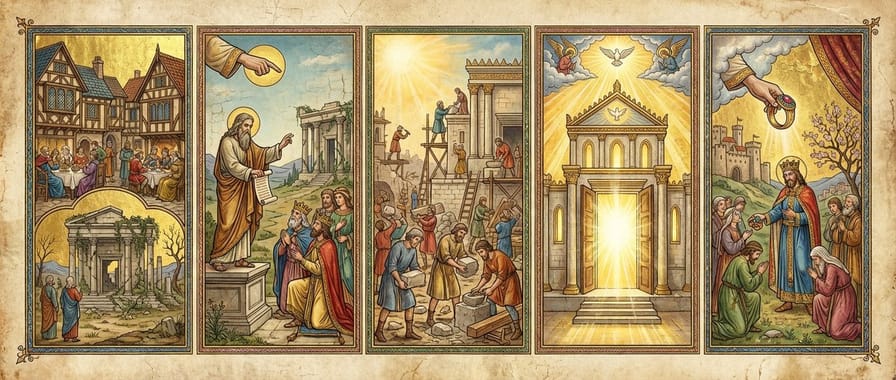
Illustration of the Book of Haggai, one of the 39 books of the Old Testament (Nano Banana Pro).
This introduction aims to offer a comprehensive and theologically rich analysis of the book of Haggai, one of the twelve minor prophets of the Old Testament. Although brief in its length, the book of Haggai is of immense theological and historical significance, acting as a beacon of exhortation and hope for the people of God in the post-Babylonian exile period. This exploration not only uncovers the rich layers of meaning contained within the sacred text but also establishes a hermeneutical and analytical model that can be applied to the introduction of any book of the Bible, founded upon a conservative evangelical Protestant perspective.
Our approach will be guided by biblical inerrancy, recognizing Scripture as the inspired and inerrant Word of God, and by the conviction that all Scripture testifies of Christ (John 5:39), thus seeking a Christ-centric and typological reading. We will address traditional authorship, the crucial historical context for understanding the message, the literary structure that organizes the divine oracles, the perennial theological themes that resonate through the centuries, and the canonical connections that integrate Haggai into the grand narrative of redemption.
Additionally, we will confront the hermeneutical challenges and critical issues that arise in the interpretation of the text, offering answers rooted in Reformed theology and evangelical scholarship. By doing so, we hope not only to illuminate the book of Haggai for the scholar and the believer but also to equip them with tools for a deeper and more faithful understanding of all divine revelation, emphasizing the continuing relevance of God's Word for the life and mission of the contemporary church.
1. Historical context, dating, and authorship
The book of Haggai emerges from a singular period in Israel's history, the post-Babylonian exile, and its understanding intrinsically depends on the historical, social, and political background of the era. The authorship of the book is traditionally attributed to the prophet Haggai, a position that enjoys almost universal consensus among scholars, both conservative and critical, due to strong internal evidence.
1.1 Haggai's authorship and internal evidence
Haggai's authorship is one of the most direct and least contested in the prophetic canon. The text itself presents itself as "the word of the Lord by the hand of Haggai the prophet" (Haggai 1:1), a phrase that is repeated at crucial moments in the narrative (Haggai 1:3, Haggai 2:1, Haggai 2:10, Haggai 2:20). This emphatic repetition not only identifies the human author of the message but also underscores the divine origin and prophetic authority of his words. There is no substantial evidence, internal or external, to suggest different authorship or later compilation by multiple authors, as is often debated for other prophetic books.
The concise and unified nature of the book, consisting of four dated oracles interconnected by a central theme, reinforces the idea that a single prophet was responsible for its composition. The direct and incisive style, characteristic of Haggai's preaching, permeates the entire text, lending it an unquestionable stylistic and theological unity. Jewish and Christian tradition has always accepted Haggai as the author, and the absence of any significant historical contestation serves as additional testimony to the solidity of this attribution.
1.2 Precise dating and the post-exilic scenario
The book of Haggai is notable for its chronological precision, providing exact dates for each of the four oracles delivered by the prophet. All of Haggai's messages were delivered in the second year of the reign of Darius I (Darius Hystaspes), king of Persia, which corresponds to 520 BC. The specific dates are:
- First oracle: the first day of the sixth month (Haggai 1:1)
- Second oracle: the twenty-first day of the seventh month (Haggai 2:1)
- Third oracle: the twenty-fourth day of the ninth month (Haggai 2:10)
- Fourth oracle: the twenty-fourth day of the ninth month (Haggai 2:20)
This precision is vital for situating the book in the historical context of the return from Babylonian exile. After the decree of Cyrus, king of Persia, in 538 BC (Ezra 1:1-4), a first group of Jewish exiles, led by Zerubbabel (governor) and Joshua (high priest), returned to Jerusalem. The initial enthusiasm led to the laying of the Temple foundations in 536 BC (Ezra 3:8-13), marking a moment of great hope.
However, this hope was quickly overshadowed by the opposition of neighboring peoples, especially the Samaritans, who, through intrigue and false accusations to the Persian court, managed to paralyze the work of rebuilding the Temple for about sixteen years (Ezra 4:1-5, 24). It was during this period of stagnation, discouragement, and distorted priorities that the ministry of Haggai, along with that of Zechariah, manifested itself.
1.3 Political, social, and cultural context
The political environment of the time was dominated by the Persian Empire, under Darius I. The Pax Persica, while bringing some stability, also imposed imperial sovereignty over the provinces, including Judah. For the returned Jewish people, the reality was harsh: the land was impoverished, harvests were scarce, and economic conditions were precarious. The prophet Haggai points to this difficult situation, describing how "you sow much, and get little; you eat, but never have enough; you drink, but never have your fill; you clothe yourselves, but no one is warm; and he who earns wages, earns wages to put them into a bag with holes" (Haggai 1:6).
Socially, the people were disillusioned and apathetic. The hope of a glorious restoration, nourished by pre-exilic prophecies, seemed distant. Instead of dedicating themselves to the house of God, they occupied themselves with their own material interests, building "paneled houses" for themselves, while the Temple of God lay in ruins (Haggai 1:4). This prioritization of personal comfort over the glory of God was the root of their problems, and Haggai was sent to confront this spiritual apathy.
Culturally, Jewish identity was intrinsically linked to the Temple. Its destruction by the Babylonians had been a devastating blow, and its reconstruction was essential for the restoration of Yahweh worship and theocratic life. Haggai's message was not just about bricks and wood, but about the restoration of faith, obedience, and the centrality of God in the lives of the people.
1.4 Response to criticisms and external evidence
As mentioned, the book of Haggai is one of the least controversial in terms of its historicity and authorship. Modern higher criticism, which often questions the traditional authorship and dating of many biblical books, finds little ground to challenge Haggai. The precision of the dates and the internal coherence of the text are strong defenses against any attempt at deconstruction.
External evidence further corroborates the authenticity of Haggai's ministry. The book of Ezra, which narrates the events of the return and reconstruction, explicitly mentions Haggai and Zechariah as the prophets who "prophesied to the Jews who were in Judah and Jerusalem, in the name of the God of Israel who was over them" (Ezra 5:1). Ezra 6:14 also attests that "the elders of the Jews built and prospered through the prophesying of Haggai the prophet and Zechariah the son of Iddo." These references in a contemporary historical book provide irrefutable external testimony to the existence and impact of Haggai's ministry.
Therefore, the conservative evangelical perspective defends Haggai's traditional authorship and the historicity of the described events as unquestionable facts, based both on biblical inerrancy and on solid contextual and canonical evidence. The book serves as a powerful reminder of the importance of obedience and the priority of the Kingdom of God, resonating across millennia with an eternal message.
2. Structure, division, and main content
The book of Haggai, though concise, presents a clear literary structure and a thematic progression that guides the reader through its oracles. Its organization is typically prophetic, consisting of four distinct messages, each introduced by a dating formula and divine authority, which gives the book a remarkable order and purpose.
2.1 Literary organization: dated oracles and their progression
Haggai is a prophetic book distinguished by its organization into a series of divine oracles. Each of these oracles is carefully dated, which not only provides a precise historical context but also reveals a progression in God's message to His people. This linear structure, with recorded responses and reactions from the people and leaders, demonstrates a dynamic theological narrative and not merely a collection of prophetic sayings.
The prophet Haggai uses the phrase "Thus says the Lord of hosts" or variations such as "the word of the Lord came by the hand of Haggai the prophet" to introduce the divine messages, emphasizing the transcendent origin and unquestionable authority of his words. This repetition serves to reinforce the idea that the message is not merely human, but the very voice of God speaking to His people at a critical moment in their history.
The progression of the oracles follows a logic of rebuke, exhortation, encouragement, and messianic promise, culminating in the assurance of God's faithfulness. This structure is not accidental; it reflects divine pedagogy, which first confronts disobedience, then calls for repentance and action, and finally offers a vision of future hope and glory to motivate perseverance.
2.2 The four main divisions and their characteristics
The book of Haggai can be clearly divided into four main sections, each corresponding to a specific oracle:
2.2.1 First oracle: the challenge to rebuild (Haggai 1:1-15)
Dated the first day of the sixth month of the second year of Darius (520 BC), this oracle is a blunt diagnosis of the people's apathy and selfishness. Haggai confronts the inverted priorities of the Jews, who dedicated themselves to their "paneled houses," while the Temple of God remained in ruins. The consequence of this neglect is divine judgment manifested in droughts, frustrated harvests, and economic difficulties. The message is a direct call to repentance and action: "Consider your ways" (Haggai 1:5, 7). The response of the people and the leaders, Zerubbabel and Joshua, is notable: they obey and begin the work, and God promises His presence: "I am with you, declares the Lord" (Haggai 1:13).
2.2.2 Second oracle: the future glory of the Temple (Haggai 2:1-9)
Delivered on the twenty-first day of the seventh month, this oracle is a message of encouragement. Addressed to those who remembered the glory of Solomon's first Temple and were disheartened by the modesty of the new building, Haggai prophesies that "the latter glory of this house shall be greater than the former" (Haggai 2:9). This promise does not refer to architectural superiority but to an eschatological and messianic glory, linked to the coming of "the desired of all nations." God promises to shake the heavens and the earth and fill the Temple with His glory, bringing peace. It is a vision that transcends the immediate present, pointing to the messianic era.
2.2.3 Third oracle: purity and blessing (Haggai 2:10-19)
Delivered on the twenty-fourth day of the ninth month, this oracle addresses the issue of ritual purity and its implications. Through questioning the priests about the law of purity and impurity, Haggai demonstrates that the spiritual impurity of the people, stemming from their neglect of the Temple, contaminated their offerings and their entire lives. Their lack of priority for God resulted in a continuous curse upon their activities. However, with the resumption of the Temple work, God promises a radical change: "From this day on I will bless you" (Haggai 2:19), underscoring the connection between obedience and divine blessing.
2.2.4 Fourth oracle: the promise to Zerubbabel (Haggai 2:20-23)
Also delivered on the twenty-fourth day of the ninth month, this final oracle is a messianic promise addressed specifically to Zerubbabel, the governor. God declares that He will shake the heavens and the earth, overthrow kingdoms, and exalt Zerubbabel as His "signet ring," a symbol of divine authority and choice. This prophecy points to Zerubbabel's Davidic lineage and, ultimately, to the coming Messiah, Jesus Christ, who will establish an eternal and unshakable kingdom. Zerubbabel is here a type of the Messiah, the true chosen servant of God who will bring final restoration and divine sovereignty.
2.3 Narrative flow and synthetic outline
The narrative flow of Haggai is a theological progression that moves from rebuke and diagnosis of the problem (apathy and selfishness), through exhortation to action and repentance, offers encouragement through future promises of glory and blessing, and culminates in messianic hope. The book demonstrates the response of the people and leaders, which is crucial for its dynamism. They hear, consider, and act, and God responds with His presence and promises.
A synthetic outline of the book could be:
I. The First Challenge: Prioritizing the Temple of God (Haggai 1:1-15)
- 1.1. The Rebuke for Neglect (Haggai 1:1-6)
- 1.2. The Call to Consideration and Action (Haggai 1:7-11)
- 1.3. The People's Response and God's Promise (Haggai 1:12-15)
II. The Second Challenge: The Future Glory of the Temple (Haggai 2:1-9)
- 2.1. Encouragement for the Disheartened (Haggai 2:1-3)
- 2.2. The Promise of God's Presence and Power (Haggai 2:4-5)
- 2.3. The Vision of Messianic Glory and Peace (Haggai 2:6-9)
III. The Third Challenge: Purity and Blessing Through Obedience (Haggai 2:10-19)
- 3.1. The Question of Ritual Impurity and Its Consequences (Haggai 2:10-14)
- 3.2. The Curse for Past Neglect (Haggai 2:15-17)
- 3.3. The Promise of Blessing from That Day On (Haggai 2:18-19)
IV. The Fourth Challenge: The Messianic Promise to Zerubbabel (Haggai 2:20-23)
- 4.1. The Promise of Cosmic Shaking and Overthrowing Kingdoms (Haggai 2:20-22)
- 4.2. The Exaltation of Zerubbabel as God's "Signet Ring" (Haggai 2:23)
This clear structure and logical sequence of oracles make Haggai an accessible and powerful book, with a message that transcends its original context and continues to challenge and encourage the people of God in all ages.
3. Central theological themes and purpose
The book of Haggai, despite its brevity, is a treasure trove of deep and interconnected theological themes, which not only address the immediate needs of the post-exilic people but also resonate with eternal principles of Reformed faith. Its primary purpose was clear to the original audience, but its relevance extends, enriching systematic theology and the life of the contemporary church.
3.1 Central doctrinal themes
We can identify several central doctrinal themes in Haggai:
3.1.1 God's sovereignty over history and nature
Haggai emphasizes the sovereignty of God over all aspects of existence. He is not only the Lord of hosts (a title occurring 14 times in the book, underscoring His military and cosmic power), but also the controller of nature and economy. God is the one who "called for a drought on the land and the mountains, on the grain, the new wine, the oil, on what the ground produces, on man and beast, and on all their labors" (Haggai 1:11). The calamities the people experienced were not mere accidents, but instruments of divine judgment to awaken them from their apathy. Likewise, God promises to "stir up" the spirits of the leaders and the people to obey (Haggai 1:14), demonstrating His sovereignty over human will and over world events, including the "shaking of the heavens and the earth" (Haggai 2:6, 21).
3.1.2 The importance of worship and the priority of the Kingdom
Central to Haggai's message is the exhortation to proper worship and the prioritization of the Kingdom of God. The ruined Temple symbolized the people's neglect of God. Their concern for their "paneled houses" (Haggai 1:4) to the detriment of "my house" (the Temple) revealed a profound spiritual failure. Haggai calls the people to "Go up to the hills and bring wood and build the house, that I may take pleasure in it and that I may be glorified, says the Lord" (Haggai 1:8). The reconstruction of the Temple was not just a civil work, but an act of restoring worship and recognizing God's centrality in their lives. This theme deeply resonates with the command to seek "first the kingdom of God and his righteousness" (Matthew 6:33).
3.1.3 The principle of sowing and reaping / Divine retribution
Haggai vividly illustrates the biblical principle of divine retribution, where disobedience brings a curse and obedience results in blessing. The prophet establishes a direct connection between the neglect of the Temple and the people's economic difficulties: "You have sown much, and harvested little. You eat, but you never have enough..." (Haggai 1:6). He invites them to "consider your ways" to see this correlation. However, from the day the people dedicate themselves again to the work of the Temple, God promises to change the situation: "From this day on I will bless you" (Haggai 2:19). This is not a legalism of "works for salvation," but a demonstration of God's faithfulness in rewarding faith manifested in obedience, even within the Mosaic covenant, where there were direct consequences for obedience or disobedience.
3.1.4 God's faithfulness to His covenant promises
Despite disobedience and judgment, Haggai reiterates God's faithfulness to His covenant. He reminds the people that God is "with you" (Haggai 1:13) and that His "Spirit remains in your midst" (Haggai 2:5). The promises of future glory for the Temple and for Zerubbabel are evidence that God has not abandoned His redemptive plan for Israel and for the coming of the Messiah. Even in discipline, there is the assurance that God will fulfill His covenants, especially the Davidic covenant, which will culminate in Christ. This faithfulness is the basis of the people's hope and perseverance.
3.1.5 Eschatology and future glory
Haggai is a book with a strong eschatological dimension. The promise that "the latter glory of this house shall be greater than the former" (Haggai 2:9) refers not only to the physical glory of the Temple but to a messianic and eschatological glory. The "desired of all nations" who will come and fill the Temple with glory points to the coming of the Messiah. The "shaking of the heavens and the earth" (Haggai 2:6, 21) and the overthrowing of kingdoms (Haggai 2:22) are apocalyptic images that prefigure the establishment of God's eternal Kingdom. These prophecies transcend the immediate context and point to the final fulfillment in Christ and the consummation of His Kingdom.
3.2 Primary purpose of the book
Haggai's primary purpose for the original audience was clear and direct: to exhort the post-exilic Jewish people to resume and complete the rebuilding of the Temple in Jerusalem. He aimed to combat the apathy, discouragement, and selfishness that had led to the paralysis of the work for sixteen years. Furthermore, Haggai sought to restore the priority of worshiping God, trust in His promises, and an understanding of the connection between the people's obedience and divine blessings, even in times of adversity. The prophet wanted the people to understand that their material difficulty was a reflection of their spiritual failure to prioritize what was God's.
3.3 Connection with Reformed systematic theology
Haggai's themes resonate deeply with Reformed systematic theology:
- Divine Sovereignty: The book of Haggai is a powerful affirmation of the sovereignty of God over creation, history, and human will, a pillar of Reformed theology. God is the primary agent behind all things, using both discipline and blessing to accomplish His purposes.
- Common Grace and Judgment: God's discipline of Israel through droughts and plagues demonstrates His common grace in calling to repentance, as well as His judgment upon disobedience, an aspect of divine justice.
- The Importance of Worship and Adoration: The emphasis on the rebuilding of the Temple underscores the centrality of public worship and adoration in the life of God's people, a value cherished in the Reformed tradition. The church, as the new spiritual Temple, must prioritize God's glory in its worship and mission.
- Reformed Eschatology: The promises of future glory and the coming of "the desired of all nations" point to the hope of Christ's Kingdom, which is both present and future, and to the final consummation of history under His sovereignty.
- Christ-centric Typology: The interpretation of Haggai in Reformed theology sees the Temple and Zerubbabel as types that point to Jesus Christ, the true Temple and the Davidic King, reinforcing the Christ-centricity of all Scripture.
Thus, Haggai is not just a historical book, but a rich source for understanding the attributes of God, the nature of faith and obedience, and the glorious redemptive plan that culminates in Christ.
4. Relevance and canonical connections
The book of Haggai, often underestimated due to its brevity, holds strategic importance within the biblical canon. It not only fills a crucial historical gap in the post-exilic period but also establishes significant theological bridges with other parts of Scripture, culminating in deep typological connections with Christ and in the New Testament.
4.1 Importance of the book within the complete canon
Haggai is one of the twelve minor prophets, but its temporal position makes it one of the first post-exilic prophets, along with Zechariah. Its message is vital for understanding the transition of the nation of Israel from Babylonian exile to restoration in Judah. It offers insights into the practical and spiritual challenges faced by the repatriates and how God called them to re-establish their theocratic identity through the rebuilding of the Temple. Without Haggai, we would have a gap in understanding the period between the initial return under Zerubbabel and the completion of the Temple, a fundamental event for the history of Israel and for the messianic expectation that would follow.
The book also demonstrates the continuity of God's covenant with His people, even after the judgment of the exile. Discipline did not mean abandonment but a call to repentance and covenant renewal. Haggai underscores that God's faithfulness does not depend on Israel's perfection, but on His own character and eternal purposes. It serves as a link between the pre-exilic prophecies of destruction and restoration and the intertestamental and New Testament prophecies that point to the consummation of the Kingdom of God.
4.2 Typological connections with Christ and messianic fulfillment
A Christ-centric reading of Haggai reveals rich typological connections with Jesus Christ. Typology is a fundamental hermeneutical principle in evangelical theology, where Old Testament persons, events, or institutions prefigure greater and fuller realities in Christ.
4.2.1 The Temple as a type of Christ
The Temple is the central figure in Haggai. The prophecy that "the latter glory of this house shall be greater than the former" (Haggai 2:9) finds its supreme fulfillment not in the architectural magnificence of Herod's Temple (which was a later reconstruction), but in the presence of the Messiah Himself. Jesus Christ is the true Temple, where the glory of God dwells fully (John 1:14). He Himself declared: "Destroy this temple, and in three days I will raise it up" (John 2:19), referring to His own body. The glory of the second Temple was, in fact, greater because the Son of God Himself, the maximum manifestation of divine glory, walked in its courts. In Christ, God's presence is no longer restricted to a building but dwells in believers, who are the "temple of the Holy Spirit" (1 Corinthians 6:19).
4.2.2 Zerubbabel as a type of the Messiah
The promise to Zerubbabel, that he would be like God's "signet ring" (Haggai 2:23), is a messianic prophecy. Zerubbabel was of Davidic lineage (Matthew 1:12, Luke 3:27) and, although he did not become an independent king in a political sense, he prefigures the true Davidic King, Jesus Christ. The "signet ring" symbolizes authority, choice, and intimacy. Just as Zerubbabel was chosen by God to lead the reconstruction and symbolize the restoration of the Davidic lineage, Christ is the chosen Messiah, the Servant of God who establishes the eternal Kingdom. He is the descendant of David who will overthrow all earthly kingdoms and establish His own unshakable Kingdom, according to Haggai's oracle.
4.3 New Testament fulfillments and allusions
Although Haggai is not one of the most directly quoted books in the New Testament, its prophecies find echoes and fulfillments in its theology. The most notable passage is in Hebrews 12:26-29, where the author quotes Haggai 2:6 ("Yet once more I will shake not only the earth but also the heavens") to contrast the shaking of Sinai with the final shaking that will come in the establishment of Christ's Kingdom. The author of Hebrews interprets Haggai's "shaking" as an eschatological event that will remove everything transient so that "what cannot be shaken may remain," referring to the Kingdom of God that believers receive in Christ. This demonstrates an understanding of the messianic and eschatological character of Haggai's prophecy.
Furthermore, Haggai's emphasis on the priority of the "house of God" finds its fulfillment and reinterpretation in the New Testament church. The community of believers is now God's "spiritual house" (1 Peter 2:5), and believers are exhorted to build the Kingdom of God in their lives and in society, prioritizing God's glory and the expansion of the gospel above their own interests. The references in Ezra (Ezra 5:1, Ezra 6:14) are the main external connections in the Old Testament, confirming Haggai's historical role.
4.4 Relevance for the contemporary church
Haggai's message maintains profound relevance for the contemporary church:
- Priority of the Kingdom of God: Haggai challenges believers to examine their priorities. The concern with "paneled houses" while the "house of God" (the church, missions, evangelism, service to neighbors) is neglected is a timeless rebuke. The message is a call to faithful stewardship and the dedication of resources (time, talents, treasures) for the glory of God.
- Encouragement Amidst Discouragement: The promise that "the latter glory of this house shall be greater" and that God is "with you" is a powerful encouragement for the church facing challenges, discouragement, and opposition. The final glory of Christ's Kingdom surpasses any present difficulties.
- Connection Between Obedience and Blessing: Although we do not live under the old covenant in an identical way, the principle that obedience to God brings blessing and disobedience brings consequences (discipline, not condemnation for the believer) remains. Haggai reminds us that spiritual, and often material, prosperity is linked to our faithfulness to God.
- Eschatological Hope: The book instills hope in the final coming of Christ and the consummation of His unshakable Kingdom. This motivates perseverance and confidence that God, the Lord of hosts, will fulfill all His promises, bringing peace and glory.
In sum, Haggai is much more than a mere historical record; it is a living prophetic word that continues to shape the faith and practice of God's people, always pointing to the Lord Jesus Christ, the center of all Scripture.
5. Hermeneutical challenges and critical issues
The interpretation of any biblical book, including Haggai, involves confronting hermeneutical challenges and responding to critical issues that arise both from the text itself and from modern academic approaches. A conservative evangelical perspective seeks to address these difficulties with intellectual honesty, fidelity to biblical inerrancy, and a Christ-centric hermeneutic.
5.1 Specific interpretive difficulties of the book
Some passages in Haggai present interpretive challenges that require careful analysis:
5.1.1 The nature of the glory of the second Temple (Haggai 2:9)
The prophecy that "the latter glory of this house shall be greater than the former" (Haggai 2:9) is a crucial point. Historically, the second Temple (that of Zerubbabel, and later reformed by Herod) never achieved the material magnificence and wealth of Solomon's Temple. Furthermore, it lacked elements such as the Ark of the Covenant and the visible Shekinah. How, then, could its glory be greater?
The dominant evangelical interpretation, aligned with Christ-centric typology, understands that this "glory" is spiritual and messianic in nature, not merely architectural or material. The greater glory lies in the fact that the Messiah Himself, Jesus Christ, "the desired of all nations" (Haggai 2:7), would enter and minister in that Temple. His presence would confer incomparable glory, surpassing any material splendor. In Christ, the presence of God was manifested fully and definitively, making the Temple a mere precursor to His incarnation. The author of Hebrews, in quoting Haggai 2:6 in Hebrews 12:26-29, corroborates this eschatological and messianic reading, pointing to the unshakable Kingdom of Christ as the true glory.
5.1.2 The application of the promise to Zerubbabel (Haggai 2:20-23)
The final oracle, which promises Zerubbabel that he would be like God's "signet ring" and that God would shake the kingdoms to exalt him, raises the question of its fulfillment. Zerubbabel, though an important leader, did not become an independent king nor establish a global empire. How, then, are we to understand this promise, which appears to be unfulfilled in its totality?
Again, a Christ-centric hermeneutic is essential. Zerubbabel, being of the Davidic lineage, acts as a type of the Messiah. The promise to him is a guarantee of God's faithfulness to the Davidic covenant (2 Samuel 7), which would culminate in the eternal King, Jesus Christ. The "signet ring" symbolizes divine choice, authority, and intimacy with God. The final exaltation and the overthrow of all earthly kingdoms to establish an eternal kingdom are fulfilled in Christ, who is the true chosen "servant" of God and the King of kings. The promise to Zerubbabel is, therefore, an anticipation of the messianic reign of Jesus.
5.1.3 The "shaking of heavens and earth" (Haggai 2:6-7)
The phrase "Once more, in a little while, I will shake the heavens and the earth" (Haggai 2:6) can be interpreted in different ways: as a literal and cosmic shaking, as contemporary historical events (wars and political upheavals in the Persian Empire), or as a final eschatological shaking. The interpretation in Hebrews 12:26-29 suggests an eschatological dimension, referring to the removal of everything transient so that the unshakable Kingdom of God may remain. It is likely that the prophecy has a multifaceted application: an initial shaking in historical events, a spiritual shaking in the coming of Christ, and a final cosmic shaking in the consummation of all things. Prophetic language often operates with this "telescopic perspective," where near events merge with distant events.
5.2 Issues of literary genre and cultural context
Understanding Haggai's literary genre as post-exilic prophecy is crucial. Prophetic language frequently uses hyperbole, symbolism, and apocalyptic imagery to describe divine intervention in history and the future. It is important not to interpret every detail literally but to seek the theological meaning intended by the prophet. The cultural context of the Temple's reconstruction is also vital. For the Jews of that time, the Temple was not just a building but the center of religious, social, and national life, the place of God's presence and atonement. Its restoration was synonymous with the restoration of their very identity and relationship with God.
5.3 Apparent ethical or theological problems
One "problem" that may arise is the apparent "exchange" of blessings for obedience, which could sound like legalism. Haggai emphasizes that the people's difficulties were a result of their disobedience and that blessing would come with obedience in rebuilding the Temple (Haggai 1:6-11; 2:15-19). However, this must be understood within the context of the Mosaic covenant, where there were direct consequences for obedience or disobedience. It is not about earning salvation by works but demonstrating a living faith through obedience, which is the response to God's grace. The promised blessing is an act of God's sovereign goodness toward His repentant and obedient people, not human merit. The relationship between law and grace in the Old Testament always points to ultimate grace in Christ.
5.4 Faithful evangelical response to skeptical criticisms
The conservative evangelical perspective upholds the biblical inerrancy of Haggai, affirming that the book is the inspired Word of God, true in all that it affirms. Against skeptical criticisms that might question the historicity of events or the authenticity of prophecies, the evangelical response is based on:
- Internal and External Evidence: As discussed in Section 1, Haggai's authorship and dating are well-attested, with corroboration from the book of Ezra.
- Nature of Prophecy: Biblical prophecy is not merely prediction but the proclamation of God's will. Haggai's prophecies about the future glory of the Temple and the exaltation of Zerubbabel should be interpreted in their messianic and eschatological dimension, fulfilled in Christ in a deeper way than an immediate literal fulfillment might suggest.
- Theological Coherence: The book of Haggai fits perfectly into the redemptive narrative of the Bible, pointing to God's faithfulness to His covenant and to the final fulfillment of His promises in Jesus Christ.
We reject interpretations that minimize the divine authority of the text, that treat it as mere human literature, or that deny the possibility of genuine prophecy and messianic fulfillment. Christ-centric typology is the key to an interpretation that honors Scripture as the Word of God.
5.5 Hermeneutical principles for correct interpretation
For a correct interpretation of Haggai, and of any biblical book, we apply the following hermeneutical principles:
- Historical-Grammatical Interpretation: Understanding the text in its original context – historical, cultural, linguistic, and literary. This means asking what the text meant to Haggai's original audience in the 6th century BC.
- Canonical Context: Reading Haggai in light of all Scripture, recognizing that the Bible is an organic unity. This is particularly important for seeing how the New Testament interprets and fulfills Old Testament prophecies, especially in relation to Christ.
- Christ-centric: Seeking how the text points to Christ, whether by direct prophecy, type, theological principle, or anticipation of God's redemptive plan. All Scripture testifies of Jesus.
- Covenant Theology: Understanding God's promises and discipline within the scope of His faithfulness to His covenants with Israel (Mosaic, Davidic) and, ultimately, to the New Covenant established in Christ.
- Theological and Pastoral Application: Once the original and canonical meaning is established, seeking the relevance and application for the contemporary church, always with the guidance of the Holy Spirit.
By applying these principles, the book of Haggai reveals itself not only as a historical document but as a living and powerful word from God that continues to challenge and encourage His people to prioritize His glory and to live in the hope of Christ's Kingdom.