


출애굽기
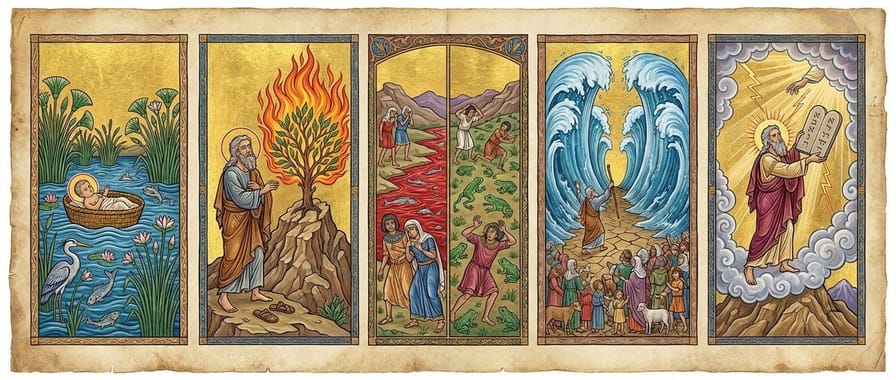
Illustration of the Book of Exodus, one of the 39 books of the Old Testament (Nano Banana Pro).
The book of Exodus, the second volume of the Pentateuch and the Hebrew Bible, stands as one of the fundamental pillars for understanding the identity, faith, and vocation of the people of Israel, and, by extension, for Christian theology. More than a mere historical chronicle of the liberation of an enslaved nation, Exodus is a profound revelation of the nature of God, of His redemptive purposes, and of His covenant relationship with humanity. It narrates the transition from a family group to a theocratic nation, forged through divine acts of judgment and grace, culminating in the giving of the Law and the institution of worship.
Since the earliest centuries, the Church has recognized in Exodus not only the foundation of Old Testament salvation history but also an inexhaustible wellspring of Christocentric typologies, which vividly point to the person and work of Jesus Christ. The narrative of Exodus is a testament to the sovereignty of God over history, to His faithfulness to the promises made to the patriarchs, and to His power to redeem and sanctify a people for Himself.
This introduction seeks to offer a comprehensive and scholarly analysis of the book of Exodus, grounded in a conservative evangelical Protestant perspective. We will defend biblical inerrancy, traditional Mosaic authorship, and a Christocentric reading of the Scriptures. In doing so, we propose a model of analysis that can be applied to any book of the Bible, addressing its context, structure, themes, canonical relevance, and hermeneutical challenges. Our aim is not only to inform but also to inspire a deeper appreciation for the theological richness and timeless relevance of this monumental book.
We will address critical issues with intellectual honesty, but always reaffirming the truthfulness and authority of the Word of God, as revealed in the Scriptures. Exodus is, in its essence, the story of how God revealed Himself to a people, called them out of slavery, and led them into a covenant relationship, establishing the foundations for His continued presence among them. This narrative echoes the spiritual journey of every believer, from the slavery of sin to freedom in Christ, and from a life of alienation to communion with the living God.
1. Historical Context, Dating, and Authorship
The book of Exodus plunges the reader into the heart of the Ancient Near East, in a period of intense geopolitical and cultural activity, dominated by the pharaonic power of Egypt. Understanding its historical context is crucial for appreciating the magnitude of the narrated events and the divine providence that orchestrated them. Jewish and Christian tradition, throughout the millennia, has consistently attributed the authorship of the Pentateuch, including Exodus, to Moses, a position that this introduction will defend based on internal and external evidence.
1.1 Mosaic Authorship and Internal Evidence
The Mosaic authorship of the Pentateuch, and specifically of Exodus, is a position firmly established by tradition. The biblical text itself offers multiple indications that Moses was the primary scribe or the compiler and authority behind the work. For example, in Exodus 17:14, the LORD instructs Moses: "Write this for a memorial in a book and recite it to Joshua." Similarly, in Exodus 24:4, we read: "Moses wrote down all the words of the LORD." In Exodus 34:27, God again commands: "Write these words, for in accordance with these words I have made a covenant with you and with Israel."
These passages, along with others in Numbers 33:2 and Deuteronomy 31:9, 22, 24, provide powerful internal testimony to Mosaic authorship. The New Testament also reinforces this view, with Jesus and the apostles frequently referring to "Moses" as the author of the Law or of specific passages in the Pentateuch (cf. Mark 12:26; John 5:46-47; Romans 10:5). The familiarity with Egyptian customs, the geography of Sinai, and the legal and cultural terminology of the period, evident in the text, also point to an author who lived and was educated in Egypt, like Moses.
1.2 Dating of the Exodus and the Ancient Near Eastern Context
The dating of the Exodus is a point of debate among scholars, with two main proposals: the "early date" (c. 1446 BC) and the "late date" (c. 1290 BC). The conservative evangelical perspective, which this introduction adopts, generally favors the early date. This date is derived from 1 Kings 6:1, which states that the construction of Solomon's Temple began in the fourth year of his reign, 480 years after the sons of Israel came out of Egypt. Considering that Solomon's fourth year was approximately 966 BC, the date of the Exodus would be c. 1446 BC.
This date places the Exodus during the 18th Dynasty of Egypt, under a pharaoh such as Amenhotep II. The political and social context of the time was one of a powerful Egypt, but with precedents for the presence and even the rise of foreigners (like the Hyksos, who previously ruled parts of Egypt). Although archaeology has not provided direct and unequivocal evidence for the Exodus (which would be extraordinary given the nomadic character of the Israelites and Egyptian policy of erasing unfavorable records), the lack of direct evidence does not equate to evidence of absence.
The late date, on the other hand, is based on Exodus 1:11, which mentions the Israelites building the store cities of Pithom and Rameses. It is argued that Rameses II (c. 1279-1213 BC), a pharaoh of the 19th Dynasty, was the great builder of a city called Pi-Ramesse. However, the name "Rameses" could be a later editorial anachronism or refer to a locality that later received that name, not necessarily implying that Rameses II was the pharaoh of the Exodus. The early date harmonizes better with internal biblical chronology and with other archaeological data, such as the Amarna Letters, which describe a period of instability in Canaan that aligns with the subsequent Israelite conquest.
1.3 Response to Criticisms and External Evidence
Modern higher criticism frequently questions Mosaic authorship and the historicity of the Exodus, suggesting that the Pentateuch is a compilation of various sources (JEDP) written much later than Moses. However, this theory has faced increasing internal and external challenges, and many conservative scholars consider it unfounded. The complexity of the text, which interweaves narrative, poetry, and legislation, does not demand multiple authors from different eras, but can be explained by the skill of a single author-compiler like Moses, perhaps with minor additions by later scribes (such as the note about Moses' death in Deuteronomy 34).
While archaeology has not conclusively "proven" the Exodus in the sense of grand Egyptian monuments mentioning the event, the absence of evidence is not evidence of absence. Egypt rarely recorded defeats or events that could tarnish the pharaoh's image. Furthermore, the nomadic culture of the Israelites in the desert means they would leave few lasting archaeological traces. Nevertheless, the detailed description of Egyptian life, the plagues, and the culture of the era in Exodus is remarkably accurate, suggesting an intimate knowledge that would be unlikely for a much later author. The tradition of a great exodus and the subsequent formation of a nation at Sinai are central narratives to Israelite identity, making it improbable that they were late inventions without a historical core.
2. Structure, Division, and Main Content
The book of Exodus is a masterpiece of literary composition, interweaving historical narrative, detailed legislation, and poetic songs. Its structure is carefully organized to present the history of Israel's redemption and the establishment of its covenant relationship with God. The transition from slavery to freedom, and from freedom to covenant responsibility, forms the central narrative arc of the book.
2.1 Literary Organization and Narrative Flow
Exodus can be divided into two main sections, each with its own subtopics, but intrinsically connected by the themes of divine presence and covenant. The first part (chapters 1-18) is predominantly narrative, focusing on Israel's liberation from Egypt. The second part (chapters 19-40) is a mixture of narrative and legislation, detailing the giving of the Law at Sinai and the instructions for the construction of the Tabernacle.
The narrative flow is linear, beginning with Israel's oppression in Egypt and culminating with the manifestation of God's glory in the Tabernacle. The narrative not only recounts events but also serves as a means to reveal the character of God (His power, holiness, faithfulness, and grace) and the nature of human response (faith, obedience, but also unbelief and rebellion). Poetry, such as Moses' song in Exodus 15, punctuates the narrative, offering theological reflections and praise.
2.2 Main Divisions and Their Characteristics
We can delineate the following main divisions in the book of Exodus:
- Chapters 1-18: The Liberation from Egypt
- 1:1-7:7: The Oppression and Moses' Call. This section describes the multiplication of Israel, their enslavement under a new pharaoh, and Moses' birth and call. God reveals Himself to Moses in the burning bush (Exodus 3) and commissions him to liberate His people.
- 7:8-12:51: The Plagues and the Passover. The sequence of the ten plagues demonstrates the sovereignty of God over nature and the Egyptian gods, culminating in the plague of the firstborn and the institution of the Passover, a perpetual memorial of redemption.
- 13:1-18:27: The Departure from Egypt and the Wilderness Journey. The crossing of the Red Sea, the provision of manna and quails, water from the rock, and the victory over Amalek mark the first challenges of the journey, revealing God's providence and care. Jethro's judicial organization of Israel is also narrated.
- Chapters 19-40: The Covenant at Sinai and the Tabernacle
- 19:1-24:18: The Giving of the Law and the Ratification of the Covenant. At Mount Sinai, God meets with Israel, revealing the Ten Commandments (Exodus 20) and the covenant laws (Exodus 21-23). The covenant is formally sealed with a blood ritual.
- 25:1-31:18: Instructions for the Tabernacle and the Priesthood. This section details the divine specifications for the construction of the Tabernacle, its furnishings, and the garments and consecration of the priests. Everything points to the presence of God in the midst of His people and the need for a means to approach Him.
- 32:1-34:35: The Breaking of the Covenant and Restoration. The golden calf incident reveals profound human depravity and the fragility of Israel's faith. Moses' intercession and God's subsequent restoration of the covenant demonstrate His mercy and faithfulness, but also His holiness.
- 35:1-40:38: The Construction and Dedication of the Tabernacle. The book concludes with Israel's obedience in constructing the Tabernacle and the descent of God's glory (the Shekinah) to dwell in it, symbolizing the divine presence at the heart of the community.
2.3 Synthetic Outline of Content
In summary, Exodus begins with Israel in servitude, cries out to God, is liberated through powerful miracles, journeys through the wilderness under divine provision, receives the Law and the Covenant at Sinai, sins grievously by worshiping the golden calf, but is restored by God's grace, and finally builds the Tabernacle, which serves as the place of the manifestation of God's glory among His people. It is the history of Israel's formation as God's people, with its own constitution, worship, and purpose.
3. Central Theological Themes and Purpose
Exodus is a theologically dense book, establishing essential foundations for understanding God, humanity, and the plan of salvation. The central theological themes are not mere abstract concepts, but dynamic revelations of God's character in action, shaping the history and destiny of His people. The Reformed and evangelical perspective emphasizes the sovereignty of God, His holiness, His covenant faithfulness, and the concept of redemption.
3.1 The Sovereignty of God and Redemption
The theme of the sovereignty of God permeates the entire book of Exodus. From the hardening of Pharaoh's heart (Exodus 4:21) to the parting of the Red Sea (Exodus 14) and the provision of manna in the wilderness (Exodus 16), God demonstrates His absolute control over history, nature, and the hearts of men. He is not a passive observer, but the primary actor who orchestrates events to fulfill His purposes. The phrase "that they may know that I am the LORD" (Exodus 7:5, 8:22, etc.) is a refrain that highlights the theophanic and epistemological purpose of divine action: to reveal His identity and power to Israel and to Egypt.
Closely linked to sovereignty is the theme of redemption. The Exodus is the archetype of redemption in the Bible. God "redeemed" (Exodus 6:6) His people from slavery, not by their merit, but by His grace and faithfulness to the covenant with Abraham. Redemption is not merely liberation from something (Egyptian slavery), but also liberation for something (service and worship of God at Sinai). This model of physical and spiritual redemption prefigures the greater redemption accomplished by Christ, who frees us from sin and death.
3.2 The Sinaitic Covenant and the Law
The covenant is a central concept in Exodus, particularly the Sinaitic covenant. In Exodus 19:5-6, God proposes a covenant relationship to Israel: if they obey His voice and keep His covenant, they will be His "treasured possession" among all peoples, a "kingdom of priests and a holy nation." This covenant is bilateral, requiring Israel's obedience in response to God's grace and faithfulness. The Law, encapsulated in the Ten Commandments (Exodus 20) and developed in the covenant laws (Exodus 21-23), is not a means of salvation, but the constitution of the redeemed nation, a guide for living in holiness and in harmony with God and with one's neighbor.
The Law reveals God's holy character and His will for His people. It exposes human depravity and Israel's inability to fully meet divine requirements, thus pointing to the need for a mediator and continuous grace. The Law, therefore, serves as a "guardian" that leads to Christ (Galatians 3:24), showing the need for a perfect sacrifice and a new covenant that enables obedience.
3.3 The Holiness of God and His Presence
The holiness of God is a prominent theme, manifested in the burning bush (Exodus 3), the theophany at Sinai (Exodus 19), and the instructions for the Tabernacle. God is "Holy, Holy, Holy" (cf. Isaiah 6:3), distinct and separate from all that is sinful and impure. His holiness requires His people to be holy (Exodus 19:6), and that worship be conducted in a holy and reverent manner. The construction of the Tabernacle, with its divisions and purification rituals, serves to demonstrate the distance between the holy God and the sinful people, while simultaneously providing a means of approach and communion.
The presence of God is the climax of the Exodus story. Beginning with the pillar of cloud and fire (Exodus 13), and culminating in the descent of God's glory to fill the Tabernacle (Exodus 40:34-38), God demonstrates His desire to dwell in the midst of His people. The Tabernacle is the center of Israel's life, the place where God meets with them, forgives their sins, and guides them. This presence is the guarantee of the covenant and the source of life and blessing for the nation. Reformed theology emphasizes that God's presence is the greatest good for His people, and that worship is the proper response to His holiness and grace.
3.4 Primary Purpose of the Book
The primary purpose of Exodus for the original audience, the newly liberated Israelites and future generations, was twofold: firstly, to reveal the identity and character of Yahweh as the God of Israel, the mighty Redeemer, and the holy Lawgiver. The book teaches Israel who God is and what He did for them, reinforcing their identity as His chosen people.
Secondly, Exodus establishes the foundations of the covenant relationship between God and Israel, outlining the moral, civil, and ceremonial obligations that govern their life as a theocratic nation. It provides instructions for worship and communion with God, ensuring that His presence can dwell in the midst of a sinful people. Thus, Exodus serves as the "birth certificate" of the nation of Israel, shaping their faith and practice forever.
4. Relevance and Canonical Connections
The book of Exodus is not an isolated island in the biblical canon, but a cornerstone that supports much of subsequent theology and narrative. Its importance lies in the foundation it establishes for Israel's identity, for the understanding of the Law, of worship, and of God's very nature. Its canonical connections are vast, permeating the historical books, prophetic books, and, crucially, the New Testament, where its truths find their ultimate fulfillment in Jesus Christ.
4.1 Importance in the Canon and Citations
Exodus is the book that defines Israel's identity as a redeemed people set apart for God. Without the Exodus, there would be no nation to whom the Law would be given, no Temple to be built, no lineage of kings to govern, nor prophets to exhort. It is the foundational event that shapes Israel's memory and hope. The Psalms frequently reference the Exodus as God's greatest act of salvation (e.g., Psalm 78, 105, 106, 136), and the prophets evoke it to remind Israel of their unfaithfulness or to promise a "new Exodus" of restoration (e.g., Isaiah 43:16-21; Jeremiah 16:14-15).
The Mosaic Law, central to Exodus, is the basis for justice and ethics in Israel. The prophets frequently condemn the nation for its failure to keep the Law and the covenant. The narrative of the manna and water from the rock is revisited in Numbers and Deuteronomy, and serves as a reminder of God's provision and patience, but also of Israel's stubbornness.
4.2 Typological Connections to Christ and Fulfillment in the New Testament
A Christocentric reading of Exodus reveals a wealth of typologies that point to Jesus Christ, the supreme Redeemer. The Passover, with the spotless lamb whose blood is applied to the doorposts to save the firstborn from death, is the most prominent type. Christ is the "Lamb of God who takes away the sin of the world" (John 1:29), whose blood shed on the cross redeems us from eternal death (1 Peter 1:18-19; 1 Corinthians 5:7). The Feast of Passover finds its fulfillment in the Lord's Supper, where Jesus institutes the new covenant in His blood (Luke 22:19-20).
Moses, as mediator of the old covenant, is a type of Christ, the mediator of the new and superior covenant (Hebrews 8:6; 9:15). Christ is the greater prophet than Moses (Deuteronomy 18:15; Acts 3:22-23). The manna in the wilderness, the "bread from heaven," is typological of Christ as the "bread of life" who came down from heaven to give life to the world (John 6:32-35). The rock that provided water in the wilderness is identified by Paul as Christ (1 Corinthians 10:4). The pillar of cloud and fire, which guided Israel, prefigures the presence of the Holy Spirit who guides believers today, and Christ Himself as the light of the world.
The Tabernacle, the dwelling place of God among His people, is a type of the incarnation of Christ (John 1:14: "the Word became flesh and dwelt [literally, "tabernacled"] among us") and of Christ Himself as the new and perfect Temple (John 2:19-21). The Levitical priesthood and its sacrifices are precursors to Christ's eternal priesthood and His unique and sufficient sacrifice on the cross (Hebrews 7-10). The blood of the covenant at Sinai is replaced by the blood of the new covenant in Christ (Matthew 26:28; Hebrews 9:18-22).
4.3 Relevance for the Contemporary Church
For the contemporary church, Exodus offers perennial lessons about the nature of God and the life of faith. The story of Israel's liberation serves as a reminder of God's power to free His people from any form of slavery, be it physical, spiritual, or social. It inspires hope in God's sovereignty amidst adversities and confidence in His faithful provision.
The themes of the covenant and the Law highlight the need for a life of obedience and holiness in response to God's grace. Although believers are not under the Mosaic law as a covenant of salvation, the moral principles of the Law (especially the Ten Commandments) continue to be a guide for righteous living, reflecting God's character and His will for humanity. The Law reveals sin and points to the need for Christ's grace.
Finally, the centrality of God's presence in the Tabernacle underscores the importance of worship, communion, and the pursuit of God's presence in the life of the church. Just as God's glory filled the Tabernacle, the Holy Spirit dwells in the church, which is the temple of God today (1 Corinthians 3:16). Exodus reminds us that true freedom and purpose are found in living in God's presence, worshiping Him and serving Him with gratitude and reverence.
5. Hermeneutical Challenges and Critical Issues
The interpretation of Exodus, like that of any ancient book, presents significant challenges. These challenges do not diminish the inerrancy and authority of Scripture, but demand a careful and contextualized hermeneutical approach. The conservative evangelical perspective seeks to respond to these critical issues with faithfulness to the biblical text and Reformed theology, without shying away from difficulties.
5.1 Difficulties of Interpretation and Ethical Questions
One of the most prominent challenges is the question of the historicity of the events. The narrative of Exodus involves miracles of epic proportions: the plagues, the parting of the Red Sea, the manna, water from the rock. For the modern skeptic, these events are seen as myths or legends. The evangelical response, however, is that the Bible recounts God's supernatural intervention in history. Christian faith is based on a God who is capable of transcending the natural laws He Himself established. The absence of large-scale direct archaeological evidence for the Exodus is not proof of its non-occurrence, but reflects the difficulties of documenting ancient nomadic events and Egyptian policy of omitting defeats.
Another difficulty arises with the hardening of Pharaoh's heart. In various passages, God is described as hardening Pharaoh's heart (e.g., Exodus 4:21; 7:3), which raises ethical questions about human responsibility and divine justice. Reformed theology addresses this by affirming the sovereignty of God over human will, but without nullifying the individual's moral responsibility. Pharaoh already had an obstinate heart (Exodus 5:2), and God, in His sovereignty, permitted and even intensified this obstinacy to demonstrate His power and glory, and so that Pharaoh and Egypt might know Yahweh.
The covenant laws (Exodus 21-23) also present challenges. Some of these laws seem harsh (e.g., the death penalty for certain offenses) or culturally distant (e.g., laws concerning slavery). Interpretation requires an understanding of the cultural context of the Ancient Near East, where slavery was a social reality different from modern chattel slavery. Mosaic laws, in that context, often offered more protection to slaves than other legislations of the time. It is crucial to distinguish between universal moral laws (like the Ten Commandments) and the ceremonial and civil laws specific to Israel under the old covenant, many of which find their fulfillment or are superseded in the new covenant in Christ.
5.2 Literary Genre and Cultural Context
The literary genre of Exodus is predominantly historical-narrative, with legal and poetic sections. It is essential to recognize that, while it is history, it is not modern history in the sense of a journalistic report. It is a theological historiography, written to reveal God's action in history. This means that events are selected and presented to emphasize theological truths and divine purpose. Understanding the worldview of the Ancient Near East, including its notions of deities, miracles, and covenants, is vital to avoid anachronisms and to interpret the text on its own terms.
The Egyptian cultural context is fundamental for understanding the plagues, which are direct attacks on the Egyptian gods (e.g., the Nile, the sun, frogs, livestock). The plagues are not merely natural disasters, but demonstrations of Yahweh's superiority over the entire Egyptian pantheon and over Pharaoh himself, who was considered a god. This cultural understanding enriches the perception of the power and uniqueness of the God of Israel.
5.3 Evangelical Response and Hermeneutical Principles
The evangelical response to the critical issues of Exodus is based on the belief in the inerrancy and infalibility of the Scriptures. We assume that the Bible is the inspired Word of God, true in all that it affirms. This means that the miracles are real, Mosaic authorship is substantially true, and the history of the Exodus is a historical event. While archaeology may not "prove" every detail, it also does not refute the biblical narrative, and in many cases, provides a background that makes it plausible.
The hermeneutical principles for interpreting Exodus include:
- Grammatical-historical interpretation: Understanding the meaning of the text in its original context, taking into account grammar, vocabulary, literary genre, and historical-cultural background.
- Canonical unity: Interpreting Exodus in light of all Scripture, recognizing the progression of revelation and the theological coherence of the biblical canon.
- Christocentric reading: Seeking the typological and prophetic connections to Jesus Christ, recognizing that the Old Testament points to Him and finds its fulfillment in Him. The new covenant in Christ is superior to the old covenant, but it does not annul it; it completes and transcends it.
- Theological and pastoral application: Drawing out timeless theological truths about the character of God, human sin, redemption, and the life of obedience, applying them to the life of the believer and the church today, always mediated by the work of Christ.
In conclusion, Exodus is a book of immense theological and historical depth. Although it presents interpretive challenges, a hermeneutic faithful to the Word of God and sensitive to its original context reveals a sovereign, redemptive, and holy God, who calls a people to Himself and establishes a covenant of love and law. It is a narrative that not only shaped the nation of Israel but continues to speak powerfully to the church of Christ about our own liberation, our calling to holiness, and the glory of God's presence in our midst.